














As decentralized perpetual trading reaches mainstream viability, the complexity of managing positions, risk exposure, and market context grows exponentially. TradeView bridges this gap by embedding AI-driven intelligence modules directly into its on-chain ecosystem. These modules do not just surface raw data; they convert volatility, behavioral patterns, and market trends into actionable risk controls and personalized insights. In TradeView, all AI tools are opt-in and gated through the TradeView token to ensure scalability, economic alignment, and premium feature access.
8.1 AI-Based Portfolio Risk Alerts
TradeView integrates a sophisticated AI-powered risk management suite designed to empower traders with predictive, real-time intelligence — transforming passive risk monitoring into an active, personalized experience. This suite provides margin warnings, liquidation forecasts, behavioral profiling, market sentiment insights, and anomaly detection powered by machine learning and NLP. Access is stratified via token-gated tiers, incentivizing ecosystem participation through the native TradeView token.
8.1.1 Overview of AI-Powered Portfolio Risk Alerts
TradeView’s AI-powered portfolio risk alert system is engineered to proactively shield traders from adverse outcomes by delivering real-time, predictive insights into portfolio vulnerabilities. Unlike traditional exchanges that reactively display static margin levels or unrealized PnL, TradeView integrates an intelligent, context-aware risk engine that monitors each trader’s portfolio state in real-time, adapts to their historical behavior, and generates personalized alerts before a critical event (e.g., margin call, liquidation, funding loss) occurs.
This system is underpinned by a hybrid logic architecture that blends deterministic formulaic models — such as margin ratio thresholds and leverage calculations — with machine learning-based probabilistic forecasting. Predictive alerts use neural network models trained on volatility, funding rates, leverage configurations, and position behaviors to infer the likelihood of specific risk events. These models dynamically adjust alert thresholds and severity based on user archetypes (e.g., aggressive scalper, passive swing trader) and real-time market conditions.
The alert engine does not merely serve as a watchdog; it operates as a strategic decision-support system, helping traders:
-
Preemptively rebalance risk before liquidation triggers.
-
Avoid unnecessary funding drain on overexposed positions.
-
Detect compounding risk due to asset correlations or slippage.
-
Act on time-sensitive changes to trading posture.
Premium access to this system is tiered by TradeView’s native token holdings or staking commitment, which unlocks deeper analytics, custom risk settings, and enhanced delivery channels.
8.1.2 Core Alert Types and Use Cases
The alert engine supports multiple distinct risk alert categories, each designed to address a key risk domain that can materially impact trading performance. Below are the primary alert types:
- Maintenance Margin Threshold Alerts
This alert is triggered when a user’s maintenance margin ratio approaches predefined critical levels, indicating proximity to a potential liquidation. The system calculates the live distance-to-liquidation as a percentage and expresses it both numerically and visually (e.g., red zone meter in UI). The model monitors:
-
Isolated margin positions independently, flagging high-risk outliers.
-
Cross margin accounts holistically, assessing shared equity across positions.
This alert gives users ample warning to:
-
Add collateral
-
Reduce position size
-
Switch margin mode if available
- Over-Leverage Detection
TradeView’s leverage alert goes beyond static multipliers. It factors in:
-
The volatility-adjusted risk tolerance of the asset (e.g., 10× on BTC may be safer than 3× on PEPE)
-
Overall account balance and exposure size
-
Time-weighted leverage trends
An alert is generated when the system detects that a trader is running leverage configurations that exceed safe bounds for the asset’s volatility regime, especially during low-liquidity conditions. This reduces the chance of “death spirals” where minor price moves trigger large-scale liquidations.
- High Funding Drain Alerts
Hourly funding payments can accumulate rapidly and erode position value, especially in one-sided markets. This alert:
-
Tracks cumulative funding paid (or received) per open position.
-
Flags when the cost exceeds predefined thresholds (e.g., 5% of position value over 6 hours).
-
Projects future funding trends using predictive models trained on historical spreads.
It helps traders exit or hedge positions that become economically unsustainable due to negative carry.
- Correlation Risk Warnings
In a correlated selloff, multiple positions that seemed independent can move in tandem, causing cascading losses. This alert:
-
Computes pairwise correlation of held assets using sliding window time-series data.
-
Flags when multiple positions exhibit >0.8 Pearson correlation or rising covariance.
-
Suggests diversification or partial closure to reduce systemic risk exposure.
This is particularly critical for traders running multiple positions on L2s, DeFi tokens, or sector-linked assets (e.g., LSD tokens like LDO, RPL).
E. Sudden Drawdown / Unrealized PnL Deterioration
If a trader’s unrealized PnL drops significantly within a short time window, the system flags it as a high-risk drawdown event. Example conditions:
-
20% drop in net account equity within 15 minutes.
-
50% unrealized loss in an isolated position due to rapid price crash.
The alert includes:
-
Suggested closeout actions
-
Optional one-click hedging tools (future roadmap)
-
Drawdown heatmaps for historical review
F. Slippage Risk Alerts
When executing market orders or large limit orders, slippage — the difference between expected price and execution price — becomes a key hidden cost. This alert activates when:
-
Order book depth is thin at the price level.
-
Estimated slippage exceeds 1.5–2.0% based on size.
-
Volatility spike co-occurs, increasing execution uncertainty.
Traders are advised to use limit orders, reduce size, or switch to TWAP/iceberg strategies.
8.1.3 Technical Workflow and System Architecture
The AI alert system operates across four tightly coupled components, optimized for performance and extensibility.
1. Data Aggregation Layer
This layer continuously ingests multi-source data, including:
-
On-chain user position state: direct reads from TradeView's L1 storage (position size, margin ratio, leverage).
-
Funding and index pricing: pulled from TradeView’s integrated oracle module (e.g., Chainlink, Pyth).
-
Real-time order book snapshots: streamed from validator nodes or via WebSocket from full nodes.
-
Execution logs: used for alert validation and system diagnostics.
These inputs are normalized and stored in a time-series structure optimized for millisecond resolution and low-latency retrieval.
2. Risk Modeling Engine
The core engine combines:
-
Rule-Based Detectors: Encapsulates logic like (margin_ratio < threshold) for deterministic risks.
-
Machine Learning Forecast Models:
-
Logistic Regression: Estimates probability of liquidation event within X minutes given volatility, position size, and margin buffer.
-
LSTM Neural Network: Predicts upcoming volatility spikes or slippage patterns from real-time price feed sequences.
-
-
Threshold Adaptation Logic: Customizes alert sensitivity based on user history, margin mode, and risk profile.
Each alert is scored by a confidence function and routed to the appropriate delivery mechanism if severity exceeds user-defined thresholds.
3. Alert Dispatch System
This subsystem delivers alerts across various channels:
-
UI Layer (real-time): Pop-ups and modal warnings in trading interface.
-
Web Push Notifications: Browser-based alerts for active users.
-
WebSocket Stream: For API consumers or bot integrations.
-
Email & Telegram (optional): For users with email/password access and notifications enabled.
The system supports batching (to prevent spam), severity tiers, and alert rate limiting.
4. Logging, Replay & Diagnostics
All alerts are stored with:
-
Timestamp, asset, position metadata, and confidence score
-
User action (e.g., dismissed, acted upon)
-
Model version used for prediction
These are available in a Risk History Dashboard, allowing users to:
-
Audit their alert response history
-
Analyze patterns (e.g., ignoring alerts before major loss)
-
Evaluate model accuracy and adjust preferences
The system also provides developers and analysts with feedback loops to fine-tune model performance based on real-world trader behavior.
8.1.4 Premium Features & Token-Gated Access
| Feature | Tier 1 (500 TradeView’s Native Token) | Tier 2 (2,000 TradeView’s Native Token) | Tier 3 (10,000 TradeView’s Native Token) |
|---|---|---|---|
| Maintenance Margin Alerts | ✅ | ✅ | ✅ |
| Over-Leverage Detection | ✅ | ✅ | ✅ |
| High Funding Loss Alerts | ✅ | ✅ | ✅ |
| Correlation Risk Analysis | ❌ | ✅ | ✅ |
| Slippage & Volatility AI | ❌ | ✅ | ✅ |
| Personalized Thresholds | ❌ | ❌ | ✅ |
| Historical Risk Logs | ❌ | ✅ | ✅ |
-
Smart contracts enforce access based on TradeView's Native Token holdings or locked staking balance.
-
Alerts are modularized via WebAssembly to allow DAO-governed addition of new alert types.
8.2.1 Overview
In traditional finance, quantitative signals often dominate risk assessments, but in the highly reactive crypto markets, sentiment is often the catalyst for major price moves, fear-driven selloffs, or coordinated surges. TradeView integrates a cutting-edge sentiment and anomaly detection module powered by AI to allow users to navigate not only what the charts say, but how the market feels and behaves beneath the surface.
This module leverages Natural Language Processing (NLP), time-series anomaly detection, and unsupervised behavioral clustering to derive market psychology indicators in real time. It monitors off-chain platforms such as Twitter (X), Reddit, Telegram, and Discord for sentiment data, and correlates these with on-chain behaviors such as order book anomalies, wallet movements, and vault activity.
Rather than reactively interpreting chart patterns or volume changes, users gain access to early warning indicators of coordinated market action, FUD campaigns, whale positioning shifts, and more — all in real time. These features are highly useful for short-term scalpers, swing traders, and algorithmic strategies seeking to front-run crowd behavior.
Access to advanced sentiment overlays and behavioral anomaly detection is token-gated and progressively unlocked through TradeView's Native Token token staking, reinforcing the role of TradeView's Native Token as a utility backbone for the ecosystem.
8.2.2 Sentiment Sources
TradeView’s sentiment and anomaly system is fueled by a combination of social layer intelligence, on-chain behavior analysis, and order book dynamics. Data is collected continuously and normalized for further processing by the AI models.
1. Social Data (NLP Layer)
This layer forms the heart of the sentiment detection system, focusing on extracting emotional, psychological, and directional signals from the broader crypto community.
-
Sources:
-
Twitter/X: Monitored for trending hashtags, influencer posts, whale chatter, and coordinated campaigns.
-
Reddit: Subreddits such as r/CryptoCurrency, r/ethtrader, and niche altcoin forums are scraped and processed.
-
Telegram/Discord: Public trading channels and coin communities are parsed using NLP APIs.
-
News Aggregators: Title-level headlines and article metadata from crypto media (e.g., CoinDesk, The Block).
-
-
Processing Pipeline:
-
Spam and low-quality content are filtered using Bayesian and ML-based spam classifiers.
-
Text is cleaned, embedded via transformer encoders, and classified as Bullish, Bearish, Neutral, FUD, or Manipulative.
-
Temporal correlation is applied to identify time-sensitive shifts in sentiment, not just cumulative averages.
-
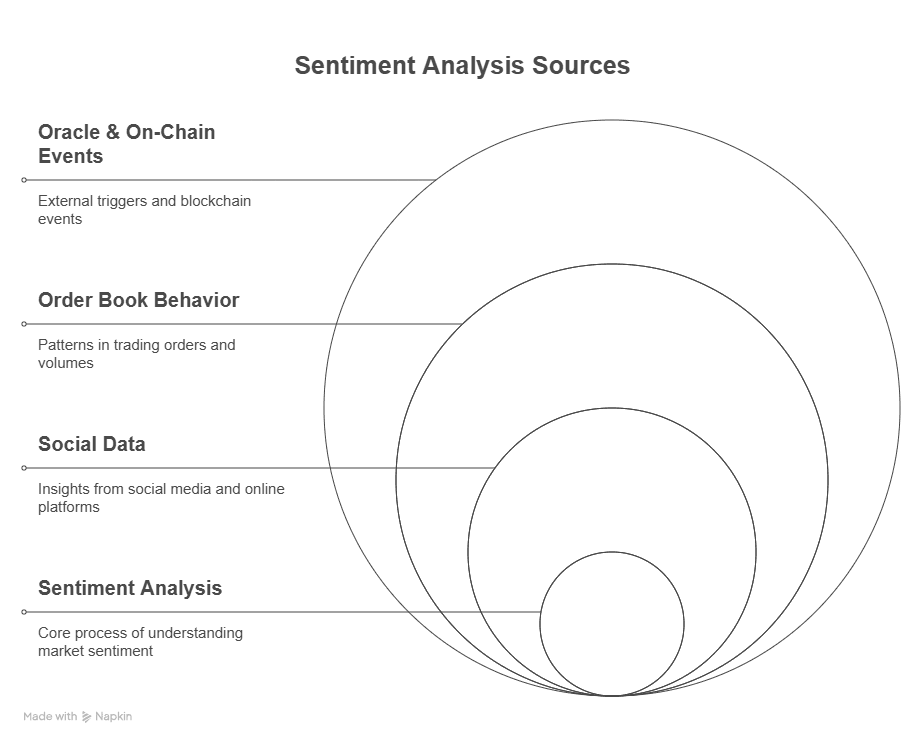
2. Order Book Behavior
Beyond textual sentiment, the AI monitors real-time order book dynamics to detect:
-
Spoofing patterns: Large orders that appear and disappear to manipulate perceived support/resistance.
-
Bid/ask wall formation: Emergence of liquidity at psychological levels to trap retail.
-
Sudden cancellation waves: Implies institutional exit or wash trading attempts.
These behavioral indicators are crucial for identifying fake optimism or manufactured panic.
3. Oracle & On-Chain Event Triggers
-
Vault Activity: Spikes in vault inflows or outflows (e.g., insurance pool exits, protocol TVL movements).
-
Whale Wallet Movements: Wallets tagged by TradeView’s system (e.g., high-PnL traders, market makers) are tracked for unusual activity.
-
Contract Calls: Sudden changes in smart contract interaction frequency may suggest exploit attempts or rug pulls in progress.
These signals are mapped to asset-specific threat scores and can serve as on-chain panic indicators, complementing off-chain psychology.
8.2.3 Model Architecture
The analytics engine comprises several tightly integrated AI components designed to extract, score, and display sentiment and behavioral anomalies.
a. Sentiment Classifier
-
Core Engine: Fine-tuned RoBERTa or DistilBERT transformer models trained on millions of labeled crypto posts.
-
Output Classes:
-
Bullish: Optimistic directional language.
-
Bearish: Pessimistic or sell-oriented.
-
Neutral: Informational with no directional bias.
-
FUD: Emotionally charged, fear-driven.
-
Manipulative: Identified by repetitive patterns, calls-to-buy/sell, or bot-like language.
-
-
Confidence Scores: Every message is scored for confidence and mapped to tokens and topics.
b. Anomaly Detection System
-
Built using:
-
Isolation Forests: Efficiently flags behavioral outliers across slippage, volume, and wallet activity.
-
Autoencoders: Compress high-dimensional behavioral data and detect reconstruction loss, signaling anomalies.
-
-
Applications:
-
Detecting pump-and-dump cycles early.
-
Identifying unusual whale accumulation or exit behavior.
-
Catching spoofing and liquidation bait patterns.
-
c. Sentiment Heatmap Engine
-
Combines order book anomalies + social sentiment + wallet activity into a normalized threat or hype score per asset.
-
Visualized as:
-
Momentum arrows: Up/down bias based on directional language + volume.
-
Confidence rings: Show how consistent sentiment is over time.
-
Whale cluster overlays: Flag markets being tracked or moved by high-performing traders.
-
8.2.4 Use Cases
1. Whale Tracking
The system builds behavioral fingerprints of large or high-ROI traders and flags:
-
When they open/close positions in volume.
-
When their sentiment diverges from general retail chatter.
-
Correlations between their activity and major asset price movements.
This is valuable for copy-trading strategies, or simply following where smart money flows.
2. Pump Alert System
Combining:
-
Spike in bullish posts
-
Whale vault inflows
-
Order book manipulation (fake walls)
→ The system can flag early signals of a coordinated pump or hype campaign, allowing traders to act before volume hits the chart.
3. Fear Monitoring
Tracks the frequency and clustering of FUD words like:
-
“Rug”
-
“Scam”
-
“Exploit”
-
“Sell”
-
“Exit liquidity”
This allows traders to recognize panic-driven exits or misinformation spreading. Paired with real asset data, it helps distinguish real risk from market overreaction.
4. Sentiment Divergence Detection
Detects when:
-
Sentiment is increasingly bullish but volume remains flat (false optimism).
-
Price rallies while sentiment falls (exit opportunity).
-
Social mood diverges from whale movement or trading behavior.
These divergences are often early indicators of trend reversal or hidden accumulation/distribution.
8.2.5 Premium Features & Token-Gated Access
To preserve performance and incentivize ecosystem value, the sentiment engine’s features are progressively gated using TradeView's Native Token token tiers.
| Feature | Free | Tier 1<br>(2,000 TradeView’s Native Token) | Tier 2<br>(5,000 TradeView’s Native Token) | Tier 3<br>(20,000 TradeView’s Native Token) |
|---|---|---|---|---|
| Market Sentiment Overlay | ❌ | ✅ | ✅ | ✅ |
| Real-Time Whale Alert Feed | ❌ | ❌ | ✅ | ✅ |
| Cross-Platform Sentiment Correlation | ❌ | ❌ | ✅ | ✅ |
| Behavioral Anomaly Detection | ❌ | ❌ | ✅ | ✅ |
| Custom Sentiment Filters & Alerts | ❌ | ❌ | ❌ | ✅ |
| Smart Money Divergence Tracking | ❌ | ❌ | ❌ | ✅ |
8.3 Personalized Insights via ML
8.3.1 Overview
Every trader is different — yet most platforms treat them as identical risk profiles. TradeView disrupts this norm by introducing Personalized ML-Driven Trading Insights, a proprietary feature that tailors risk and strategy recommendations to each individual user based on historical behavior, outcomes, and psychological patterns.
This module acts as a trading performance coach, powered by AI. It continuously analyzes a trader’s decisions — trade size, leverage, asset choices, time-in-market, loss response, win streaks, and volatility exposure — and derives insights aimed at improving performance while reducing emotional or statistically suboptimal behavior.
Rather than pushing broad-based analytics, this system learns from the trader’s own data to answer critical personalized questions like:
-
“Am I consistently overtrading after a loss?”
-
“Would I be more profitable using isolated margin?”
-
“Is my trading style better suited for BTC or altcoins?”
-
“When do I typically make high-risk decisions?”
These insights become more powerful over time as the model observes patterns in:
-
Reaction to wins/losses
-
Entry/exit timing
-
Use of leverage
-
Margin modes
-
Risk-reward ratios
This capability is entirely AI-generated, user-specific, and token-gated, offering premium coaching insights to committed users holding or staking TradeView's Native Token.
8.3.2 Core Components & ML Architecture
TradeView's personalized engine is composed of several interlinked machine learning modules, designed to assess, cluster, compare, and advise based on individualized trading history.
1. Behavioral Profile Builder
-
Goal: Identify and assign each user a behavioral trader archetype based on longitudinal trading data.
-
Engine:
-
K-Means Clustering
-
Gaussian Mixture Models
-
Time-series embedding vectors via LSTM encoders
-
-
Inputs:
-
Position size relative to equity
-
Leverage used per trade
-
PnL volatility
-
Trading frequency and session time
-
Margin mode usage history
-
-
Output Example:
-
“You are an Aggressive Intraday Leverage Trader”
-
“You exhibit High-Risk Mean Reversion Behavior”
-
“You typically close trades too early after 3 losses (risk aversion)”
-
These profiles are recalculated periodically and displayed in the UI, enabling traders to track how their behavior is evolving.
2. Strategy Fit Scoring Engine
This module compares the user's trading behavior against a large reference set of anonymized trader archetypes and computes:
-
Strategy compatibility scores
-
Asset-leverage pairings that align with their success rate
-
Optimal session hours (e.g., “You perform best in low-volatility hours”)
The model can flag mismatches, such as:
-
Persistently using high leverage on assets where user win-rate is poor.
-
Trading during high volatility when the user historically underperforms.
-
Misuse of cross-margin mode in correlated portfolios.
The output isn’t static advice — it’s a statistical mapping of what works best for that user, based on empirical results.
3. PnL Optimization Simulator (What-If Engine)
-
Objective: Provide hindsight analysis on how alternate decisions could’ve changed outcomes.
-
Implementation:
-
Rule-based backtesting engine layered with Monte Carlo simulations.
-
Simulates alternate trade decisions (e.g., lower leverage, different margin mode, early exit) using real execution and market data.
-
-
Use Case Examples:
-
“If you had used isolated margin instead of cross, your drawdown on ETH short would’ve been 42% lower.”
-
“You missed $174 in funding gains by exiting early.”
-
This engine helps users quantify mistakes, adjust strategy, and reinforce positive decisions.
4. Emotional Behavior Tracker & Cool-Off Advisor
Certain trading behaviors reflect emotional decision-making, such as:
-
Revenge trading after a loss
-
Overtrading after a win streak
-
Chasing pumps without confirmation
TradeView tracks patterns like:
-
Time between trades
-
Size escalation after drawdown
-
Session ROI slope post-volatility spike
When behavioral loops are detected, the system:
-
Recommends cool-off breaks
-
Suggests limiting exposure or switching assets
-
May auto-limit leverage (optional feature)
This is particularly valuable for users prone to performance deterioration during stress cycles.
8.3.3 User Interface & Insights Delivery
The ML-generated insights are delivered via an intuitive, layered dashboard system that updates daily or in real-time depending on user tier.
a. Daily Insight Panel
-
High-level summary of past 24 hours:
-
Total PnL, Drawdown, Leverage Used, Average Margin Ratio
-
Behavior rating (e.g., “Aggressive but stable”, “Emotionally reactive”)
-
b. Strategy Recommendations
-
“You are underperforming with high-leverage altcoin trades — consider reducing size or leverage.”
-
“You outperform 82% of users in sideways BTC markets — focus on range-bound strategies.”
c. Alert System
-
Triggers if user deviates from optimal strategy or repeats past negative behavior.
-
Delivered via:
-
UI Pop-ups
-
Notification center
-
Optional in-app coaching prompts
-
d. Insight Timeline
-
Visual graph of:
-
Trading performance over time
-
Risk score evolution
-
Key decision analysis (win/loss impact)
-
8.3.4 Premium Features & Token-Gated Access
The ML coaching suite is accessible only through TradeView’s native token staking or wallet balance verification, ensuring commitment to the ecosystem and responsible use of AI resources.
| Feature | Free | Tier 1<br>(1,000 TradeView’s Native Token) | Tier 2<br>(TradeView’s Native Token) | Tier 3<br>(15,000 TradeView’s Native Token+) |
|---|---|---|---|---|
| Daily Performance Summary | ❌ | ✅ | ✅ | ✅ |
| Behavioral Archetype Profiling | ❌ | ❌ | ✅ | ✅ |
| Strategy Fit Recommendations | ❌ | ❌ | ✅ | ✅ |
| What-If Scenario Engine | ❌ | ❌ | ❌ | ✅ |
| Emotional Risk Alerting | ❌ | ❌ | ✅ | ✅ |
| Full Personalized Coaching Suite | ❌ | ❌ | ❌ | ✅ |
Staking/Access Models:
-
Users can stake TradeView's Native Token for 30-day rolling access to each tier.
-
Lifetime unlock available for Tier 3 with a one-time stake of 25,000 TradeView's Native Token.
-
Token slashing applies if user abuses AI systems (e.g., multi-account farming).
8.3.5 Future Roadmap: AI as a Trading Mentor
-
Voice-Driven Feedback Assistant: AI that speaks or chats with the trader to guide them post-loss or before high-risk trades.
-
Gamified Coaching Missions: Earn badges or rewards for improving behavioral metrics (e.g., no revenge trading for a week).
-
ML-Driven Auto-Risk Adjuster: Allows the AI to auto-adjust leverage or margin allocation based on learned behavior (optional feature).
8.4 AI System Architecture & Tech Stack
8.4.1 Introduction: Engineering Requirements for On-Chain AI Risk Management
Designing an AI-powered system within a decentralized perpetual trading platform like TradeView introduces unique technical challenges that differ from conventional Web2 applications. Key architectural considerations include:
-
Real-time inference at sub-second latency for alert generation and portfolio insights.
-
Scalability to handle thousands of concurrent users with evolving behavioral models.
-
On-chain/off-chain sync to ensure that data from the blockchain (e.g., positions, margin ratios) aligns with AI predictions.
-
User-specific privacy: Ensuring models do not leak sensitive trading patterns.
-
Governance modularity: Enabling DAO-based upgrades and access control.
To address these, TradeView’s AI layer is designed as a hybrid off-chain microservice system with on-chain feature gating, model registry anchoring, and DAO-driven governance compatibility.
8.4.2 High-Level Architecture
The AI system is composed of five core layers:
-
Data Ingestion Layer
-
Model Training & Inference Layer
-
Microservice Infrastructure (Inference Engine)
-
Delivery & Access Layer
-
Governance, Versioning & Model Audit Layer
These modules operate asynchronously yet are tightly integrated via shared schema contracts and event buses.
8.4.3 Data Ingestion Layer
The first layer is responsible for fetching, cleaning, and organizing data for both real-time inference and periodic model training.
Key Input Sources:
-
On-Chain Trading Data:
-
Position sizes, margin ratios, funding rates
-
User liquidations, leverage usage
-
Oracle-sourced price data (Pyth/Chainlink)
-
-
Order Book Streams:
-
Full depth snapshots
-
Slippage, spoofing, wall formation signals
-
-
Off-Chain Social Streams:
-
Tweets, Reddit posts, Telegram messages (via public API scrapers)
-
News headlines (via RSS + NLP scrubbing)
-
Pipeline Mechanics:
-
Events are normalized into a time-series store using Apache Kafka or NATS as the messaging bus.
-
Stored in TimescaleDB (for sequential numeric data) and MongoDB (for structured user sessions).
-
ETL jobs (via Apache Airflow) preprocess data into training windows or serve as input for real-time inference.
8.4.4 Model Training & Inference Layer
At the core of the system lies a distributed ML model lifecycle, built to support:
-
Behavioral clustering
-
Portfolio risk classification
-
Anomaly detection
-
Sentiment NLP analysis
Model Types Used:
| Function | Model Type | Framework |
|---|---|---|
| Liquidation risk prediction | Logistic regression, LSTM | PyTorch, scikit-learn |
| Volatility & funding forecasting | LSTM, Temporal CNNs | PyTorch, Keras |
| Sentiment classification | RoBERTa / DistilBERT transformers | HuggingFace Transformers |
| Anomaly detection | Isolation Forest, Autoencoders | Scikit-learn, TensorFlow |
| Behavioral clustering | K-Means, DBSCAN, t-SNE | scikit-learn |
| Strategy fit engine | XGBoost, random forests | XGBoost, LightGBM |
Training Strategy:
-
Offline training: Nightly retraining jobs via Airflow using 30-day rolling windows.
-
Model evaluation: Precision-recall, false positive rate (FPR), F1-score — logged via MLflow.
-
Model promotion: Only validated versions are pushed to production inference via signed registries.
8.4.5 Microservice-Based Inference Infrastructure
Each AI model is deployed as an independent microservice — using containerized runtimes (Docker) orchestrated via Kubernetes (K8s). Each container exposes gRPC or REST interfaces for high-speed querying.
Advantages:
-
Modular scaling per model type (e.g., whale tracker can scale separately from liquidation predictor).
-
Fault isolation (bad behavior in sentiment engine won’t affect PnL profiler).
-
Fine-grained API-level rate limiting.
Optimizations:
-
TorchScript / ONNX model compilation for low-latency, hardware-accelerated inference.
-
Redis/Memcached used for temporary caching of frequently requested predictions.
-
WebSocket push layers allow real-time alert broadcasting to active users
8.4.6 Delivery & Access Layer
Once predictions and insights are generated, they must be securely delivered to users based on access rights and UX preferences.
Channels Supported:
-
In-App UI: Alerts, heatmaps, insight cards, and dashboards.
-
Web Push Notifications: Instant browser-based warnings for critical alerts (e.g., liquidation).
-
Email / Telegram / Mobile: Premium users may opt into extended channels (secure opt-in only).
-
WebSocket API: Institutional traders and bots can subscribe to prediction streams for integration.
Access Control:
-
Token-gated via TradeView's Native Token-staked wallet signatures.
-
API key issuance only after signature verification and tier validation.
-
Users exceeding rate limits or lacking required TradeView's Native Token levels are met with access fallback messages.
8.4.7 Governance, Versioning & On-Chain Anchoring
TradeView builds governance-aware AI by linking its inference engines and model updates to the DAO lifecycle.
Model Registry Anchoring:
-
Every approved model is hashed (SHA-256) and stored on-chain in a DAO-controlled registry contract.
-
Metadata includes:
-
Model version
-
Training date
-
Feature schema hash
-
Auditing checksums
-
-
Allows validators, auditors, and users to verify the integrity of models in use.
Upgrade Path:
-
Developers can submit a new model proposal to the DAO (e.g., new sentiment classifier).
-
DAO votes to approve or reject after simulation results are shared.
-
If approved:
-
Model hash is updated on-chain
-
Backend automatically fetches and deploys new model to inference layer
-
This ensures TradeView remains community-controlled and non-static, allowing models to evolve over time without breaking decentralization.
8.4.8 User Privacy and Security
A critical component of AI architecture is trust. TradeView ensures:
-
All ML training is done on anonymized or opt-in data.
-
No wallet-specific identifiers or API keys are exposed to inference logic.
-
Behavioral insights are only shown to the respective user, with full opt-out controls.
-
Model telemetry is aggregated without attribution for privacy-safe accuracy tuning.
8.4.9 Summary: Infrastructure Stack
| Layer | Tools / Frameworks |
|---|---|
| Data Ingestion | Kafka, NATS, Airflow, TimescaleDB, MongoDB |
| Model Training | PyTorch, TensorFlow, HuggingFace, scikit-learn |
| Containerization | Docker, Kubernetes (K8s), FastAPI, gRPC |
| Inference Optimization | TorchScript, ONNX, Redis |
| Delivery Channels | WebSocket, REST, Push API, Notification Microservices |
| On-Chain Integration | Solidity (DAO registry), Merkle hash verifications |