














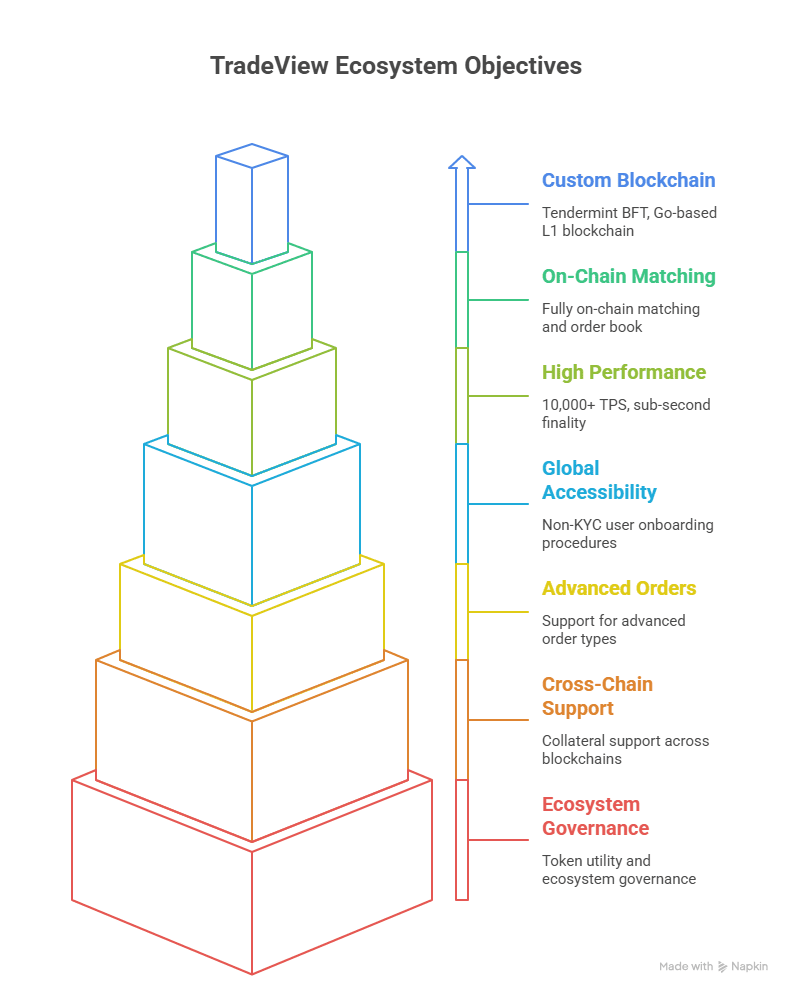
3.1 Fully On-Chain Matching & Order Book
TradeView’s architecture breaks from the DeFi status quo by ensuring that the entire trading lifecycle — from order intake to sequencing, matching, and settlement — happens on-chain, transparently, and trustlessly. In doing so, it addresses the fundamental decentralization gaps that plague existing perpetual DEXs.
3.1.1 The Challenge with Existing Models
Most DEXs marketed as decentralized are only partially so. While they may settle trades on-chain, the core matching and sequencing logic often remains off-chain or under centralized control. This leads to:
- “Deceptive” Decentralization
Platforms often use phrases like “decentralized trading” while keeping mission-critical components — like matching, order sequencing, and risk management — behind closed infrastructures. This not only introduces trust assumptions but actively undermines user sovereignty.
- Invisible Matching Logic
Most users have no access to order sequencing logs, cannot audit fill prioritization, and remain blind to potential manipulation or latency advantages enjoyed by insiders or bots.
- Sequencer Bottlenecks & Downtime
Rollup DEXs (like those on Optimism, Arbitrum, or zkSync) rely on a centralized sequencer — typically controlled by the core team — to publish and order transactions. This:
-
Exposes users to censorship risk
-
Creates downtime when sequencers crash
-
Adds liveness dependencies to off-chain infra
4. MEV Hotbeds
Without in-protocol sequencing and deterministic matching, trades are vulnerable to:
-
Front-running: A malicious actor inserts their transaction ahead of yours.
-
Sandwich attacks: Your trade is surrounded by price-impacting transactions.
-
Back-running: A bot mirrors your strategy seconds later to extract alpha.
This makes the trading experience more expensive and unpredictable, recreating the very trust assumptions DeFi was meant to remove.
3.1.2 TradeView’s Fully On-Chain Trading Engine
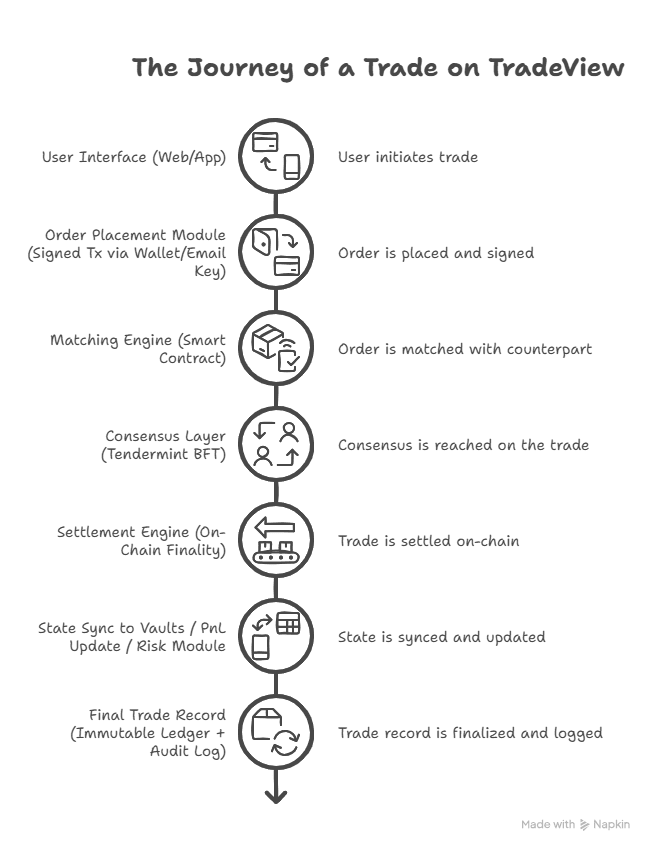
TradeView sets a new bar by deploying a fully on-chain, validator-driven order book and matching engine that operates as a smart contract module within its high-performance Layer-1 blockchain.
- Smart Contract Matching Engine
-
Trade execution happens entirely within smart contracts, not through centralized matching engines.
-
Matching is done using deterministic logic that is transparently encoded into the protocol.
-
Supports a full suite of advanced order types, including:
-
TWAP (Time-Weighted Average Price): Slices large orders to minimize impact.
-
OCO (One Cancels the Other): Automates profit-taking and stop-loss simultaneously.
-
Trailing Stop: Protects gains by adjusting dynamically to price movements.
-
Iceberg Orders: Splits large orders into smaller visible units to reduce market disruption.
-
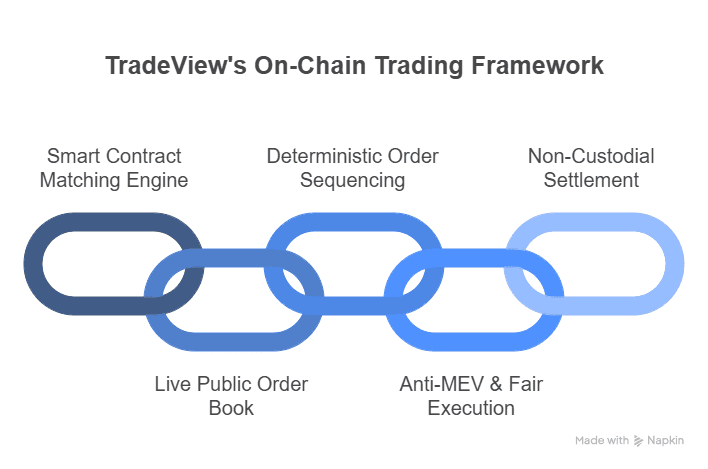
- Live Public Order Book
-
All bid/ask activity is recorded on-chain, enabling full auditability.
-
Market data is real-time accessible for bots, aggregators, and third-party interfaces.
-
This promotes permissionless liquidity sharing, deeper integrations, and reduced fragmentation.
- Deterministic Order Sequencing via Tendermint BFT
-
TradeView’s Layer-1 is powered by Tendermint Byzantine Fault Tolerance (BFT) consensus.
-
Validators produce blocks with deterministic finality, eliminating the need for centralized sequencers.
-
Transaction order is transparent, reproducible, and fair by design.
- Anti-MEV & Fair Execution Guarantees
-
TradeView embeds execution fairness directly into protocol logic.
-
By removing centralized intermediaries, it reduces front-running and sandwich attack vectors.
-
Execution is triggered by users or relayers, and kept transparent with predictable sequencing.
- Non-Custodial and Verifiable Settlement
-
Users retain custody of their assets throughout the entire trading process.
-
Trade lifecycle, including margin accounting and PnL adjustments, is resolved within smart contracts.
-
Every action is on-chain verifiable, aligning with DeFi's principles of transparency and user control.
3.1.3 Strategic Benefits
| Feature | CEX | Rollup DEX | TradeView |
|---|---|---|---|
| Order Matching | Centralized | Off-chain/Semi-on | Fully On-Chain |
| Sequencing | Proprietary | Centralized Sequencer | Validator-Based |
| Auditability | None | Partial | Full Transparency |
| Composability | None | Medium | High |
| MEV Resistance | None | Low | High (Bounded) |
| Settlement Finality | Milliseconds | ~1–2s | <1s Deterministic |
TradeView doesn’t simulate decentralization — it executes it by design.
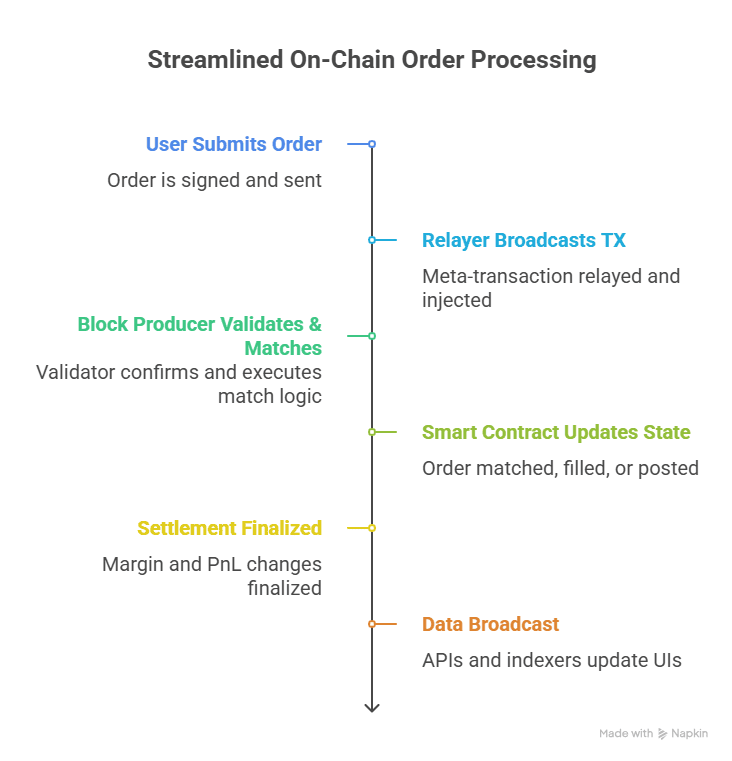
3.1.4 End-to-End On-Chain Order Flow Lifecycle
TradeView’s order flow lifecycle is built to ensure that every trade — from placement to final settlement — occurs entirely on-chain, within a deterministic, auditable, and MEV-resistant execution pipeline.
Lifecycle Breakdown:
-
*1. Order Submission (User → TradeView)*
-
*Orders are signed using either wallet keys or custodial abstraction (email/password).*
-
*Orders are broadcast to the mempool and queued for inclusion in the next consensus block.*
-
*TradeView accepts both market and advanced orders (TWAP, OCO, trailing stop, etc.) in standard format with predefined metadata.*
-
-
*2. Pre-Matching Buffer and MEV Protections*
-
*Once in the mempool, orders are subject to TradeView’s deterministic sequencing rules:*
-
*FIFO (first-in, first-out) sequencing enforced at consensus level, OR*
-
*Randomized shuffling of order batches to avoid latency-driven reordering.*
-
-
*Batch Auction Mechanism is used to aggregate orders within a block and match them at a single clearing price, eliminating front-running incentives.*
-
*Self-trade prevention logic ensures that identical addresses (or linked wallets) cannot execute against themselves.*
-
-
*3. Matching Engine (Fully On-Chain)*
-
*The smart contract-based matching engine processes orders in batches, applying post-only, IOC, and slippage constraints.*
-
*Matches are executed atomically within the same transaction block to avoid race conditions.*
-
*Matching is MEV-aware by design — no external relayers or sequencers can override trade priority.*
-
-
*4. Trade Execution & Settlement*
-
*Matched trades trigger an atomic settlement flow that deducts margin, updates balances, and updates PnL — all in a single on-chain state transition.*
-
*Trade receipts are finalized under sub-second Tendermint BFT consensus, ensuring immutability and global finality without settlement risk.*
-
-
*5. State Sync to Risk Engine & Vaults*
-
*The risk engine is triggered post-settlement to recalculate margin ratios and check for liquidation triggers.*
-
*If liquidation criteria are met, the position is flagged, and partial or full liquidation is triggered based on the latest on-chain state.*
-
*TradeView's vault infrastructure and copy trading modules receive real-time sync to reflect follower positions and strategy PnL.*
-
-
*6. Public Verification & Auditable Logs*
-
*All order events (submitted, matched, cancelled, filled, liquidated) are recorded on-chain with full traceability.*
-
Traders, bots, and third-party dashboards can subscribe to event logs or query the state using TradeView’s GraphQL APIs.
-
Side Notes:
3.1.5 Outcome
With a matching engine and order book that live entirely on-chain:
-
Traders gain full visibility into the book and execution logic, enabling them to execute high-frequency and programmatic trades with full confidence in the protocol.
-
Institutions can rely on provable fairness, reliable execution, and predictable uptime without worrying about centralized control, MEV leakage, or opaque fills.
TradeView transforms the matching engine, historically the black-box crown jewel of centralized finance, into a public, programmable utility for the next generation of trustless markets.
3.2 Custom L1 Blockchain: Tendermint BFT, Go-based
To support high-frequency, decentralized perpetual trading with the performance, reliability, and transparency expected of institutional-grade systems, TradeView moves beyond the limitations of Layer 2 rollups and adopts a purpose-built Layer-1 blockchain. This custom chain, written in Go and powered by Tendermint’s Byzantine Fault Tolerance (BFT) consensus, enables deterministic, censorship-resistant execution at internet speed.
This design offers vertical sovereignty over performance, latency, infrastructure, and composability, which are essential ingredients for building a world-class trading layer on-chain.
3.2.1 Limitations of Layer 2s for Perpetual Trading
L2s made significant progress solving scalability for general DeFi. But they fall short on five fronts when it comes to powering perpetual DEXs and real-time financial primitives. Despite recent advancements, Layer 2 solutions are built on Ethereum’s foundational architecture and inherit many of its bottlenecks or introduce new trade-offs altogether.
Let’s break down the major blockers:
- Sequencer Centralization
Most leading rollups today, including Arbitrum, Optimism, and StarkNet, are built around a centralized sequencer, responsible for transaction ordering and publishing blocks.
-
This introduces a single point of failure in what’s otherwise claimed to be decentralized infrastructure.
-
Sequencers can censor, reorder, or delay user transactions, especially under pressure from regulators or internal business incentives.
-
In volatile markets, these sequencers can go offline, causing rapid price movement, crashing the sequencer for several minutes, resulting in trade failures, missed liquidations, and losses.
Bottom line: No matter how robust the base chain is, centralized sequencing breaks trust.
- Latency Is Not Guaranteed
L2s batch and compress user transactions before submitting them to Ethereum (L1). This process introduces multi-second latency, even in the best-case scenarios.
-
Most rollups average 3–10 seconds of latency from trade submission to confirmation.
-
In high-frequency trading, this delay is unacceptable for:
-
Flash liquidations that must execute within milliseconds
-
TWAP/VWAP execution where precise block-by-block timing matters
-
Market-making that relies on real-time response
-
This leads to unpredictable user experiences, missed profits, or unintended liquidations.
Bottom Line: L2s are fast enough for DeFi swaps. They are not fast enough for precision-driven perpetual trading standardized by the CEXs.
- Dependency on Ethereum Finality
Even if a transaction is executed on a rollup, its security still depends on the finality of Ethereum.
-
Finality can take several minutes, depending on Ethereum’s block time and validator conditions.
-
Dispute periods on optimistic rollups (e.g., 7-day challenge windows) delay withdrawal and settlement.
-
Gas costs are highly volatile. During high demand, users on rollups can see fees spike 5–10x, as rollup compression battles for L1 blockspace.
Bottom Line: Ultimately, L2s are always tethered to Ethereum’s availability, fee market, and throughput limits.
- Lack of Deep Customization
L2s inherit constraints from the Ethereum Virtual Machine (EVM) and its surrounding tooling.
-
You can’t customize consensus rules to fit low-latency, high-frequency use cases.
-
You can’t modify the gas model to reward specific behaviors like liquidation performance or order matching efficiency.
-
Storage optimization, crucial for real-time order books, is nearly impossible within current rollup SDKs.
L2s may be modular, but true vertical control is out of reach.
- Cross-Chain Interoperability Gaps
Trading infrastructure thrives on interoperability, the ability to interact with other protocols instantly.
-
On L2s, bridging to other apps (or other L2s) requires cross-chain messaging layers like LayerZero, Wormhole, or Axelar.
-
These systems introduce:
-
Latency from cross-domain messaging
-
Security assumptions about message relayers
-
Fragile dependencies that can break under congestion or upgrades
-
In practice, this means fragmented liquidity and reactive trading strategies that simply cannot execute on time.
3.2.2 How a Custom Layer-1 (Like TradeView’s) Solves These Issues
TradeView’s decision to build a custom Layer-1 blockchain, based on Tendermint BFT and Go implementation, stems from the foundational need to remove the performance ceilings, control bottlenecks, and centralization trade-offs present in rollup-based architectures.
This section outlines how this bespoke architecture addresses each Layer-2 shortcoming with deep technical control, high-speed execution, and composability as a core primitive.
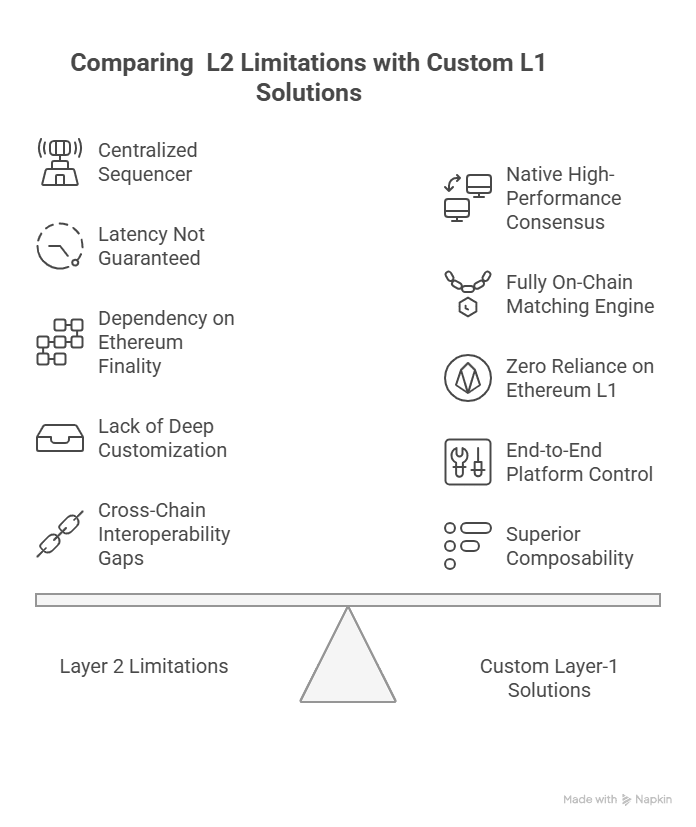
- Native High-Performance Consensus
At the heart of TradeView’s infrastructure lies Tendermint Byzantine Fault Tolerant (BFT) consensus, a battle-tested protocol renowned for its deterministic finality, fault tolerance, and modular design.
- Deterministic Block Finality
Unlike probabilistic finality models (like Nakamoto consensus), Tendermint provides immediate and irreversible transaction finality once a block is validated. This is critical for perpetual futures where latency and confirmation assurance are paramount.
- Sub-Second Block Times
TradeView achieves <1 second block production, enabling real-time market interactions, rapid liquidation processing, and smooth execution for high-frequency trading systems.
- Throughput at Scale
With a target of 10,000+ transactions per second (TPS), the chain can support large-scale order throughput, thousands of users, and simultaneous liquidations, without congestion-based slowdowns.
- No Rollup Batching or Fraud Proof Dependence
Since TradeView operates as a sovereign L1, it does not rely on batching transactions off-chain or on a parent L1 for fraud proofs. This eliminates settlement delays and complexity.
- Fully On-Chain Matching Engine
A central breakthrough in TradeView’s architecture is its native, fully on-chain order book and matching engine.
- Smart Contract-Based Matching Logic
Orders are posted, matched, and filled via smart contracts, without intermediaries or backend scripts. This allows transparent, auditable, and deterministic trade execution, a stark contrast to centralized sequencing in rollups.
- Advanced Order Types as First-Class Citizens
Features like TWAP, OCO, trailing stop, and others are implemented at the protocol level. This unlocks high-level trading strategies without reliance on external bots or frontends.
- Censorship-Resistant Sequencing
Validators, not a centralized sequencer, are responsible for transaction ordering. This removes control asymmetry and builds trust into the system’s core.
- Composable and Public Order Book
Every order, fill, and cancellation is visible on-chain, making TradeView’s order book a public utility, enabling bots, frontends, and indexing tools to operate seamlessly.
- End-to-End Platform Control
Unlike L2s constrained by upstream infrastructure, TradeView’s custom chain provides full vertical control over protocol logic and execution layers.
- Consensus & Block Parameters
TradeView sets its own rules around block size, timeouts, validator rotation, and penalties, enabling faster consensus tuning based on trading workloads.
- Storage Model Optimization
The state storage is optimized for real-time financial operations, minimizing read/write latency for order books, liquidation queues, and user margin accounts.
- Validator Incentive Design
With native staking and slashing, validators are economically aligned with uptime, fairness, and performance goals.
- Gas Model Tailored for Trading
TradeView implements a predictable, trade-specific gas model, minimizing volatility and ensuring traders can execute with confidence even in high-traffic moments.
- Modular Upgradability
Custom modules (e.g., liquidations, funding rate curves) can be deployed and upgraded without relying on Ethereum or EVM compatibility constraints.
- Zero Reliance on Ethereum L1 for Finality
TradeView is self-contained and does not require Ethereum L1 for any core functionality.
- No Bridging Delays or Fraud Windows
Since finality is native, there's no 7-day challenge period (as with optimistic rollups) or cryptographic proof cycles (as with zk-rollups).
- No ETH Gas Fee Dependency
Traders are protected from cost unpredictability caused by ETH mainnet congestion, especially during global volatility events.
- True Sovereignty & Upgrade Flexibility
Protocol logic evolves independently, allowing TradeView to implement upgrades on its governance timeline, without dependency or coordination with Ethereum forks or L2 tooling stacks.
- Superior Composability (Internal and Cross-Chain)
TradeView is not just a trading platform; it’s an execution layer built for developers, vault creators, and structured product designers.
- On-Chain Financial Modules
Developers can build high-frequency automation tools such as:
-
Liquidation bots
-
Dynamic leverage modules
-
Collateral rebalancing vaults
-
Structured product engines
-
Plug-and-Play Cross-Chain Extensions
Rather than retrofit messaging bridges, TradeView supports deliberate and secure cross-chain interfaces that interoperate with Ethereum, Cosmos zones, and other DeFi ecosystems through IBC or native bridges.
- Composable Vaults & Indices
Smart contract vaults can interact directly with the order book, enabling structured strategies like:
-
Index replication
-
Passive rebalancing
-
Leverage ETFs
-
Copy trading vaults
| Feature | L2 (Rollups) | TradeView Custom L1 |
|---|---|---|
| Finality Time | 2–10 seconds (variable) | <1 second |
| Order Matching | Off-chain or hybrid | Fully on-chain |
| Sequencer | Centralized (usually) | Decentralized PoS Validators |
| Latency Guarantee | No | Yes (block-time native) |
| Gas Fees | Varies with L1 | Predictable, tunable |
| Control & Optimization | Limited by L1 stack | Full vertical control |
| Censorship Resistance | Partial | High |
| Modular Composability | Constrained | Fully programmable |
*Strategic Outcome*
By building its own Layer-1, TradeView doesn’t just fix latency or gas fees. It creates an extensible, sovereign infrastructure layer for next-generation derivatives.
This means:
-
Total composability for traders, protocols, and institutions
-
Upgradeability without upstream constraints
-
A validator-driven execution environment with full transparency
In essence, TradeView’s custom L1 is not just a performance decision — it’s a long-term design commitment to making decentralized trading scalable, programmable, and trustless by default.
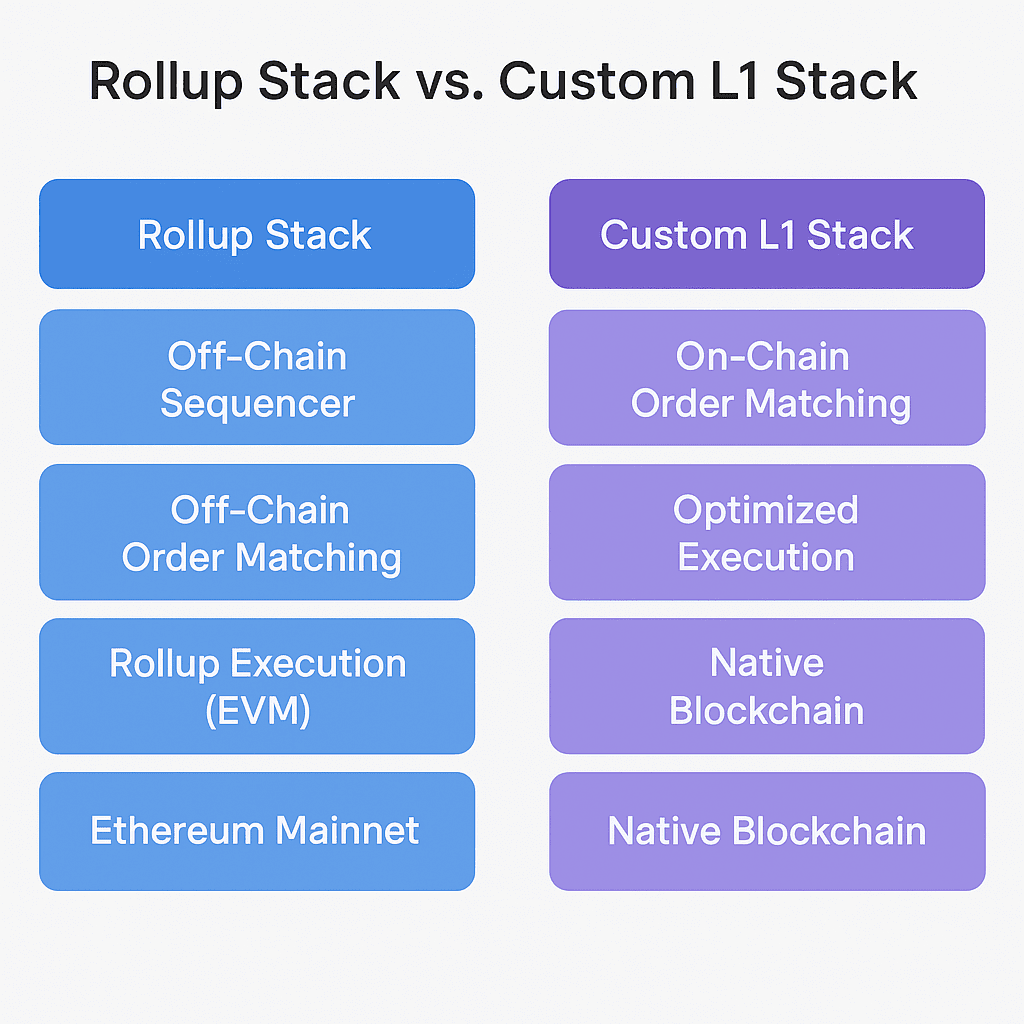
This graphic visually contrasts the limitations of rollup-based architectures with TradeView’s custom Layer-1 design. While rollups rely on centralized sequencers, off-chain matching, and delayed L1 finality, TradeView’s vertically integrated stack eliminates these bottlenecks. It features validator-driven sequencing, fully on-chain matching, and sub-second deterministic finality — all optimized for real-time, censorship-resistant perpetual trading. The diagram underscores how TradeView transforms the matching engine from a proprietary black box into a public utility, purpose-built for composability, transparency, and institutional-grade performance.
3.3 High Performance: 10,000+ TPS, Sub-second Finality
In perpetual markets, speed is a currency. Execution latency, transaction throughput, and state update precision directly impact trader profitability, liquidation reliability, and market trust. Unlike conventional DeFi platforms that struggle under volume, TradeView’s performance-first architecture is purpose-built for trading environments that demand speed without compromise.
3.3.1 10,000+ Transactions Per Second (TPS): Built for Real Throughput
TradeView's infrastructure doesn’t just advertise high TPS like many chains tout theoretical TPS metrics. It is engineered to deliver sustained, real-world throughput. The platform supports over 10,000 transactions per second under active market conditions, providing elasticity during peak demand.
Key implications:
-
*Massively Concurrent Trading* Supports thousands of concurrent trading accounts, modifying orders, updating margins, and settling trades in parallel, without degradation in execution speed.
-
*Event-Driven Scalability* During volatile market events (e.g., macro announcements, liquidation cascades), the network can scale execution capacity to absorb volume spikes, without network freeze or latency degradation.
-
*Bot-Compatible Infrastructure* High TPS accommodates strategy bots, HFT agents, and arbitrage algorithms operating at sub-second intervals without throttling or gas wars.
-
*Multi-Stream Execution* Funding updates, oracle syncs, liquidation queues, and vault strategy updates are processed in tandem, ensuring composability does not become a bottleneck.
This capacity is critical to preventing common issues like order queue overflow, stuck transactions, and missed liquidation windows. Unlike many Layer-1s or rollups that slow down when usage increases, TradeView's base layer is vertically optimized to perform under pressure.
3.3.2 Sub-Second Finality: Instant Assurance, No Waiting
Finality, the guarantee that a transaction is irreversible, is foundational in trading. In TradeView, this is achieved in under 1 second thanks to its use of Tendermint BFT consensus. This sub-second block confirmation translates into near-instant order posting, fills, and margin updates.
Why it matters:
-
*Instantaneous Feedback* Traders see their orders executed and settled almost immediately, enabling tighter control over fast-moving markets.
-
*Eliminates Trade Guesswork* No more waiting multiple seconds to confirm whether a trade went through — ideal for scalpers, arbitrageurs, and real-time hedgers.
-
*Reliable Liquidations* Liquidation engines can act decisively within a second of margin breach, improving safety for LPs and fairness for traders.
-
*Smooth UX for Bots & Scripts* Automated systems can interact with the protocol with deterministic timing, reducing risk of over-execution or price chasing.
Sub-second finality also reduces the exploitability of front-running or sandwiching strategies, since order matching is deterministic and finalized nearly instantly within the same block.
| TradeView’s 10,000+ TPS and sub-second finality are not marketing metrics — they are the technical foundation for a new class of real-time, globally accessible, decentralized trading infrastructure. By delivering CEX-grade responsiveness with DeFi-native transparency and sovereignty, TradeView creates an execution layer worthy of the next wave of institutional and algorithmic capital. |
|---|
3.3.3 Deterministic Execution Paths: No Forks, No Guesswork
In a decentralized trading infrastructure, the certainty of execution is as critical as speed. For real-time financial protocols, execution determinism ensures that once a trade is submitted, it will be processed and settled in a single, predictable pathway, without rollback risk, reorg confusion, or multi-versioned history.
TradeView achieves this determinism by leveraging Tendermint BFT (Byzantine Fault Tolerance) — a consensus algorithm that guarantees instant finality and single-chain progression with no probabilistic branching. This stands in contrast to chains like Ethereum, where block finality is probabilistic and vulnerable to temporary forks or chain reorgs.
- Key Benefits of Deterministic Finality
-
*Single-Version State History* Every block committed on TradeView is final and irreversible. There are no temporary forks or reorganizations that can roll back trades, invalidate transactions, or cause divergence in margin accounting.
-
*Fork-Free Execution* For strategies like TWAP (Time Weighted Average Price) or algorithms that span multiple blocks, deterministic finality guarantees that data references from previous blocks are always consistent, eliminating inconsistencies caused by forks.
-
*Predictable Block Timing* With TradeView’s fixed block production intervals, smart contracts and bots can rely on accurate timestamping and cycle frequency, which is crucial for:
-
Scheduled liquidations
-
Oracle updates
-
Time-sensitive trade conditions (e.g., expiry-based settlements)
-
-
*No Guesswork in Order Sequencing* Validators commit transactions in a strictly ordered fashion as defined by consensus. Traders and developers can trust that execution logic (e.g., who gets filled first) is enforced identically for everyone and is visible on-chain.
-
*Secure Reactive Automation* Reactive smart contracts, such as liquidation engines, funding modules, or copy-trading bots, require guaranteed state accuracy. Determinism ensures these contracts don’t misfire due to inconsistent data or chain reorgs.
- Why This Matters for Perpetual Trading
In perpetual futures, milliseconds and microstates matter. Deterministic finality makes TradeView uniquely positioned to power:
-
*Precision Risk Engines* Accurate liquidation and funding systems require exact margin values at specific block heights. Reorgs can break this precision; deterministic execution guarantees it.
-
*Programmatic Trading Logic* Bots and trading agents can depend on exact trigger windows without polling or adjusting for probabilistic block timing.
-
*Composable Contract Reliability* If a vault or a bot references another contract for execution, both need guaranteed consistency in state. Deterministic consensus provides the reliability needed for secure inter-contract execution.
By removing the uncertainty of probabilistic chains, TradeView’s deterministic execution guarantees traders, developers, and institutions that what they see is what they get — instantly and immutably. Whether it’s a liquidation, a fill, a price update, or a vault trigger, TradeView ensures it happens once, on time, and exactly as expected, forming the backbone of a professional-grade trading chain.
3.3.4 Block-level Parallelism and Transaction Prioritization
In high-frequency financial environments, performance isn't just measured by the number of transactions a blockchain can handle per second — it's also determined by how those transactions are processed and prioritized within each block. Speed without control can lead to poor execution quality, misfired liquidations, and exploitable sequencing. TradeView’s infrastructure is engineered to solve for both throughput and precision, using advanced execution-layer logic.
- Parallel Execution for Scalability
Unlike traditional sequential transaction processing — where each operation is executed one after the other — TradeView supports block-level parallelism, a design that allows:
-
Multiple non-conflicting transactions to be processed concurrently, reducing average processing time per block.
-
Optimal utilization of multi-core CPU architecture at the validator/node level — improving system throughput under load.
-
Support for high activity windows (e.g., liquidations, arbitrage, large market movements) without clogging up execution queues.
This is made possible via smart contract classification and execution context isolation — where different types of transactions (e.g., order placements, vault updates, oracle reads) are pre-classified and directed to different concurrent processing threads.
The result? TradeView handles spikes in trading, liquidations, and copy vault syncs — all at once — without delay or performance degradation.
- Deterministic Transaction Ordering
TradeView also eliminates a major pain point in modern rollups and hybrid DEXs: execution uncertainty due to non-deterministic transaction ordering.
Key features include:
-
Predefined prioritization rules are embedded into block-building logic (e.g., liquidations always precede new order placements).
-
Fair sequencing at the consensus level, enforced by Tendermint BFT — so no validator or relayer can rearrange transactions for MEV gains.
-
Front-running and sandwiching protections, since order placement, execution, and fills are all finalized within the same block and visible to all participants at once.
This prevents race conditions, eliminates latency arbitrage vectors, and ensures equal access to blockspace, regardless of user sophistication or gas bid strategy.
- Priority Queues for Critical Operations
Not all transactions are created equal, especially in DeFi trading.
TradeView introduces transaction-type-aware block scheduling, which allows the system to:
-
Assign top priority to system-critical operations, such as:
-
Liquidation triggers
-
Oracle price updates
-
Stop-loss conditions
-
-
Defer or batch non-urgent tasks like:
-
Passive rebalances
-
UI-driven requests (e.g., scroll events or leaderboard refreshes)
-
Pending reward calculations
-
This ensures that critical actions like liquidations — which protect the solvency of the system — are never delayed due to blockspace congestion.
- Smart Congestion Management
During periods of extreme volatility, when trading activity can increase 10–20x, most chains suffer from:
-
Transaction backlog
-
Gas fee surges
-
Execution delays or stuck orders
TradeView’s parallelism and priority architecture are built to withstand these spikes through:
-
Dynamic execution sharding based on transaction type and urgency
-
Pre-funded relayers that ensure gasless execution do not stall
-
Mempool-aware block building that identifies and promotes latency-sensitive transactions
Summary: Performance with Purpose TradeView doesn’t just scale — it scales intelligently. By combining parallel execution, deterministic ordering, and context-sensitive prioritization, it delivers an execution environment that ensures: - Liquidations are never delayed. - Orders are never re-sequenced unfairly. - Performance scales with intelligence, not just brute force. This architecture is vital for building a decentralized trading system that remains usable, fair, and transparent, even during the most volatile market conditions.
3.3.5 High Availability & Load Resilience
In decentralized perpetual trading, performance doesn’t just mean speed — it means reliability under pressure. Market volatility, rapid order influxes, and sudden liquidations can create unprecedented stress on blockchain systems. While most rollup-based or pseudo-decentralized platforms struggle during these moments, TradeView’s architecture is explicitly designed to remain performant and available.
- Global Validator Distribution: Regional Redundancy, Latency Optimization
TradeView’s validator set is strategically distributed across multiple global regions — including North America, Europe, Asia, and LATAM. This has two critical advantages:
-
Reduced Latency Variability: Traders in different geographies receive more uniform performance, reducing the execution gap between continents.
-
Uptime Assurance: A regional outage or geopolitical failure in one zone won’t compromise the entire network. Validators in other regions continue seamlessly validating blocks and broadcasting transactions.
By avoiding regional centralization of nodes, TradeView preserves fairness and minimizes latency arbitrage opportunities that might otherwise advantage one geography over another.
- Auto-Scaling RPC and Indexing Layers
Performance at the consensus layer is not enough. Applications, analytics engines, bots, and dashboards must also fetch data in real time. To that end, TradeView runs a horizontally scalable RPC infrastructure and query layer, backed by:
-
Real-time indexers for order books, position data, and margin events
-
Caching layers that serve low-latency access to commonly requested data
-
Load-balanced API clusters with regional failovers
This ensures that during usage spikes — for instance, when a popular token suddenly rallies — the platform does not suffer frontend delays, API rate limits, or dashboard inconsistencies.
- Intelligent Meta-Transaction Fallbacks
TradeView's gasless architecture uses meta-transactions, which are executed through relayer networks. To avoid failure during congestion:
-
Redundant Relayer Networks: If one relayer is congested, another pre-funded node can rebroadcast the transaction with an identical signature and payload.
-
Prioritized Replays for Critical Actions: Margin updates, liquidations, and order cancels are requeued and prioritized if they initially fail, ensuring users don’t suffer liquidation or slippage due to network delays.
-
Fail-Safe Retries: Signature validity is retained across attempts, and relayers employ backoff strategies, so performance gracefully degrades rather than collapsing during spikes.
- Performance Under Volatility: Designed for Stress
Historically, many DeFi platforms (including rollups and monolithic chains) have failed during periods of extreme volatility. Examples include:
-
Order book delays or freezes due to unconfirmed block congestion
-
Liquidation failures leading to systemic bad debt
-
Oracle update stalls, causing margin mispricing or inaccurate funding
TradeView avoids these pitfalls through a combination of architectural features:
| Stress Point | TradeView Mitigation |
|---|---|
| Volatile Volume Surge | High TPS + prioritized queues |
| Regional Downtime | Global validator redundancy |
| RPC/API Overload | Auto-scaled infrastructure |
| Meta-TX Failure | Multi-node rebroadcast & backoff logic |
| Oracle Delays | Prioritized execution and batching |
- Outcome: Always-On Trading, Regardless of Conditions
Whether during CPI releases, token launches, or liquidation cascades, TradeView remains operational, fair, and accessible. This guarantees:
-
Trader confidence in uninterrupted execution
-
Bot compatibility for always-on strategies
-
Institutional-grade uptime, approaching 99.99% SLA equivalents
TradeView, therefore, isn’t just fast. It’s resilient and ready for any market, any time.
3.3.6 Performance Without Trade-Offs
In decentralized systems, performance is often viewed as a compromise, a necessary trade-off between decentralization, composability, and real-time responsiveness. Most chains or rollup-based platforms prioritize one of these at the expense of the others:
-
Ethereum champions decentralization but suffers from congestion and latency.
-
Solana offers speed but struggles with uptime and validator inclusivity.
-
Rollups promise scalability but reintroduce centralized sequencers and fragmented liquidity.
TradeView rejects this trade-off. Instead, it re-architects the execution layer from the ground up to deliver:
- Sustained High Throughput (10,000+ TPS)
Unlike “burst speed” marketing claims, TradeView's TPS is sustained in production, meaning it handles spikes during liquidations, volatility, or peak market hours without degrading performance. This is made possible by:
-
A performant Tendermint-based consensus layer
-
Block-level parallelism and transaction categorization
-
Decentralized relayer infrastructure handling order routing and retries
- Sub-Second Finality with Deterministic Guarantees
Finality in <1s ensures:
-
TWAP/VWAP and market-making logic execute with accurate state assumptions
-
Liquidations and re-margining happen in real time, preventing cascading failures
-
Bots, oracles, and copy trading systems operate in tightly timed loops
Unlike probabilistic chains that suffer from reorgs or uncertain state confirmation, TradeView’s deterministic execution flow guarantees a single-version history, crucial for perpetuals.
- Modular Composability Without Fragmentation
TradeView’s smart contract architecture is designed to be composable. Vaults, liquidation bots, copy trading modules, and risk engines can plug into:
-
A unified on-chain order book
-
Shared margin and collateral layers
-
Public APIs and event streams
This composability occurs without needing bridges, wrappers, or protocol-specific hooks, ensuring latency-sensitive financial applications can compose natively within the L1.
- No Sequencers, No Admin Keys, No Shortcuts
Performance was not gained by compromising core decentralization principles. TradeView maintains:
-
Validator-based block production
-
Fully on-chain execution logic
-
Transparent governance and upgrade paths
This ensures no single entity has preferential control over block ordering, censorship power, or system recovery — even at peak throughput.
Why It Matters
For perpetual traders, this convergence means:
-
Fairness: No backdoors, front-running, or hidden matching rules
-
Predictability: Bots and institutions can rely on stable, sub-second conditions
-
Trustlessness: Performance is provable, not promised
For developers, it means:
-
Infra Sovereignty: Build vaults, dashboards, analytics, or trading agents that are not subject to rollup failures or Ethereum congestion
-
Reactive Design: Architect real-time financial primitives with fine-grained execution control and composability
TradeView proves that decentralization and performance are not mutually exclusive — they’re achievable in tandem with the right design.
Rather than patching limitations of Layer-1 or Layer-2 systems, TradeView sets a new baseline: a trustless, high-speed, programmable financial infrastructure where perpetuals, structured products, and real-time strategies can thrive, without compromise.
3.4 Global Accessibility and User Onboarding With Non-KYC Procedures:
In the evolving world of decentralized finance, accessibility cannot be an afterthought. It must be a core principle. TradeView is purpose-built to serve users in every part of the globe, regardless of their access to traditional identity documents, technical know-how, or familiarity with blockchain infrastructure.
At its core is a powerful idea: financial inclusion begins where friction ends. TradeView’s zero-KYC model, combined with its dual-path onboarding framework, empowers individuals and institutions alike to participate in global markets without barriers or gatekeeping.
A Radical Departure from Centralized Models
Most centralized exchanges still follow legacy financial frameworks:
-
KYC mandates tied to local regulations
-
Manual document submission, often taking hours or days
-
IP-based geo-blocking that excludes entire countries
-
Custodial asset control with opaque access rights
These constraints disproportionately exclude:
-
Citizens in emerging economies lack formal identity credentials
-
Users in politically unstable or sanctioned regions
-
Privacy-conscious individuals who distrust surveillance regimes
TradeView flips this model — access is instant, borderless, and sovereign-first, aligning with the core values of decentralization.
3.4.1 Multiple Sign-In Options for Different User Segments
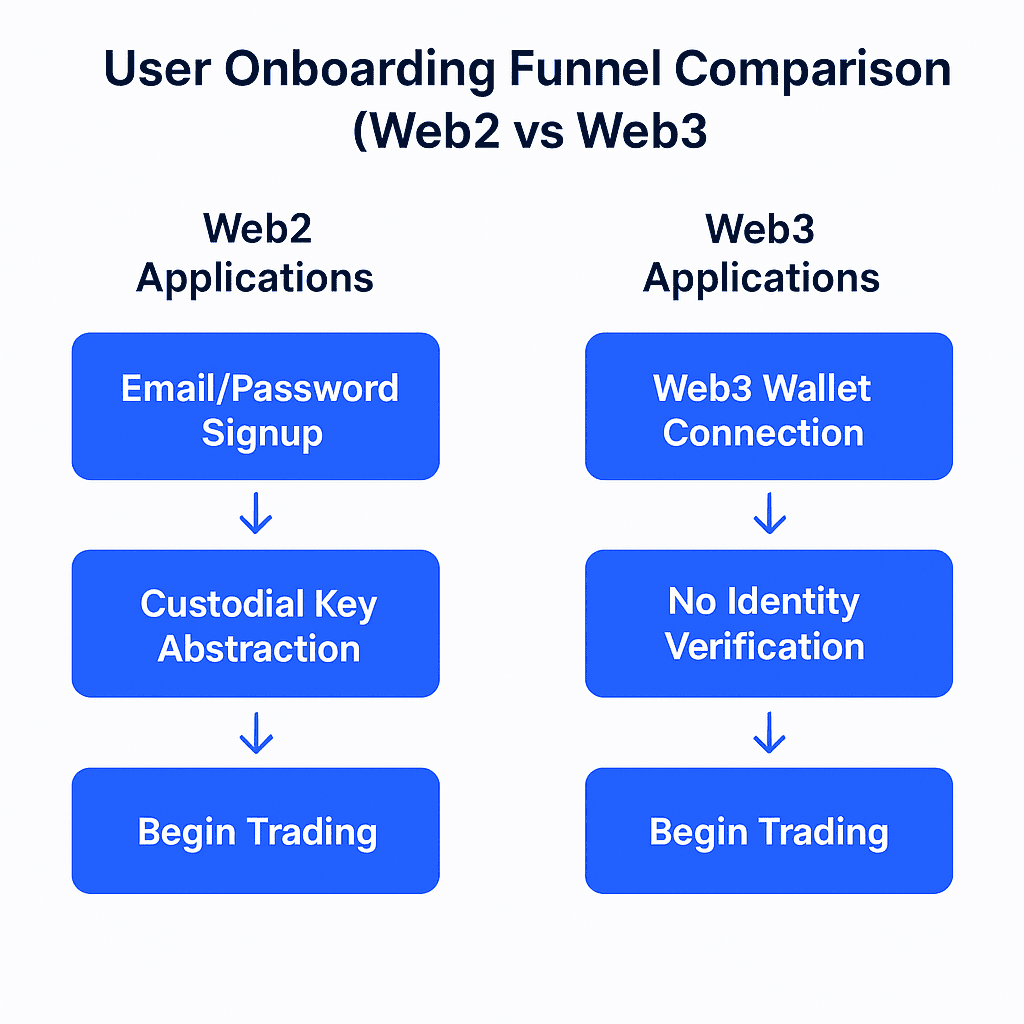
To deliver accessibility without compromise, TradeView offers two distinct onboarding paths, each designed to serve a specific user profile while maintaining shared access to all core features.
The dual onboarding models include:
- Web3 Wallet Connection — For Crypto-Native Users
This login method empowers experienced DeFi users to connect directly via:
-
MetaMask: The most widely used browser wallet
-
WalletConnect-compatible wallets: Supporting a broad spectrum of mobile/web options
-
Coinbase Wallet: Trusted among mainstream users with deeper integrations
Key Features:
-
Zero Friction: No forms, no uploads — just one signature to authorize a session.
-
Non-custodial Access: Users retain full control over their assets at all times.
-
Session Persistence: Temporary session keys ensure continuous, low-latency interactions without frequent wallet prompts.
-
Maximum Security: Compatible with hardware wallets and multi-sig setups for institutional-grade security.
Ideal For:
-
High-frequency traders
-
Liquidity providers and bots
-
Developers and DeFi-native users
This login path ensures full interoperability with the broader DeFi ecosystem — whether users are importing strategies, managing capital across chains, or plugging into TradeView’s APIs.
- Email + Password Login — For Newcomers and Mobile-First Markets
TradeView’s second option caters to the next billion users — those who may not yet be crypto-native but are eager to engage with modern finance.
How it works:
-
Users sign up using a familiar email/password flow.
-
Behind the scenes, a secure custodial key is generated and abstracted.
-
Keys are encrypted, recoverable, and optionally exportable once users are ready to transition to self-custody.
Key Benefits:
-
Low Learning Curve: No wallet installations or seed phrase handling required.
-
Web2 Familiarity: Mirrors the UX of modern fintech and neobank apps.
-
Mobile-Ready: Especially effective in mobile-first markets where dApp wallets are still niche.
-
Progressive Decentralization: Users can upgrade to full wallet access at any time — maintaining continuity and security.
Ideal For:
-
First-time DeFi users
-
Traders onboarding via influencer campaigns
-
Users from low-infrastructure regions like LATAM, India, and Africa
This design ensures maximum onboarding reach without compromising asset safety or DeFi composability.
How Multiple Onboarding Options Enhance User Experience?
The dual-login architecture is not a patch but a scalable access primitive.
A. Reduces Friction Across All Skill Levels
Most decentralized platforms create barriers by forcing users into a single onboarding path, typically requiring:
-
A self-custodied wallet
-
Seed phrase management
-
Web3 transaction signing
This can be intimidating and impractical for:
-
First-time crypto users
-
Mobile-first users without desktop wallets
-
Users unfamiliar with DeFi best practices
By offering email/password signup alongside wallet connection, TradeView provides:
-
A gentle onboarding ramp for newcomers
-
A direct connection for experienced Web3 users
-
A progressive experience: Email users can upgrade to full wallet control later
B. Enables Targeted Experiences Based on User Type
Unlike platforms that enforce a single onboarding route (e.g., MetaMask only), TradeView meets users where they are. This segmentation not only maximizes adoption but also allows TradeView to run personalized marketing and education funnels.
Let’s explore how TradeView enables different UX tiers for each onboarding preference user segment.
| User Segment | Preferred Onboarding | TradeView Experience |
|---|---|---|
| Crypto-native/ Professionals | Wallet Connect | Direct, composable, fastest path, with full DeFi access and tooling |
| Casual Web2 User or New Retail User | Email/Password Login | Web2 familiarity, simple UI with DeFi backend infrastructure |
| Influencer-Driven Users | Email via Referral Link | Low-friction, mass onboarding with referral/quest campaigns |
| Institutional trader/desks | Multi-sig wallet + API Key | Controlled, programmable, and Secure access with auditable integrations |
| Mobile-first user | Email + Biometric Auth | One-tap login, app-like speed, and notifications with gasless trades and push alerts |
This allows TradeView to personalize user flows based on the onboarding method, without fragmenting the backend.
- Other Benefits
This model:
-
Preserves decentralization for those who want it
-
Enables ease-of-use for those who need it
-
Supports seamless onboarding, allowing users to migrate from abstracted custody to full sovereignty
Retention Benefits:
-
Email users stay engaged longer due to reduced initial friction
-
Wallet users enjoy full feature parity and low-latency trading
-
Both types of users can participate in leaderboards, vaults, and governance without restrictions
In aggregate, this model converts, educates, and retains, turning curious visitors into committed on-chain participants.
Outcome: Inclusive Onboarding as a Competitive Advantage
In most DeFi products, onboarding is a conversion bottleneck. In TradeView, it’s a growth loop.
-
Fewer drop-offs during sign-up
-
Higher mobile retention
-
Broader demographic reach
-
Faster go-to-market for partner programs
Multiple onboarding options are not merely for convenience. By treating access as a spectrum, not a binary, TradeView creates a model for what next-generation decentralized platforms should look like: fast, flexible, idealistic performance, retention-focused, and radically inclusive.
By respecting the diverse needs of its global user base, TradeView maximizes adoption without sacrificing decentralization or security.
“The next billion users won’t care if it's DeFi or CeFi — they’ll care if it works. TradeView ensures it does.”
3.4.2 Built for Global Markets
Global expansion in DeFi requires more than just multilingual UIs. It demands architectural inclusivity. Different geographies present distinct user behaviors, tech literacy levels, and privacy concerns. TradeView’s onboarding infrastructure adapts to these real-world variations through modular account handling, layered security primitives, and an access-agnostic identity system.
TradeView is not just a decentralized derivatives trading platform; it’s a global financial gateway designed to serve users in every geography, on any device, under any connectivity condition. While many DEXs are optimized for crypto-native environments in developed markets, TradeView prioritizes accessibility and performance in mobile-dominant, bandwidth-constrained, and regulatory-diverse regions.
This inclusivity is not just a moral stance; it’s a strategic edge. The fastest-growing crypto adoption today comes from places where users:
-
Rely solely on mobile devices
-
Have intermittent or expensive internet access
-
Lack of access to centralized exchanges due to restrictions or local policy
-
Are unfamiliar with seed phrases, self-custody, or DeFi tooling
Regional Differences in Crypto Access
-
*Emerging Markets (e.g., India, Brazil, Philippines)* In these regions, mobile devices are the primary computing tool.
However, self-custodial wallets remain rare due to:-
Limited access to educational resources
-
Confusion around seed phrases
-
High sensitivity to friction in first-time use
-
-
*Western Markets (e.g., U.S., EU, Canada)* Browser wallets like MetaMask are more familiar, but:
-
Users still face signature fatigue and session drop-offs
-
Convenience and performance still influence retention
-
-
*Restricted or Surveillance-Heavy Jurisdictions (e.g., parts of Asia, MENA)* Privacy and off-ramp anonymity become critical.
-
Traders may not want to reveal identities
-
App-based onboarding must avoid geoblocking or centralized account scrutiny
-
TradeView is engineered from the ground up to meet these realities head-on.
- Mobile-First Access
TradeView’s onboarding infrastructure adapts to these real-world variations through modular account handling, layered security primitives, and an access-agnostic identity system. As mentioned earlier, across regions like India, Southeast Asia, Nigeria, Brazil, and parts of Eastern Europe, mobile is the primary (often the only) computing platform. TradeView embraces this reality with a deeply optimized mobile architecture:
-
Mobile-Responsive Web App
-
Fully responsive layouts adapt to various screen sizes and device orientations
-
Touch-optimized UI/UX for actions like swiping between charts, modifying orders, or managing vaults
-
Minimalist interface layers ensure fast rendering, even on low-end Android phones
-
-
Native Mobile Apps (Under Development)
-
iOS and Android apps with deep system integration, providing smoother interactions and access to device-native features
-
Support for biometric auth, offline caching, and push alerts
-
Customizable dashboards tailored for smaller form factors
-
Optimized for Low-Bandwidth Environments
-
Efficient data polling to minimize server calls and payload size
-
Compressed API responses for faster syncing
-
Local caching and light-mode toggles to conserve bandwidth and battery
| Most of the DeFi traffic from emerging markets originates from mobile devices. TradeView is built around that reality, not despite it. |
|---|
- Streamlined Wallet UX For Western Markets
TradeView is also built with the needs of users in high-income, infrastructure-rich regions like the U.S., Canada, and the EU. These users are often familiar with browser-based wallets and DeFi protocols, but retention challenges still exist due to cognitive overhead and UX fatigue.
-
Wallet Experience Optimized For Power Users
-
Auto-reconnection flows and persistent sessions reduce the need for repeated wallet approvals.
-
Support for browser extensions like MetaMask, Rabby, and Coinbase Wallet ensures fast onboarding for advanced users.
-
In-line signing prompts, custom gas fee controls, and fail-safe transaction previews increase trust and speed.
-
-
Performance-Tuned for Desktop Trading
-
Interface includes desktop-optimized charts, hotkey support, and multitab trading session persistence.
-
High refresh rate data streams and WebSocket feeds enhance the experience for traders using external dashboards or dual-screen setups.
-
Deep integration with keyboard-first interactions and developer APIs accelerates usage by HFT teams and quants.
- Privacy-Conscious Design for Surveillance-Heavy Jurisdictions
In regions where financial surveillance, censorship, or overbearing KYC policies are the norm, TradeView provides meaningful alternatives by embedding privacy-respecting architecture from the start.
-
Anonymity-Preserving Onboarding
-
Signature-based wallet login does not require identity verification or personal information.
-
Email-based access avoids asking for phone numbers or government IDs, preventing linkability to real-world identity.
-
No third-party KYC partners or centralized account recovery tied to off-chain identity.
-
-
Decentralized Infrastructure, No Geoblocking
-
No reliance on centralized cloud geofencing — all TradeView nodes, RPC endpoints, and relayers can be accessed via public or private gateways.
-
Progressive Web App (PWA) mode allows full feature access even in environments with app store restrictions.
-
Support for privacy wallets (e.g., Rabby, Torus) and optional IP obfuscation layers in the future roadmap.
Augmenting the Experience With Biometric Login and Push Notifications
Bridging the user experience gap between decentralized protocols and modern fintech apps is essential for mass adoption. TradeView achieves this by integrating intuitive security and real-time engagement mechanisms, typically missing in traditional DEXs.
-
Biometric Authentication
-
Enables one-tap login via face unlock or fingerprint
-
Reduces friction compared to wallet connections or password entry
-
Maintains security via encrypted key vaults tied to user identity
-
Biometric login is especially vital for:
-
Mobile-first traders who prioritize speed and convenience
-
Users in public/shared environments (e.g., internet cafés) who can’t safely store seed phrases
-
Customizable Push Notifications
Real-time engagement is key for traders. Especially in volatile markets. TradeView supports push alerts for key trading events, including:
-
Price crossing a watch level or stop
-
Funding rate changes or negative carry
-
Liquidation proximity or margin threshold breaches
-
Protocol upgrades, reward emissions, or strategy alerts
Push alerts turn TradeView from a passive interface into a proactive trading assistant, essential for users who can’t stare at a chart all day.
Strategic Benefits of Open Access
| User Type | Challenge Faced | TradeView Solution |
|---|---|---|
| Emerging Market Users | Lack of banking/KYC documentation | Wallet-based or email login, no KYC |
| First-Time Crypto Users | Confusion with wallets & seed phrases | Email onboarding with key abstraction |
| Influencers & Communities | Need to onboard fast & at scale | Fast sign-ups + referral tracking |
| Mobile-Only Traders | Limited UI support on DEXs | Responsive UI + app-first roadmap |
In essence, TradeView democratizes perpetual trading by eliminating the traditional friction points that prevent users from participating in global DeFi. This approach isn’t just user-friendly but also strategic. The next wave of DeFi users will come from mobile-first, KYC-light regions, and TradeView is already built for them.
Outcome: Bridging DeFi and Everyday Utility
The convergence of mobile-first UX, biometric login, and real-time notifications enables TradeView to:
-
Operate like a modern fintech app, not a protocol dashboard
-
Onboard users in seconds, not minutes — critical in regions with short attention spans and tight bandwidth
-
Ensure access is continuous, even during connectivity drops or device changes
-
Deliver equal experience quality across low-end and high-end devices
Where other DEXs require users to adapt to clunky workflows, TradeView adapts to users on their terms, in their language, and on their devices.
“TradeView doesn’t just run on mobile — it thrives on it. The world’s next traders aren’t coming from Bloomberg terminals. They’re already on Android.”
3.4.3 Unified Security Architecture Across Access Types
As TradeView opens the gates of perpetual trading to a global audience, spanning mobile-only users, institutions, and crypto newcomers, it faces a critical challenge: How to maintain robust, permissionless security across radically different user access paths.
Where many platforms sacrifice decentralization for convenience (e.g., soft KYC, hidden custodianship), TradeView builds a unified security framework that supports both flexibility and sovereignty.
- Secure Access Without Compromising User Freedom
TradeView supports two core authentication flows:
-
*Wallet-Based Access* Users connect via MetaMask, WalletConnect, or Coinbase Wallet. TradeView validates identity using signed messages, not credentials.
-
No stored user data
-
No backend session tracking
-
Zero reliance on centralized authentication providers
-
-
*Email/Password Onboarding via Key Abstraction* For non-crypto natives, TradeView offers email login, where private keys are securely abstracted. These accounts:
-
Are backed by encrypted key vaults
-
Can support biometric fallback (e.g., fingerprint)
-
Are eligible for account recovery and migration to full self-custody
-
This dual model ensures that users choose their balance of convenience vs. control, while staying fully on-chain.
- Account Abstraction & Role-Based Access Control
To bridge usability and protocol integrity, TradeView uses smart account primitives that:
-
Allow multiple session keys per user — for devices, bots, or subaccounts
-
Support gasless meta-transactions with nonce protection and expiry logic
-
Assign permissions by role: trading-only, vault management, bot execution, etc.
These accounts can be:
-
Upgraded from email-based to full wallet control
-
Paired with multi-sig access for institutional accounts
-
Configured to delegate execution (e.g., relayers, automation bots) without giving up custody
- Regional Adaptation Without Security Dilution
TradeView’s access stack is purposefully resilient in a wide variety of jurisdictions and device environments:
| Region Type | Risk Challenge | TradeView Security Response |
|---|---|---|
| Emerging Markets | Weak connectivity, device loss | Biometric fallback + optional email recovery |
| Censorship Zones | Identity risk, surveillance | Wallet-only access with zero metadata collection |
| Western Web3 Hubs | Sophisticated bots, wallets | Full wallet support with signed nonce + relayer replay protection |
| Institutional | Multi-user ops, audits | Role-based subaccounts, private API key rotation |
The goal is one infrastructure, many access surfaces, with no compromise in decentralization or user rights.
- Seamless Session Management & Fallbacks
To preserve uptime and usability under varying network conditions, TradeView also implements:
-
Session Keys: Temporary, renewable keys tied to accounts avoid constant wallet prompts
-
Auto-Relayer Redundancy: If one relayer fails, another rebroadcasts the user’s intent
-
End-to-End Signing Flows: Even email users indirectly sign off via embedded custodial contracts
This ensures the platform functions not just during normal conditions, but during spikes, outages, and volatility.
- Outcome: Security That Scales With the User Base
By weaving together session abstraction, multi-path access, and decentralized authentication, TradeView creates an onboarding and access model that:
-
Onboards casual users with zero friction
-
Serves institutions with operational guarantees
-
Respects the privacy of users in sensitive zones
-
Maintains trustless, transparent security throughout
It is not a trade-off between ease and ethics — it’s a unified architecture where accessibility and sovereignty are engineered to coexist.
3.4.4 Improves Conversion Rates and Retention
One of the most overlooked challenges in decentralized finance is not access, but activation. Getting users through the front door of a dApp is only half the battle; ensuring they stay, engage, and return is where most DeFi platforms falter.
Dual onboarding in TradeView directly addresses this drop-off dilemma by creating recovery paths and adaptive flows that optimize for user retention at every stage.
- Bounce Recovery via Seamless Fallbacks
First-time users who abandon wallet-based sign-ins, often due to browser errors, seed phrase confusion, or mobile incompatibility, are immediately offered a fallback: email and password registration. This minimizes cold exits and keeps the user within the ecosystem, even if they aren’t yet ready for full self-custody.
This fallback pathway is not a compromise but a bridge. Users who start with email logins can:
-
Link wallets later to enable advanced features like portfolio analytics or cross-chain settlements
-
Export private keys when they become comfortable with self-custody
-
Participate in DeFi safely without facing a steep learning curve on day one
- Re-Engagement Through Social and Competitive Mechanics
TradeView’s UX is also designed to trigger deeper engagement through social elements:
-
Leaderboards and referrals prompt users to invite peers or compete for status
-
Copy trading becomes frictionless when sign-up doesn’t require Web3 fluency
-
Campaigns and quests are accessible via both wallet and email, increasing participation rates
This accessibility enables viral loops and retention hooks that most wallet-gated DEXs simply can’t support.
- Proven Impact on Key Metrics
By lowering technical barriers and giving users multiple on-ramps to start their journey, TradeView improves:
-
Activation Rates – More users complete onboarding and begin interacting with markets
-
Session Length – Users stay longer thanks to smoother UI and fewer technical blocks
-
Repeat Usage – They return, not out of obligation, but because the platform feels usable and familiar
In a sector where most platforms lose users at the sign-up page, TradeView captures and cultivates them with intention.
3.4.5 Future-Proofed for Platform Growth
TradeView’s dual-mode onboarding architecture is not a short-term convenience feature. It is a long-term design foundation that enables sustainable scaling across user segments, regions, and use cases. Rather than tailoring the onboarding experience to current market norms, TradeView builds for a modular future, where users, institutions, and protocols will demand differentiated access models tied to their needs, security postures, and regulatory constraints.
- Designed for Ecosystem-Scale Expansion
As TradeView evolves beyond its core trading engine, onboarding will extend into:
-
Native Mobile Apps with embedded wallets, biometric unlock, and device-aware session persistence
-
Institutional Access Layers supporting managed accounts, operational subaccounts, and programmatic key control
Each of these frontiers introduces new onboarding needs — from secure team-based credentialing, to mobile-first wallet abstraction, to UI-deep integration of smart contract permissions. TradeView’s flexible access system allows these to be incorporated without disrupting the user base or fragmenting the platform.
- Infrastructure Built for Modular User Types
TradeView’s onboarding logic is not tied to a fixed wallet model or a rigid account abstraction path. Instead, it’s structured as an access-agnostic identity layer, where:
-
A single user ID can map to multiple credentials — wallets, emails, API keys
-
Identity keys can be recovered, rotated, or upgraded across security tiers
-
Permissions can be granularly assigned, enabling custom access rules for subaccounts, vault operators, or external apps
This abstraction allows TradeView to adapt to shifts in user expectations and developer frameworks, whether it’s account abstraction upgrades in Ethereum, wallet standard changes, or new compliance frameworks.
In this way, onboarding becomes more than just a gateway to trading — it becomes a developer primitive and a product distribution channel.
- Future-Proof, Not Fragile
Most DeFi platforms rely on wallet-specific entry points, which require complete UX overhauls when broader support is needed. TradeView, by contrast, was designed from day one to:
-
Expand identity handling as the space matures
-
Serve diverse user profiles simultaneously without fragmenting logic
-
Integrate smoothly with future-proof technologies like passkeys, biometric ID standards, or zero-knowledge credentials
This makes TradeView’s onboarding system not just robust for today’s user needs, but also extensible for tomorrow’s global financial participation.
3.4.6 Zero-KYC Philosophy: Privacy, Inclusion, and Composability
At the heart of TradeView’s onboarding and access design is a foundational principle: no user should be excluded from open financial systems due to geography, paperwork, or identity requirements. TradeView is built on a Zero-KYC architecture — not as an afterthought, but as a core design pillar that enables privacy, composability, and borderless access.
- Why Zero-KYC Matters
In the traditional world, KYC (Know Your Customer) is a regulatory mandate intended to prevent fraud and illicit finance. However, in practice, it often becomes a tool of exclusion, denying access to:
-
Unbanked users in the Global South without a government-issued ID
-
Citizens of sanctioned or politically unstable regions
-
Privacy-conscious traders who prefer to avoid invasive data collection
-
Refugees, dissidents, or individuals with no formal financial history
TradeView does not dismiss regulatory concerns but it challenges the assumption that surveillance is a prerequisite for security. In the DeFi paradigm, non-custodial design, verifiable code, and transparent on-chain behavior provide better safeguards than user surveillance ever could.
- Implementation: How Zero-KYC Is Achieved
TradeView achieves non-KYC onboarding through a multi-layered stack of technologies and policy decisions:
-
Dual Onboarding Modes: Users can sign in via self-custodied Web3 wallets or email/password accounts with abstracted keys — no personal data required.
-
No Form-Based Verification: There are no forms, document uploads, or identity checks at any stage of the user lifecycle.
-
On-Chain Permissions Only: All access control is governed by cryptographic ownership and smart contract logic, not admin databases or KYC flags.
-
No Central Account Custody: Even in email-based access, keys are non-custodial and exportable, ensuring users maintain asset control at all times.
-
Relayer-Based Meta-Transactions: Gas is abstracted through relayers, allowing even zero-ETH wallets to onboard and operate, crucial for first-time users in underbanked regions.
- Privacy by Design
TradeView’s zero-KYC stance does not imply a lack of safety — instead, it enables privacy by architecture:
-
No PII Stored or Collected: Personally identifiable information is never collected, stored, or shared.
-
Session Key Rotation: All user sessions are signed with ephemeral keys, minimizing traceability while preserving functionality.
-
Encrypted Account Metadata: Email logins are backed by optional recovery metadata, encrypted end-to-end, and inaccessible to TradeView itself.
-
Decentralized Analytics: Platform analytics and telemetry are de-identified and aggregate-only, preserving user anonymity.
This approach ensures data minimization, one of the fundamental principles of modern digital privacy frameworks like GDPR, and Web3-native self-sovereignty.
- Inclusion Without Borders
A Zero-KYC design also unlocks unprecedented financial inclusion, enabling access for:
-
Unbanked or under-documented individuals
-
Mobile-first traders with no desktop infrastructure
-
Crypto users in jurisdictions without formal fiat on-ramps
-
Communities onboarding via social channels or referrals, without friction
These users are often the most underserved in both TradFi and CeFi, and the most likely to benefit from permissionless derivatives and capital markets.
- Interoperability & Composability
Requiring no KYC also enables frictionless composability with other protocols, wallets, and tooling. This means:
-
TradeView can plug into any aggregator, dApp browser, or wallet without identity gating
-
Smart contract integrations, copy vaults, and strategy bots can be used or composed by any user without privileged access
- Strategic Edge in the Global Landscape
While many platforms are forced to implement geofencing, blacklisting, or full KYC due to their centralized architecture or regulatory exposure, TradeView’s design minimizes those surface areas entirely:
-
Non-custodial execution means no custody risk
-
Smart contract-based operations remove admin intermediaries
-
Validator-based block production decentralizes operational authority
As a result, TradeView can continue to operate openly and safely in jurisdictions where centralized platforms cannot, without compromising on compliance with core DeFi principles.
A Platform for the 99% KYC-based financial models are inherently exclusionary. TradeView flips that paradigm by proving that security, compliance, and fairness can be achieved without identity extraction. Instead of designing for regulators first, TradeView designs for users and builds transparency, auditability, and control directly into the protocol. For the next billion users — whether they’re in Lagos or Lisbon, Mumbai or Miami — TradeView offers an open door to advanced, decentralized trading without compromise.
3.5 Advanced Order Types
In perpetual trading, precision, risk management, and automation are non-negotiable, especially for professional traders, strategy bots, and institutions. Yet, most decentralized exchanges offer only the basics: market and limit orders. TradeView transcends this limitation by integrating a robust suite of advanced order types directly at the protocol layer.
Rather than building these tools as frontend hacks or off-chain workarounds, TradeView natively supports complex execution logic through smart contracts, allowing for fully trustless automation, composability, and fine-grained strategy control.
3.5.1 Native Execution Engine for Order Logic
At the core of TradeView’s trading infrastructure lies a fully on-chain execution engine purpose-built for deterministic, brokerless fulfillment of advanced order types. Unlike platforms that rely on off-chain computation or external execution bots, TradeView treats every order, from simple limit instructions to complex algorithmic triggers, as a first-class, smart contract-defined object.
Each advanced order type is encoded as an autonomous contract module directly interpreted by the protocol. This ensures that execution logic is transparent, auditable, and functions predictably based on current on-chain conditions, rather than depending on external relayers or privileged actors.
- What Makes It Native?
-
*Protocol-Embedded Execution Logic* Advanced orders like TWAP, OCO, and trailing stop are not patched through third-party bots — they are supported at the protocol level, via dedicated on-chain modules.
-
*Deterministic Evaluation* Orders are triggered based on verifiable blockchain state: price feeds, timestamps, funding rates, or margin status. This eliminates ambiguity and ensures fair sequencing across all users.
-
*No Middleware Dependence* The system does not outsource critical trade logic to centralized services or API-bound market makers. Users retain full custody and execution confidence without backend dependence.
- Key Advantages
-
*Trustless & Autonomous Execution* Orders do not require user intervention or backend monitoring. Once submitted, they self-execute when conditions are met, guaranteed by the protocol.
-
*No Reliance on Bots or External Scripts* Unlike other DEXs that require off-chain bots to monitor and execute triggers, TradeView handles all logic natively. This minimizes failure risk during congestion or downtime.
-
*Composable Across Interfaces* While TradeView is not a builder-first protocol, its public API endpoints expose order status, type metadata, and execution events, enabling wallets, vaults, and analytics platforms to reflect real-time logic without needing to replicate the engine itself.
-
*Security by Design* Every order contract is audited, state-isolated, and evaluated within the context of protocol governance, ensuring consistent behavior and avoiding execution surprises.
-
*Performance-Centric Design* Orders are sequenced within the same Tendermint-driven validator logic as standard trades, meaning they benefit from <1s finality and sub-block deterministic matching.
- UX Implications
-
Users can set and forget advanced strategies, knowing they’ll be executed with the same speed and guarantees as market orders.
-
There is no need for extensions, browser plug-ins, or manual bots, even for complex trade logic.
-
Interfaces can render order state dynamically (e.g., trailing price bands or OCO dependencies) without accessing proprietary services or middleware APIs.
3.5.2 Supported Advanced Order Types
TradeView introduces a rich suite of advanced order types that empower users to execute professional-grade strategies, all enforced natively through smart contracts. While some of these order types have been briefly mentioned in earlier sections, this section consolidates them and outlines how each one operates within TradeView’s on-chain execution engine.
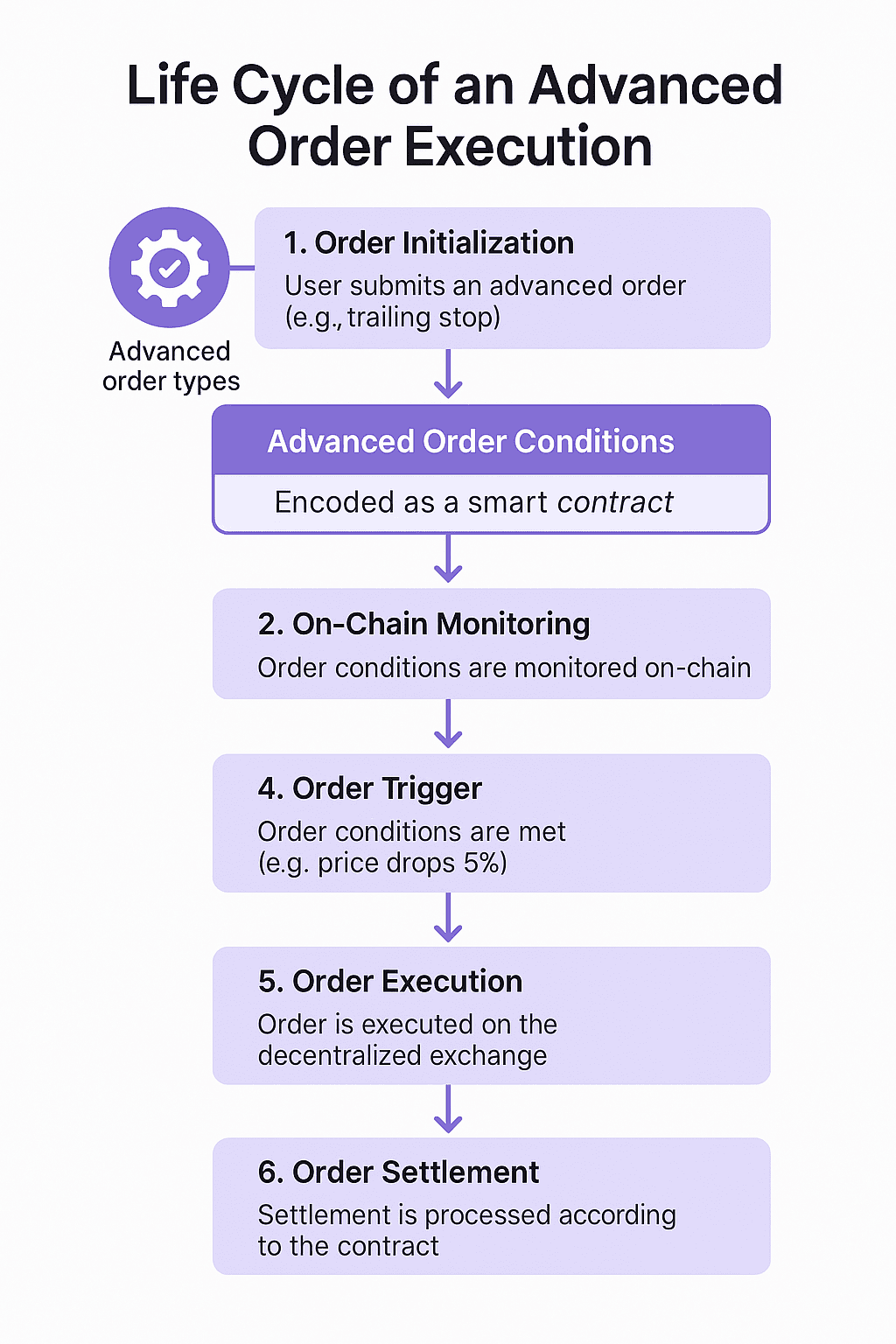 Unlike off-chain bots or third-party services, all these order types are protocol-native, transparent, and verifiable, bringing the sophistication of CEX-grade automation to a fully decentralized environment.
- TWAP (Time-Weighted Average Price)
As previously noted, TWAP splits a large trade into evenly sized chunks over time. What hasn’t been emphasized is that:
-
TWAP execution logic in TradeView is state-aware, adapting to market depth and volatility.
-
Traders can define time windows, minimum fill amounts, and slippage ceilings, enabling tailored pacing strategies.
-
TWAP is useful not just for trading large positions, but for vault managers seeking low-impact index rebalancing or delta adjustments.
- VWAP (Volume-Weighted Average Price) (Planned for V2)
Unlike TWAP, VWAP adjusts order slices based on observed trade volume distribution. While this feature is planned for V2, its design will:
-
Leverage aggregated real-time volume from the on-chain order book.
-
Allow dynamic resizing of sub-orders in proportion to market activity.
-
Provide analytics compatibility, giving institutions post-trade execution reports to benchmark slippage vs. idealized VWAP.
VWAP will be a first-of-its-kind implementation among DEXs with on-chain volume feedback loops — a core differentiator for funds seeking execution parity with CEXs.
- OCO (One Cancels the Other)
Mentioned earlier as a bracket tool, OCO deserves additional technical clarification:
-
TradeView binds stop-loss and take-profit orders through a one-time composable transaction.
-
If either leg is filled, the protocol automatically invalidates the sibling, even across volatile price gaps.
-
OCO logic can be combined with trailing triggers, forming multi-layered exit logic ideal for high-volatility assets.
- Trailing Stop Orders
TradeView supports serverless trailing stop-loss execution by embedding price-relative triggers:
-
The trigger price updates automatically as the asset moves in favor of the user.
-
The offset (trail distance) is stored on-chain and enforced without polling or third-party watchers.
-
Particularly useful for mobile or passive traders who want to automate exit protection while remaining non-capped on upside.
- Iceberg Orders
Iceberg logic in TradeView allows a visible order slice while keeping the bulk of the position hidden:
-
Only a configurable percentage of the order is exposed to the order book at a time.
-
The next chunk is revealed only when the visible part is filled.
-
Execution is deterministic but intentionally obfuscated from public order flow viewers, offering privacy without compromising on transparency.
This is particularly valuable for:
-
DAO treasuries and protocol-native funds executing governance-aligned rebalances
-
High-volume traders operating with price sensitivity
- Conditional Orders
Beyond simple price triggers, TradeView’s conditional orders can:
-
Activate or cancel based on Oracle-supplied funding rates
-
Be timed against block height or funding intervals
-
React to volatility bands, allowing passive exposure only during defined market states
This enables complex entry or exit behaviors tied to macro-conditions, rather than raw price levels.
- Multi-Trigger Logic (Custom Strategies)
This is the most flexible execution primitive within the protocol:
-
Orders can be bound to multiple triggers (e.g., price AND funding rate AND volatility index).
-
Logic can be layered: if-then branches, delayed activation, or windowed re-evaluation.
-
Particularly powerful for advanced use cases like:
-
Automated hedging (e.g., trigger a hedge if volatility spikes AND BTC price drops 5%)
-
Vault automation (e.g., only rebalance when slippage is low AND volume is above threshold)
-
These are not custom-coded strategies, but rather parameterized smart order templates — deployable by vaults, community pools, or power users that will leverage TradeView’s open APIs.
3.5.3 What Makes TradeView’s Advanced Orders Unique?
| Order Type | Fully On-Chain | Trigger Flexibility | Modular Execution | UI/UX Native |
|---|---|---|---|---|
| TWAP | ✅ | Time windows, pace | Yes | Yes |
| VWAP (v2) | Planned | Volume-weighted | Planned | Yes |
| OCO | ✅ | Dual-leg cancel logic | Yes | Yes |
| Trailing Stop | ✅ | Price-relative | Yes | Yes |
| Iceberg | ✅ | Order visibility | Yes | Yes |
| Conditional | ✅ | Oracle, time, logic | Yes | Yes |
| Multi-Trigger Logic | ✅ | Complex conditions | Yes | API-only |
These features position TradeView as the only decentralized perpetual platform offering fully on-chain, latency-optimized, modular, advanced orders, comparable to institutional-grade execution platforms — but without the centralized risks.
3.5.4 Smart Contract-Driven Risk Controls
Advanced orders in TradeView are more than execution tools. They double as an integrated, trustless risk management layer. By moving beyond passive order placement and encoding execution logic directly into smart contracts, TradeView enables proactive, automated defenses against volatility, overexposure, and liquidation risk.
In traditional finance, such functionality is delivered through prime brokerage risk engines or OMS/RMS middleware — tools that remain inaccessible to most DeFi users. TradeView brings this functionality natively on-chain, turning smart contracts into programmable safeguards.
- Pre-Programmed Liquidation Buffers
Rather than waiting until margin ratios are breached, users can define conditional stop-outs:
-
Stop orders that trigger well before liquidation thresholds
-
Based on dynamic risk curves, not fixed price levels
-
Reactive to funding rate pressure, PnL exposure, or vault utilization
This gives traders:
-
A margin of safety to exit positions gracefully
-
Avoidance of full liquidation losses
-
Protection against MEV-triggered final-block liquidations
These buffers act like circuit breakers, preemptively managing downside without active monitoring.
- Volatility-Aware Entry/Exit Points
TradeView’s conditional logic allows users to define volatility band-based execution rules:
-
Only enter a long if the asset’s implied volatility is within a predefined range
-
Exit positions if sudden volatility spikes breach a trailing threshold
-
Combine with trailing stop orders for adaptive reactivity
By doing so, users effectively simulate:
-
Options desk behavior, such as delta hedging or volatility harvesting
-
Event-driven strategies, such as positioning around CPI reports or rate decisions
No off-chain data feeds or external bots are needed; just price and volatility conditions are directly referenced on-chain.
- Vault Rebalancing Based on Market Regimes
For fund managers or DAO-controlled vaults, TradeView enables automated vault behavior based on pre-set market regimes:
-
Reallocate to stables if the price drops 10% in 24 hours
-
Rotate exposure between correlated assets when the correlation breaks
-
Adjust the leverage ratio based on funding rate dynamics
Because vaults interact with TradeView through smart contracts, they can:
-
Modify open positions
-
Trigger limit or conditional orders
-
Adjust internal exposure autonomously, without governance or manual ops
This creates a fully programmable asset manager architecture, governed by logic, not humans.
Why This Matters: From Risk Alerts to Risk Automation
Most DeFi platforms offer static risk dashboards — useful for information, but useless for action. TradeView upgrades this with:
-
Execution-coupled risk control — Orders that not only inform but respond
-
Modular automation — Strategy logic written once, executed many times
-
User-defined safety rails — Risk boundaries set on deposit, not mid-volatility
This moves risk management from advice to action, a shift as fundamental as going from a candlestick chart to an auto-trading strategy.
| Risk Scenario | Traditional DEX Handling | TradeView Smart Order Logic |
|---|---|---|
| Near-liquidation position | Manual close (if noticed) | Predefined stop-out with buffer |
| Sudden volatility spike | Slippage, panic execution | Conditional exit within defined range |
| Funding rate spike | No automated response | Triggers hedge or reallocation logic |
| DAO vault underperformance | Manual rebalance by multisig | Autonomous strategy switch or unwind |
TradeView transforms risk handling from a reactive, user-dependent burden into an automated, protocol-native capability, delivering the sophistication of institutional tooling without surrendering custody or decentralization.
3.5.5 Benefits for Diverse Trader Profiles
Advanced order types are not just technical upgrades. They’re usability multipliers across the entire spectrum of DeFi participants. By embedding institutional-grade execution primitives directly into the smart contract layer, TradeView ensures that every trader, from casual retail to algorithmic vault designer, benefits from automation, precision, and composability.
| User Segment | Advanced Order Utility |
|---|---|
| Retail Traders | Easy stop-loss + take-profit automation without constant monitoring |
| Pro Traders | Execute large orders programmatically via TWAP, OCO, or Iceberg logic |
| Strategy Vault Creators | Implement trustless signal-based entries using conditional orders |
| Institutions & Funds | Reduce slippage, ensure stealth execution, and trigger exits based on funding or volatility metrics |
Why It Matters
Each of these groups has traditionally relied on CEX-native tooling, proprietary bots, or off-chain services to manage complex execution flows. TradeView brings those capabilities fully on-chain — accessible through UI, APIs, or smart contract interfaces, without compromising security, transparency, or composability.
| Outcome: With native support for a wide spectrum of advanced orders, TradeView replaces the need for third-party execution software or custodial prime services. It brings the discipline of algorithmic trading to the trustless execution layer of DeFi, closing the usability and sophistication gap between DEXs and traditional trading venues. |
|---|
3.5.6 Composability and Ecosystem Integration
Unlike centralized exchanges, where advanced order types are siloed behind proprietary APIs or interfaces, TradeView’s architecture treats every execution primitive as a first-class smart contract object — modular, auditable, and composable. This enables not just flexible trading, but cross-protocol utility and integration at the infrastructure level.
- Open-Contract Execution Templates
Every advanced order type, including TWAP, OCO, trailing stops, or Icebergs, exists as an on-chain, permissionless execution module. These are:
-
Publicly callable by any user or protocol
-
Composable with other contracts, such as vault managers, index funds, or automation layers
-
Upgradeable or forkable, enabling adaptation for niche use cases or strategy-specific extensions
This means advanced orders are not just UI features, but they are protocol-level primitives, deployable across the DeFi stack.
- Use Cases Across the Ecosystem
| Integration Layer | How It Leverages TradeView’s Advanced Orders |
|---|---|
| DEX Aggregators | Route orders through TradeView’s smart contracts to utilize Iceberg or TWAP logic for best execution, without needing to replicate infrastructure. |
| Strategy Protocols | Inherit execution templates to build structured products, like delta-neutral vaults that trigger entry/exit based on volatility bands or funding rate signals. |
| Index or ETF Projects | Use VWAP/TWAP modules to balance weightings across volatile assets without affecting slippage or on-chain signal visibility. |
| Yield Platforms | Automate capital deployment or rebalancing based on market conditions — e.g., entering long-only or hedged positions via conditional triggers and smart order sequencing. |
| Risk Management Tools | Integrate with on-chain analytics to simulate execution outcomes under various market conditions, enabling pre-trade compliance checks or automated position capping. |
- Strategic Advantage
By making its execution layer programmable and modular, TradeView becomes more than a venue — it becomes a backend primitive for structured trading logic. This positions the protocol as a foundational layer for:
-
Structured DeFi derivatives
-
Social trading automation
-
On-chain portfolio management infrastructure
It also means developers can build atop TradeView without needing privileged access or coordination. Any protocol, interface, or DAO can use the same building blocks, reducing duplication, increasing speed to market, and preserving composability across the DeFi ecosystem.
3.5.7 Outcome: Strategy-Grade Infrastructure
TradeView’s advanced order system isn’t just a convenience layer for traders but a foundational upgrade to how DeFi trading infrastructure is built and used. By embedding programmable execution logic directly into smart contracts, TradeView turns advanced order types into first-class financial primitives.
This transforms TradeView from a mere trading venue into a strategy-grade execution layer, the kind traditionally offered only by prime brokers, algorithmic desks, or proprietary trading systems in centralized finance.
- Programmable Execution at the Core
At its heart, TradeView offers a deterministic, transparent, and trustless alternative to traditional execution logic:
-
Smart contract–driven logic ensures neutrality — orders trigger based on encoded market conditions, not opaque off-chain decisions.
-
Each order is composable — able to be plugged into vaults, copy-trading systems, or DeFi protocols without loss of auditability.
-
Users aren’t locked into UI-driven workflows — they can trigger orders via dApps, APIs, keepers, or strategy controllers.
- Catering to Every Strategy Tier
Whether the user is a solo retail trader, an algo fund, or a DAO building complex vaults, TradeView’s architecture supports them natively:
| User Type | Execution Goals |
|---|---|
| Retail Traders | Risk-managed entries and exits, auto-profit taking, trailing protection |
| Algorithmic Traders | Precise, low-latency execution of time or volume-based strategies |
| Vault/ETF Protocols | Composable triggers for market rebalancing or index tracking |
| Institutions | Stealth execution at scale, conditional hedging, funding rate arbitrage |
These goals, which once required proprietary bots and centralized APIs, are now possible entirely on-chain, opening a new era of strategy-driven, trustless trading infrastructure.
- Real-Time, Reactive Execution
Thanks to sub-second block finality and deterministic sequencing (via Tendermint BFT), execution latency is consistent and reliable. That makes advanced strategies like:
-
Funding rate harvesting
-
TWAP rebalancing
-
Delta-neutral hedging
-
Auto-deleveraging during volatility
…not only feasible on-chain, but also performant at scale.
- Foundation for the Next Generation of DeFi Applications
TradeView’s programmable execution modules enable a broader class of DeFi apps to emerge:
-
Yield platforms that optimize based on order logic (e.g., trailing stop yields or TWAP-based harvesting)
-
Index and ETF builders that rebalance passively without gas-bloating
-
Risk managers who codify circuit breakers and conditional liquidity access directly into position logic
These are more than just side effects. They’re intentional outcomes of designing the system as a modular, composable execution layer.
Final Perspective In TradeView, the order book is no longer just a place where buyers meet sellers — it’s a programmable surface. And each advanced order is a smart, self-enforcing instruction set. This elevates the platform from being a user interface to becoming DeFi’s execution backbone — capable of powering portfolios, protocols, and strategies in real-time, without intermediaries. TradeView, therefore, doesn’t just host trades. It hosts intent — transparently executed.
3.6 Cross-Chain Collateral Support
In today’s multi-chain DeFi landscape, the notion of collateral has evolved beyond single-chain constraints. Capital now exists in diverse forms from stablecoins on Solana and Cosmos, to LSDs (like stETH) and LRTs on Ethereum rollups, to native assets on Avalanche, Polygon, and beyond. Yet, most perpetual DEXs are architecturally siloed, enforcing collateral lock-in within one chain or ecosystem.
TradeView redefines this paradigm by introducing native cross-chain collateral support, allowing traders to post margin, open positions, and manage PnL using assets that reside outside the core execution layer. This design brings a new level of capital mobility and efficiency to perpetual trading, without compromising speed or determinism.
3.6.1 Why Cross-Chain Collateral Matters
As DeFi matures into a multi-chain ecosystem, capital is no longer confined to a single dominant layer. Instead, users hold significant assets, including high-yield staking tokens, native gas assets, and synthetic instruments, across dozens of chains and rollups. Yet, most trading platforms remain architecturally rigid, demanding users conform to a one-chain collateral paradigm. This creates systemic inefficiencies, user friction, and opportunity loss.
- Fragmented Collateral = Fragmented Opportunity
When collateral is restricted to one chain, liquidity becomes trapped. Traders must either:
-
Manually shuttle funds across bridges (introducing time, cost, and risk), or
-
Sacrifice exposure by sitting out trades until capital can be repositioned.
For time-sensitive strategies — such as reacting to sudden volatility, hedging across correlated pairs, or participating in limited-time arbitrage windows — this latency is fatal. Collateral mobility, therefore, is not a nice-to-have; it is a prerequisite for strategic responsiveness.
- The Rise of Multi-Chain Treasury Management
Institutional and DAO treasuries increasingly manage portfolios across multiple ecosystems. These portfolios contain:
-
Native tokens (ETH, ATOM, AVAX)
-
Yield-bearing instruments (stETH, aUSDC, yvDAI)
-
Risk-managed LP positions
And while many of these assets are theoretically tradeable, none can be used natively as margin on a single-chain DEX without compromise. The result is inefficient capital buffers, duplicated balances, and fragmented strategy execution. TradeView’s collateral model changes this by supporting multi-chain collateral without forfeiting deterministic execution.
- Smart Margin, Not Just Portable Collateral
Beyond simply accepting cross-chain assets, TradeView treats collateral as a programmable financial primitive. This means:
-
Margin can adapt dynamically to on-chain conditions across ecosystems.
-
Risk parameters (e.g., LTV, liquidation threshold) can reflect asset volatility, chain security, or governance risk in real time.
-
The collateral layer becomes intelligent, capable of driving triggers, vault behavior, or even dynamic leverage provisioning.
- From Asset Support to Cross-Ecosystem Coordination
Supporting cross-chain collateral is not just about onboarding more assets — it’s about enabling coordination between ecosystems:
-
Users can open positions on TradeView using Solana-based USDC while continuing to earn yield or use the same USDC in other protocols via intent-based workflows.
-
LSD holders on Ethereum can post stETH as collateral without losing staking rewards or entering bridge delay queues.
-
Avalanche or Polygon-native assets can be marginized without the user leaving their native wallet, enabling a composable UX across ecosystems.
- Strategic Implications
Cross-chain collateral unlocks advantages far beyond convenience:
-
User acquisition: Traders don’t need to migrate capital, making onboarding instant.
-
Capital efficiency: Unused or dormant collateral across ecosystems is activated without tradeoffs.
-
Market depth: TradeView can tap into liquidity previously siloed across L2s and appchains, enhancing slippage profiles and scaling leverage safely.
-
Sovereignty: Users maintain exposure to their preferred chains, protocols, and yield mechanisms, all while trading on a high-performance L1.
3.6.2 How It Works: Under-the-Hood Mechanics of Cross-Chain Collateral
TradeView’s cross-chain collateral system is not a superficial bridge or wrapped token model. It is a modular and verifiable collateralization framework, purpose-built for decentralized trading, with full security, latency resilience, and composability.
This system integrates IBC-style messaging, collateral adapter contracts, and canonical vault logic to create an interoperable margin framework across chains, without requiring users to move assets out of their preferred ecosystems.
Step-by-Step Flow
-
*Collateral Adapter Contracts (External Chain Layer)* On each supported source chain (e.g., Ethereum, Solana, Base, Polygon), TradeView deploys adapter contracts that:
-
Accept user collateral deposits (e.g., USDC, stETH, rsETH, cbETH, DAI, RWA tokens).
-
Lock these assets in a secure vault.
-
Generate a cryptographic proof of deposit for use in downstream messaging.
-
Monitor real-time balance changes, slashing risks, or potential rebasing behavior for yield-bearing tokens.
-
-
*Message Relayers (Transport Layer)* Instead of using insecure bridges, TradeView uses permissionless relayer sets that:
-
Collect deposit proofs from the adapter contracts.
-
Transmit these to TradeView’s native L1 using IBC-style messaging protocols with acknowledgment handling.
-
Ensure delivery order, state consistency, and redundancy through deterministic gossip networks or light-client verification.
-
-
*Canonical Vaults (Settlement Layer on TradeView L1)* Once the message is verified:
-
A synthetic, margin-eligible representation of the asset is minted (e.g., xUSDC, xstETH).
-
The Canonical Vault records the margin balance, collateral ratio, liquidation parameters, and funding impact.
-
Liquidation, interest accrual, and reward claims (if any) are calculated and executed within TradeView's L1.
-
-
These vaults are smart contract-governed, non-custodial, and support modular rulesets, allowing the system to distinguish between stablecoins, rebasing tokens, yield-bearing assets, and non-fungible collaterals like staking vault receipts.
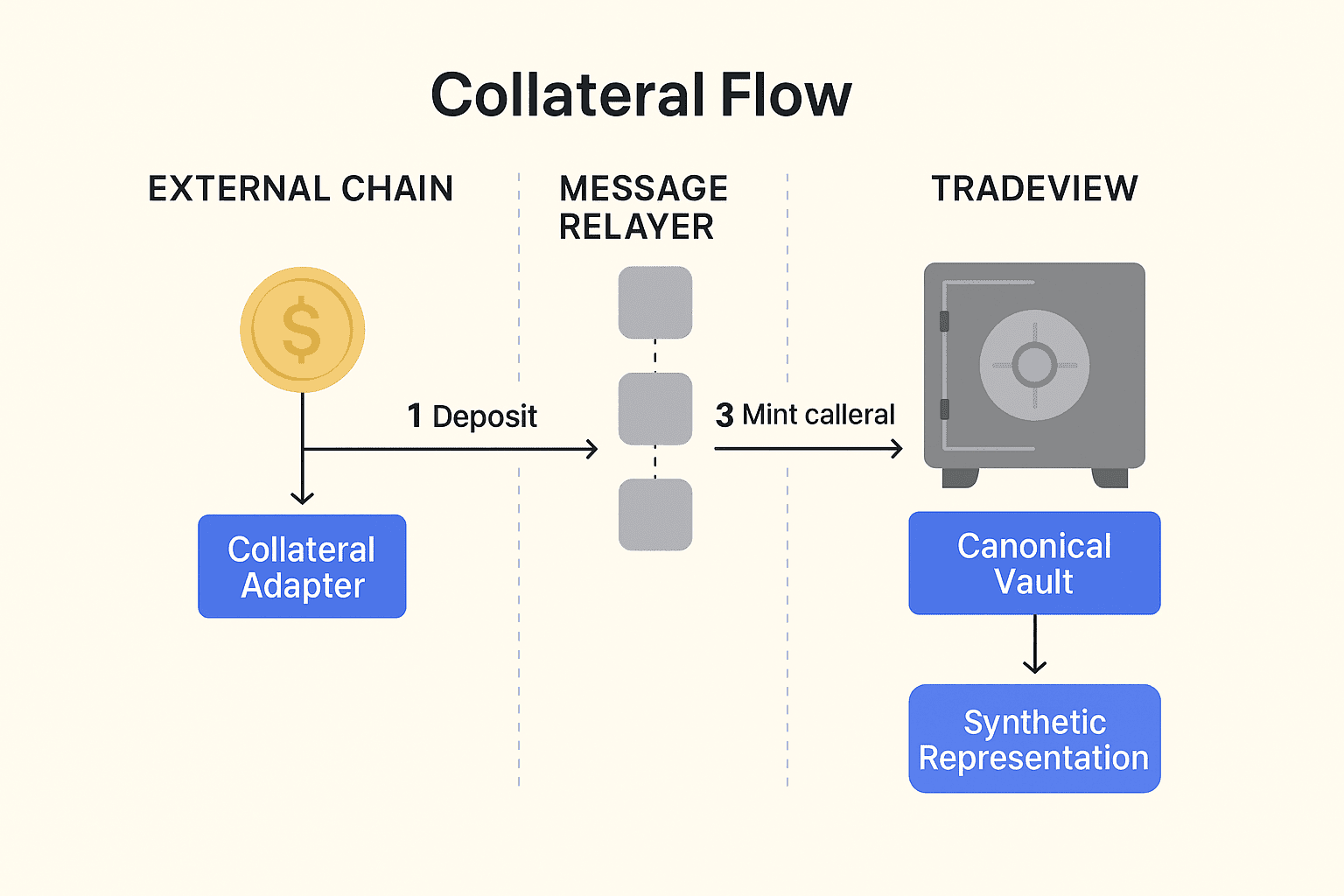
3.6.3 Unique Architectural Advantages
TradeView’s cross-chain collateral architecture isn’t a makeshift wrapper around bridges — it’s an intentionally designed capital coordination layer that brings coherence, flexibility, and security to margin management across heterogeneous ecosystems. Each advantage below represents a structural breakthrough in how decentralized platforms handle composability across chains.
- Asset-Native Exposure, Preserved
Unlike conventional approaches that wrap assets into static representations or require them to be bridged entirely out of their source chain, TradeView enables margining without migration. This means:
-
stETH continues to accrue staking yield on Ethereum, even while margining trades on TradeView.
-
Native assets on chains like Solana, Avalanche, or L2s like Base are never relinquished — only represented and verified through deterministic, proof-based messaging.
-
Users retain access to the original utilities or governance rights tied to those assets.
This fundamentally changes the capital cost of participation. Yield-bearing assets no longer sit idle or forfeit income to participate in leverage. Liquidity remains active and dual-purpose.
- Asynchronous Yet Deterministic Settlement
TradeView doesn’t rely on real-time message finality to ensure correctness. Instead, it introduces a timeout-aware sequencing model with deterministic rules. This means:
-
Even if message relays from external chains take several blocks, TradeView’s canonical vault logic can simulate solvency margins, price buffers, and risk states with accuracy.
-
Protocol-internal modules track deposit/withdrawal proofs with built-in fallbacks and expiration thresholds, minimizing any window for exploitation or dispute.
-
Critical operations like margin calls or funding adjustments are never bottlenecked by latency; predictable execution guarantees are always preserved.
This asynchronous design is particularly vital for supporting high-latency chains (e.g., Bitcoin sidechains, Layer 2s with fraud-proof delays) without degrading performance or trust assumptions.
- Unified Liquidation Engine
Cross-chain platforms typically face fragmented risk models, where every chain's collateral must be assessed separately, leading to inconsistent liquidation behavior or execution gaps.
TradeView solves this through a centralized liquidation logic on its L1, which governs:
-
Real-time solvency checks across all margin pools
-
Uniform application of LTV ratios, price impacts, and delay penalties
-
Priority sequencing of liquidation triggers, including cascading failure management during volatile market events
This ensures that no asset origin can bypass or delay liquidation, and users are protected by predictable, transparent risk enforcement, regardless of collateral diversity.
- Composable Collateral Management
TradeView vaults are not monolithic. Each one is modularly structured and programmable via smart contract plug-ins, enabling:
-
Dynamic Loan-to-Value (LTV) adjustment per asset type or volatility regime
-
Collateral boosts based on loyalty, staking, or governance participation
-
Yield redirectors that auto-stream earned rewards (e.g., staking yield, LRT emissions) to offset funding or interest charges
-
Custom penalty buffers for slow finality chains or illiquid collateral classes
This composability empowers not only users but strategy creators, funds, and DAOs to define their vault logic. It moves collateral away from a rigid margin calculator into a programmable risk canvas.
Why It Matters
In traditional DeFi or cross-chain platforms, collateral is treated as either static or constrained:
-
Bridges force full custody transfer, breaking the capital utility
-
Yield-bearing assets lose their upside just to be usable
-
Margin accounts are siloed per chain, per protocol, per strategy
TradeView changes this.
Its cross-chain collateral architecture acts like a clearing engine for on-chain capital, one that:
-
Ingests diverse asset classes
-
Verifies them without compromising yield or location
-
Standardizes risk treatment across them
This means a trader using stETH from Ethereum, USDC from Solana, and AVAX from Avalanche gets the same execution guarantees as someone trading with native margin.
Key Outcomes:
-
Capital Efficiency: More of your portfolio becomes usable without fragmentation
-
Security Coherence: One liquidation pipeline means no loopholes or edge-case exploits
-
User Simplicity: Traders don’t need to “think in bridges” — they think in assets and margin, period
In essence, TradeView doesn’t just make cross-chain trading possible. It makes it intelligent, efficient, and coherent.
3.6.4 Supported Asset Types (v1 and Roadmap)
To unlock maximum capital efficiency, TradeView’s collateral architecture is designed to support a wide spectrum of asset types, not just traditional stablecoins, but yield-bearing tokens, chain-native assets, and experimental primitives like NFT-based vault shares. This composable collateral system ensures that liquidity is not only accessible but strategically usable in real-time margin workflows.
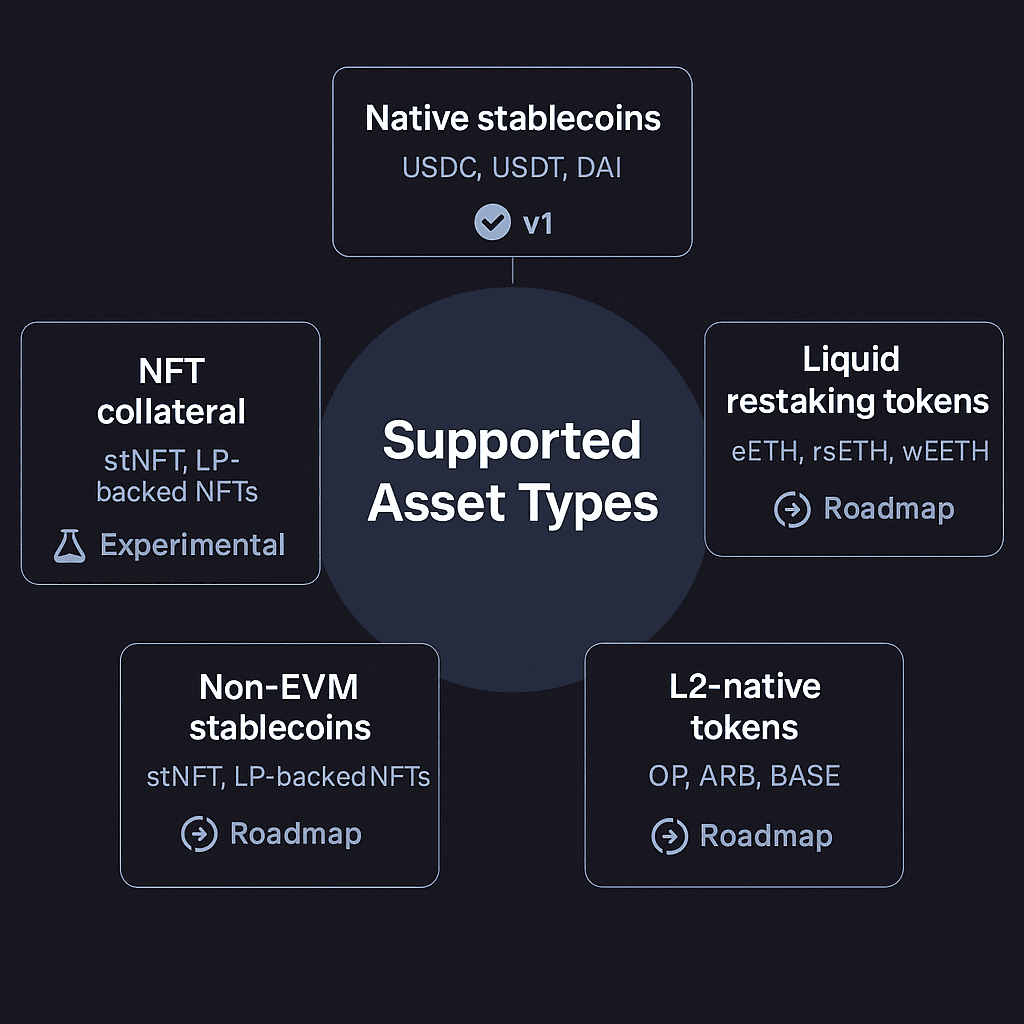
Support is rolled out in phases, balancing technical maturity, oracle availability, and systemic risk considerations. The goal is not just to support more tokens, but to ensure that each collateral type is risk-modelled, accurately priced, and resilient under stress scenarios like liquidations or rapid market movement.
Below is a breakdown of the collateral types, examples, and their current or planned support status:
| Asset Type | Example Tokens | Support Status |
|---|---|---|
| Native Stablecoins | USDC, USDT, DAI | ✅ v1 |
| Liquid Staking Tokens | stETH, rETH, mLSD | ✅ v1 |
| Liquid Restaking Tokens | eETH, rsETH, weETH | 🔄 Roadmap |
| L2-native Tokens | OP, ARB, BASE | 🔄 Roadmap |
| Non-EVM Stablecoins | USDC (Solana), UXD | 🔄 Roadmap |
| NFT Collateral | stNFTs, LP-backed NFTs | 🧪 Experimental |
TradeView is committed to a multi-asset collateral future that mirrors the evolving diversity of the DeFi ecosystem. Early support focuses on the most liquid and composable assets (e.g., USDC, stETH), while the roadmap includes more sophisticated assets like restaking derivatives, L2-native governance tokens, and even NFT-based wrappers tied to underlying yield-bearing strategies or DAO vaults.
Support for each asset type is not just a technical integration- it includes Oracle pipelines, risk scoring models, LTV calibration, and liquidation pathing. This ensures that TradeView’s capital layer is both highly usable and inherently stable.
As new primitives mature, including EigenLayer points-based assets, Solana-native stablecoins, or LP NFTs with composable rights, TradeView will continuously evolve its collateral adapters and risk engines to bring them into the marginable universe, while maintaining system solvency and performance guarantees.
3.6.4 Collateral Optimization Engine
Collateral support is only half the equation. To maximize efficiency while maintaining systemic safety, TradeView introduces a dynamic Collateral Optimization Engine, a smart contract-based framework that continuously evaluates each asset’s margin utility across risk, volatility, and systemic exposure.
Unlike traditional DEXs that apply static margin ratios across all supported tokens, TradeView uses asset-specific scoring logic that adapts in real time. This allows for differentiated treatment of low-risk and high-risk assets, enabling capital to be used more intelligently.
- Multi-Factor Collateral Evaluation
Every collateral asset is scored based on a matrix of parameters:
-
*Volatility & Correlation Metrics* Assesses how violently the asset moves and whether it's correlated with major pairs (e.g., ETH, BTC, USDC). Lower correlation with core trading pairs increases haircut severity.
-
*Liquidity Depth & Oracle Granularity* Measures how deep on-chain and off-chain liquidity is, and whether reliable, tamper-resistant oracles exist with sufficient update frequency.
-
*Historical Drawdown Risk* Captures black-swan scenarios or flash crash behavior to determine potential systemic contagion during sharp moves.
-
*Chain Latency & Finality Lag* For cross-chain assets, how quickly the external chain confirms messages and how final the proofs are impact real-time solvency enforcement.
- What the Engine Controls
The scoring system is then used to dynamically adjust the following parameters:
| Parameter | Description |
|---|---|
| Max Leverage per Asset | Sets maximum allowable leverage. e.g., stETH might offer 8x, while an LP NFT may offer only 2x. |
| Haircut Ratio | Reduces the notional value of volatile or illiquid assets. e.g., $100 of a token may only count as $75 for margin. |
| Liquidation Buffer | Adjusts how early liquidations are triggered, based on asset risk. Higher risk = larger safety margins. |
| Auto-Borrow Access | Determines which assets can be auto-borrowed against, and at what utilization levels. |
| Rehypothecation Eligibility | Flags whether an asset can be reused as backing in protocol-native vaults or hedging engines. |
- Adaptive & On-Chain by Design
Importantly, the optimization logic is:
-
Fully Transparent: All scores, thresholds, and changes are visible on-chain.
-
Governable: Parameters can be adjusted via DAO proposals or protocol governance votes.
-
Composable: External protocols can query the scoring system to build on top of TradeView’s collateral models, including structured products, lending vaults, or ETF-like wrappers.
Why It Matters
In a world of volatile, multi-chain assets, collateral isn't static. Market regimes, price behavior, and liquidity conditions constantly shift. The Collateral Optimization Engine allows TradeView to:
-
Avoid overexposure to thin or manipulated assets
-
Provide higher capital efficiency to well-behaved assets
-
Incentivize users to deposit high-quality collateral
-
Automatically adapt margin profiles without manual upgrades
This transforms TradeView from a passive trading platform into an active capital allocator, safeguarding the system while maximizing utility across users and assets.
3.6.5 What TradeView Enables: Collateral Composability
In most trading platforms, collateral is a static prerequisite — locked, non-earning, and system-specific. TradeView breaks away from this legacy approach by turning collateral into an active, composable layer that fuels capital efficiency, strategy automation, and risk-aware trading across chains and asset classes.
TradeView transcends the role of collateral as a backend feature and makes it a strategic foundation for the next generation of DeFi.
From Passive Capital to Coordinated Liquidity
TradeView’s composability engine redefines how margin interacts with the broader DeFi ecosystem. Rather than siloing deposits into an isolated risk pool, TradeView enables the protocol and users to compose, analyze, and route capital dynamically, all with real-time guarantees and fully on-chain auditability.
This allows for a fluid capital base that adapts to market conditions, user goals, and evolving protocol mechanics.
Key Enablers
A. Real-Time Collateral Accounting
Every deposit, withdrawal, and margin adjustment is captured at the block level. This ensures:
-
Zero sync lag between user intent and protocol state.
-
Deterministic solvency tracking, even under volatility spikes.
-
Instant eligibility updates for position sizing, liquidation risk, or cross-margin effects.
TradeView treats each margin movement as a capital signal, not just a transaction.
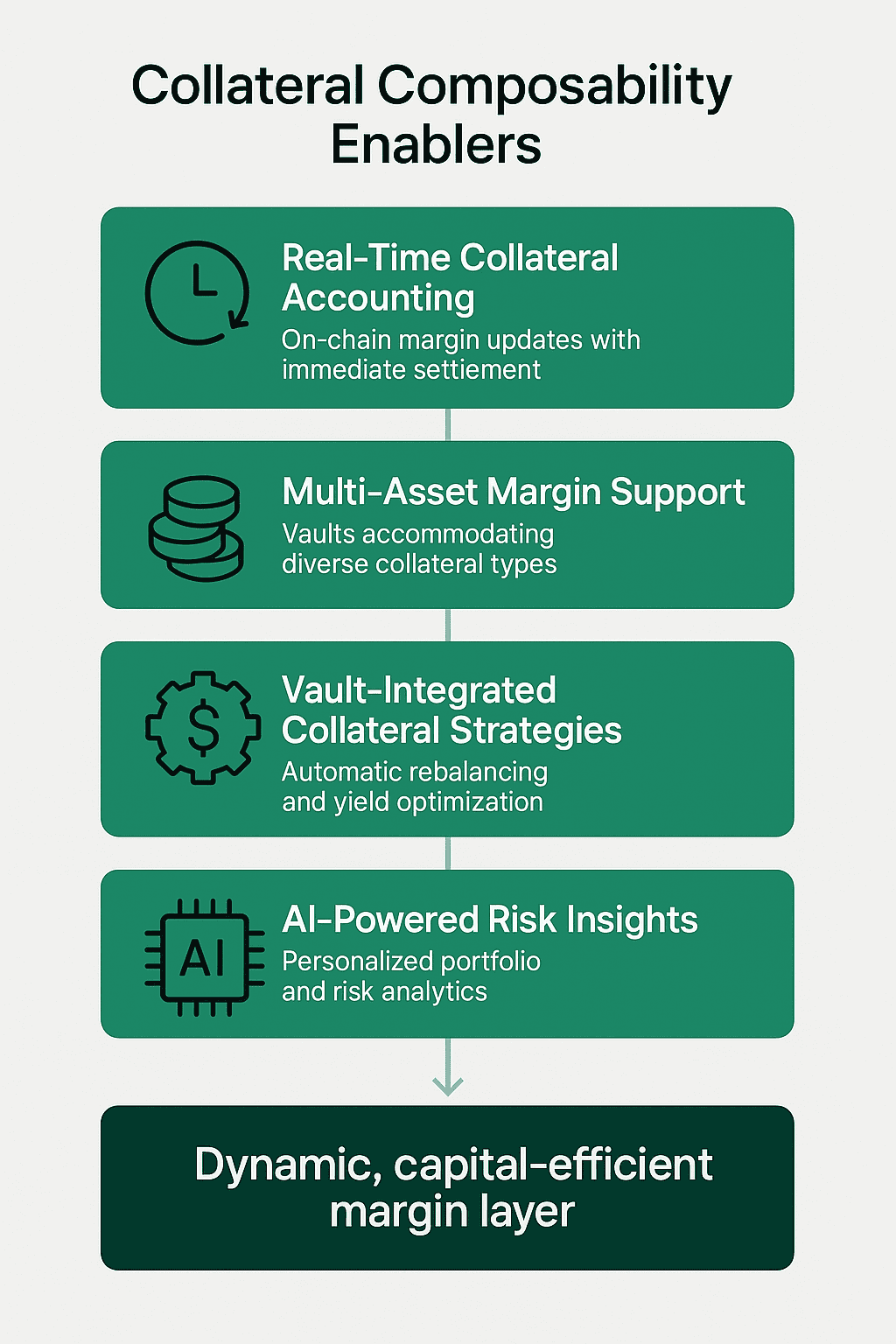
B. Multi-Asset Margin Support
While TradeView will launch with USDC as the primary margin asset, its architecture is built for extensibility:
-
Native support for ETH, stETH, rETH, and other LSTs.
-
Modular vaults that accept LP tokens, Curve gauges, and restaking assets with dynamic LTV models.
-
No need to pre-swap or wrap tokens into a single format.
This flexibility caters to the real-world behavior of traders and vault operators who hold diverse assets and don’t want to convert capital just to access margin.
C. Vault-Integrated Collateral Strategies
Unlike legacy DEXs, where deposited collateral sits idle, TradeView enables smart strategy layering directly on top of user margin:
-
Rebalance between yield farming, delta-neutral hedging, or funding optimization automatically.
-
Plug-in modules that optimize for APY vs. margin exposure per user-defined thresholds.
-
Strategy vaults that auto-migrate user capital between collateral types to maximize efficiency.
These strategies are opt-in, composable, and transparently governed — no hidden vault logic or off-chain bots.
- AI-Powered Risk Insights
Collateral optimization is only valuable if users understand its impact. TradeView provides:
-
Personalized dashboards with real-time liquidation probabilities, volatility impact scores, and portfolio fragility metrics.
-
Funding-aware projections that estimate carry cost or yield drift across positions.
-
Alerts for cross-collateral contagion, helping users avoid unexpected correlation blowouts during market stress.
This risk layer turns abstract margin ratios into actionable intelligence, even for non-technical users.
Collateral as a Dynamic Asset Layer
In TradeView, margin isn’t just a back-office requirement. It’s:
-
A programmable capital base.
-
A yield-generating portfolio substrate.
-
A risk-managed signal for AI-driven optimization.
-
A building block for vaults, ETFs, and structured financial products.
This approach unlocks new classes of DeFi participants — from LST holders and DAO treasuries, to vault strategists and institutional liquidity providers.
Outcome: A Capital-Efficient, Composable Margin Layer By combining real-time settlement, diverse asset onboarding, intelligent strategies, and modular governance, TradeView transforms collateral from a silo into an on-chain liquidity protocol of its own — one that is: - **Instantly responsive, ** - **Strategically deployable, ** - Composable with the broader ecosystem In this new paradigm, margin becomes a growth vector, not a constraint. And composability isn’t an add-on — it’s the default.
3.6.6 Native Token Utility in Collateral Management
In most DeFi platforms, the native token is treated as a governance or fee-discount vehicle, isolated from the actual trading or collateral processes. TradeView departs from this convention by embedding its native token directly into the core risk and margin systems, giving it real utility without compromising platform security or fairness.
A. Tiered Collateral Utility Based on Token Role
The native token is not universally accepted as collateral by default. Instead, TradeView introduces a tiered framework:
- Direct Margin Use (with Risk Haircut):
In later phases, users may post the native token as part of their margin, subject to dynamic haircut ratios based on volatility and on-chain liquidity.
- Staked Token Collateralization:
Users staking their native tokens to validators or protocol modules may unlock collateral multipliers or gas fee discounts, aligning network security participation with capital utility.
- Locked Token Collateral in Vaults:
Long-term holders can allocate native tokens into smart contract vaults that:
-
Earn staking or protocol fees,
-
Act as a safety reserve for liquidations or insurance,
-
Offer limited margin collateralization with circuit breakers.
This layered model ensures that speculative exposure to the native token is offset by structured constraints, preventing systemic risk from overleveraged native-asset margin.
B. Strategic Roles Beyond Margin
- Insurance Fund Participation:
A portion of native tokens, either from treasury, stakers, or opt-in pools, can be reserved as a backstop layer. This may be tapped during black swan events to cover bad debt or system imbalances, improving long-term solvency trust.
- Governance-Gated Risk Parameters:
While base collateral logic remains deterministic and on-chain, native token holders may vote on:
-
New collateral asset approvals,
-
Haircut tiers and leverage limits for non-stable collateral,
-
Insurance fund refill thresholds.
- Cross-Module Utility:
The token may be used to access or incentivize:
-
Early liquidation rights (priority queues),
-
Cross-chain relayer subsidies,
-
Vault creation rights for advanced structured products.
C. Why This Matters
Native tokens often suffer from one of two extremes: either they are over-financialized and fragile, or underutilized and speculative. TradeView avoids both by building native utility that is:
-
Modular: Can be tuned or phased without rewriting protocol logic.
-
Optional: Not a requirement for trading or onboarding, avoiding exclusion.
-
Functional: Anchored to collateral behavior, not just speculation.
This creates a healthy, demand-driven token economy where utility arises from platform usage, not just price movement.
3.6.6 Outcome: Unified Capital Across Chains
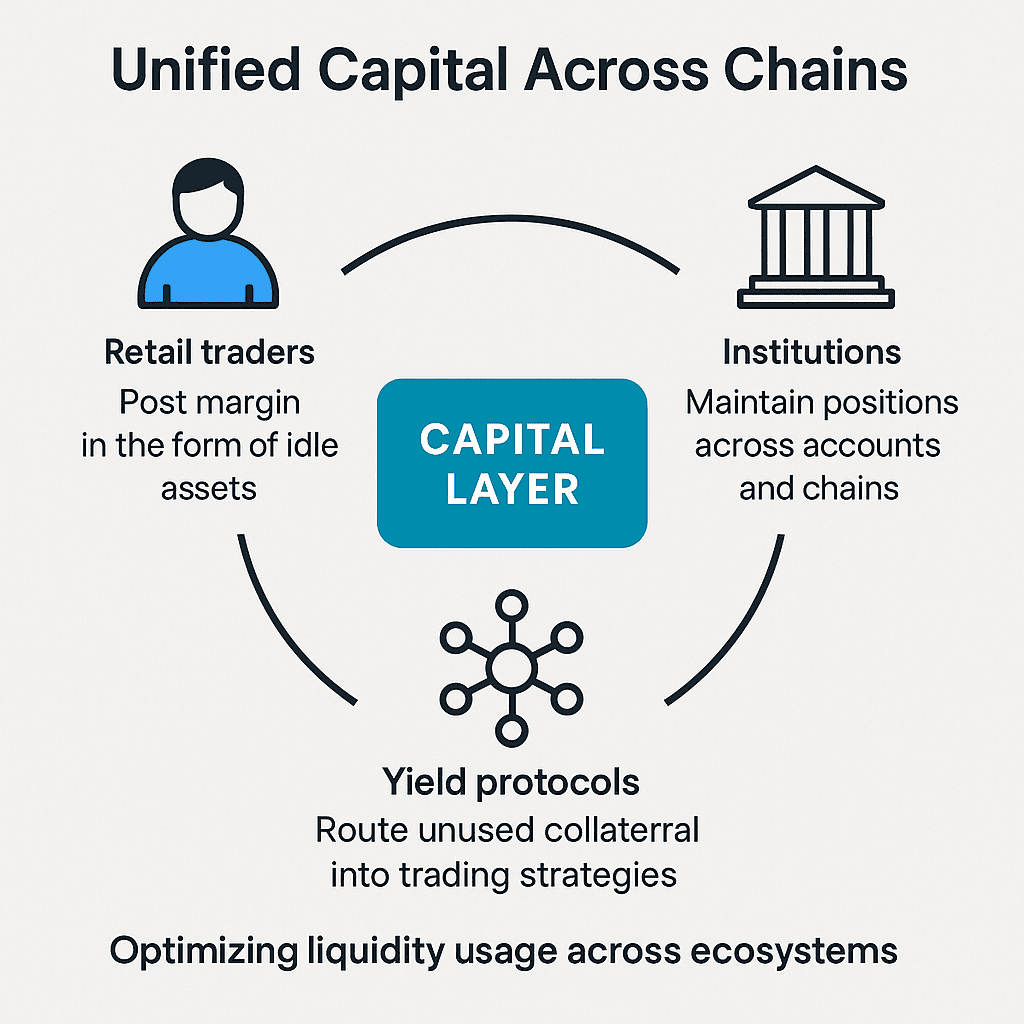
TradeView’s cross-chain collateral model redefines how liquidity flows across the decentralized ecosystem. Instead of forcing users to migrate assets, sacrifice yield, or juggle fragmented wallets, the system abstracts complexity behind a seamless layer of smart contracts and real-time settlement logic. This architectural shift unlocks capital efficiency and trading optionality in ways legacy perpetual platforms simply cannot replicate.
🔹 For Retail Traders
Retail users no longer need to move assets across bridges or convert tokens to meet margin requirements. They can:
-
Use staked assets like stETH as margin without forfeiting staking yield.
-
Avoid exposure to bridge risk and transaction friction.
-
Participate from any chain without having to become a multi-wallet expert.
This drastically lowers the barrier to active participation, enabling more users to tap into high-performance perpetual trading with the assets they already hold, on the chain they already use.
🔹 For Yield and Vault Protocols
Collateral is no longer passive. Vault-based DeFi protocols can:
-
Leverage idle TVL as active trading margin, creating new yield layers for depositors.
-
Route liquidity into leveraged strategies without moving funds out of the ecosystem.
-
Access liquidation-safe, margin-optimized interfaces via TradeView’s canonical vaults and adapters.
This transforms yield protocols into capital coordinators, giving them composable hooks into one of the most efficient trading engines in DeFi.
🔹 For Institutions and Funds
Institutional desks operating across multiple wallets and chains benefit from:
-
Consolidated margin accounting across fragmented portfolios.
-
Automated risk boundaries, even for remote assets under trustless custody.
-
Transparent reporting and auditability via on-chain collateral proofs and unified liquidation logic.
This reduces operational overhead and enables more sophisticated multi-chain strategies with centralized-style UX, without sacrificing decentralization or custody.
TradeView’s collateral layer is not a side feature — it’s a core advantage. By turning isolated, idle, or risk-averse capital into fluid, margin-eligible liquidity, TradeView unifies the fractured DeFi capital base under a single performance-driven protocol. This convergence of yield, composability, and safety transforms TradeView from a trading venue into a full-stack capital layer for on-chain finance.
3.7 Token Utility and Ecosystem Governance
At the heart of TradeView's architecture lies its native token, a utility-driven asset that underpins everything from gas fees and network security to incentive alignment and long-term governance. Unlike speculative tokens with narrow utility, Tradeview’s native token is engineered to operate as the cohesive economic engine of the platform, reinforcing performance, decentralization, and adaptability.
3.7.1 Native Token as the Core Economic Layer
TradeView's Native Token is not a passive asset or speculative placeholder. It is a programmable, multi-dimensional instrument woven into the infrastructure of the platform. From securing the blockchain to powering day-to-day user operations, it acts as the underlying fuel, policy layer, and coordination mechanism that sustains TradeView’s decentralized and high-performance ecosystem.
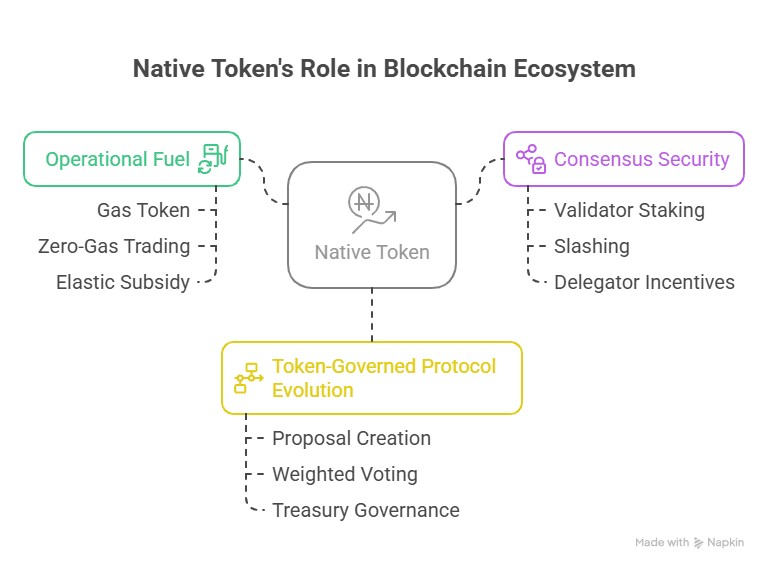
A. Operational Fuel for the Layer-1 Chain
Unlike monolithic Layer-1s, where gas costs can spike with congestion, TradeView is optimized for predictable, low-cost usage:
-
Gas Token for System Transactions: While trading is designed to be gasless, all other system operations, including collateral deposits, withdrawals, vault interactions, and governance votes are powered by the native token.
-
Zero-Gas Trading Model: Inspired by CEX-like UX standards, trading interactions (placing orders, modifying stops, executing strategies) are either gas-free or heavily subsidized by the protocol. This ensures cost consistency for retail and institutions alike without degrading decentralization.
-
Elastic Subsidy System: Gas fees are optionally underwritten by treasury mechanisms, such as token inflation or governance-approved incentive budgets, allowing for dynamic tuning of network costs to support growth and adoption.
This system ensures that usability and decentralization are not at odds — the token acts as a gas asset where needed, without becoming a barrier to high-frequency participation.
B. Consensus Security via Proof-of-Stake and Slashing
TradeView uses a Tendermint-based Proof-of-Stake (PoS) consensus, and the native token is critical for its security architecture:
-
Validator Staking: Validators are required to stake a significant amount of TradeView's Native Token to participate in consensus. This stake ensures that validators are economically incentivized to prioritize network uptime, performance, and fairness.
-
Slashing for Misbehavior: Validators that engage in malicious actions (e.g., double-signing, liveness failures, or censorship) face punitive slashing, which burns part of their staked TradeView's Native Token. This mechanism strengthens the chain’s fault tolerance and punishes dishonest behavior.
-
Delegator Incentives: Non-validator users can delegate their tokens to validators and share in the rewards. This expands the security footprint and aligns long-tail stakeholders with network health.
With economic skin in the game for all validator participants, TradeView's Native Token transforms from just a governance asset into a security primitive underpinning network consensus.
C. Token-Governed Protocol Evolution
In most DeFi ecosystems, governance is either inaccessible, ignored, or centralized. TradeView flips that narrative by embedding the native token as the primary channel for decentralized protocol direction:
-
Proposal Creation and Voting Rights: Holders of TradeView's Native Token can table and vote on improvement proposals (TIPs), covering every aspect of the protocol, including fee structures, new market launches, collateral listings, vault rules, and incentive programs.
-
Weighted Voting with Delegation Support: Stake-based voting is enhanced through delegation mechanics, allowing passive holders to entrust votes to active participants without forfeiting custody.
-
Treasury Governance: Community governance extends to the protocol treasury, determining emission schedules, incentive campaigns, and ecosystem grants.
In short, the TradeView's Native Token transforms community members from users into stewards, actively shaping the roadmap and financial scaffolding of the protocol they participate in.
Why It Matters
The multi-utility nature of TradeView's Native Token ensures that TradeView’s most fundamental operations — performance, trust, and innovation — are not outsourced or centrally managed. Instead:
-
Execution is subsidized where it matters most
-
Security is enforced by economic accountability
-
Token-aligned participants decide on upgrades
This alignment of economic utility with governance and security principles ensures TradeView remains autonomous, scalable, and user-owned, even as it expands across chains, products, and user bases.
3.7.2 Incentives and Ecosystem Flywheel
The TradeView native token is not just a governance or staking asset. It serves as the fuel for an incentive-driven flywheel that encourages platform usage, expands liquidity, strengthens community engagement, and reinforces long-term ecosystem growth. Every interaction with the platform, from trading to referrals to loyalty, is designed to produce reciprocal value and stimulate healthy network activity.
A. Trading Rewards: Volume-Based Loyalty Programs
In order to bootstrap liquidity and incentivize consistent trading behavior, TradeView implements a performance-aligned rewards system:
-
Volume-Based Rebates: Traders who hit certain volume thresholds over time may receive TradeView’s native tokens as rebates, essentially converting part of their fees into ownership or utility.
-
Competition-Driven Distribution: During trading competitions or market-making initiatives, top-performing or consistent traders can earn token rewards based on leaderboard positions.
-
Strategy-Based Participation: Specific order types (e.g., TWAP/VWAP execution, conditional liquidity provisioning) may qualify for bonus rewards, encouraging smart trading behavior.
This model drives stickiness — rather than temporary incentives, it encourages users to build and grow their trading footprint over time while participating in the token economy.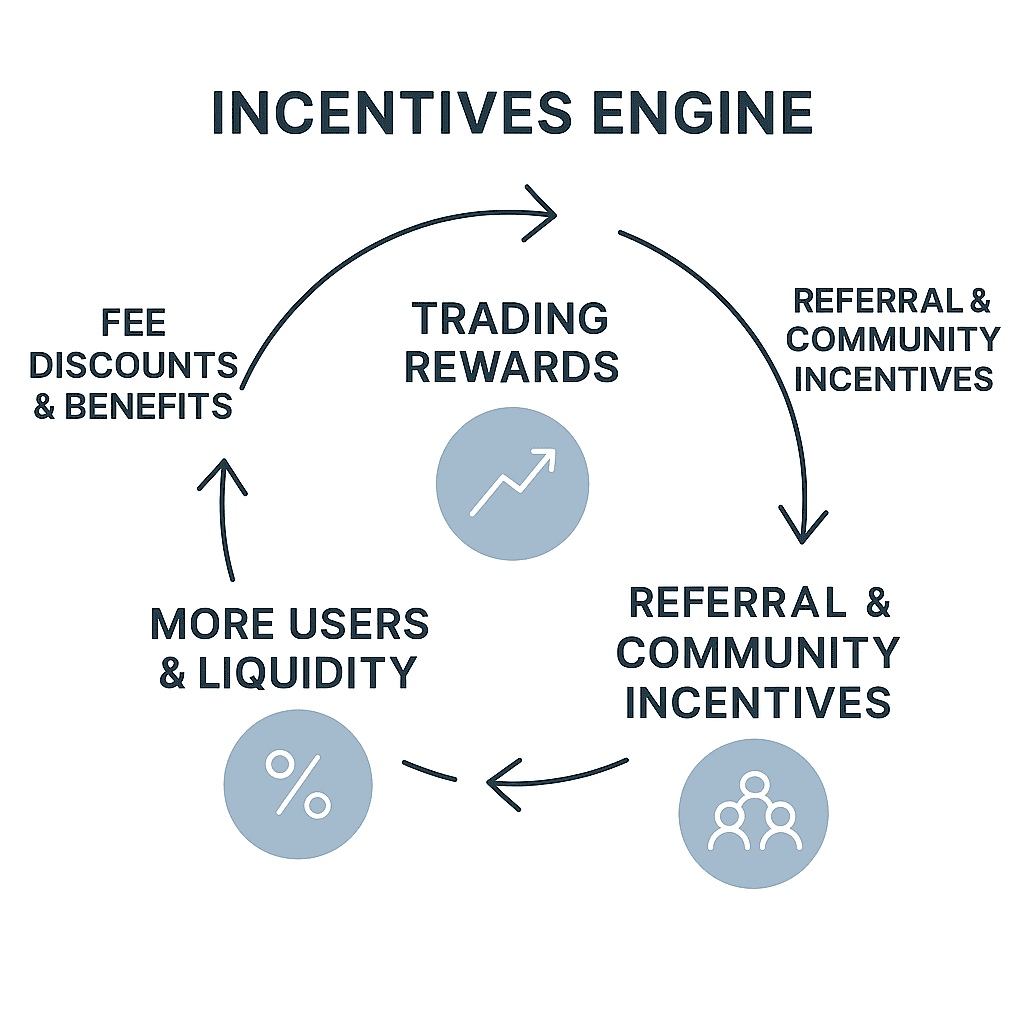 B. Referral, Affiliate, and Community Incentives
Growth doesn’t come from infrastructure alone. It’s driven by community, creators, and advocates. TradeView's token plays a central role in decentralized user acquisition:
-
Referral Tracking Infrastructure: Every new user or trader brought in through an invite link or code can be tied to the original referrer, with both parties rewarded in TradeView’s native token.
-
Affiliate Campaigns: Larger communities, social influencers, or DAOs can plug into the protocol’s affiliate modules, earning token-based payouts based on verified referrals, TVL, or trading milestones.
-
Programmatic Distribution: Through on-chain bounties and quest-like challenges, users can earn tokens for achieving platform goals, such as onboarding a cohort, testing features, or engaging with new assets.
This breaks the reliance on centralized marketing and empowers the ecosystem to grow itself, organically and cost-effectively.
C. Fee Discounts, Tiered Access, and User Benefits
Holding and using the native token offers tangible benefits to end-users, not as an abstract utility, but through meaningful privileges:
-
Progressive Fee Discounts: Users with sufficient TradeView’s native token balances unlock lower trading fees across tiers, reducing effective trading costs and encouraging token retention.
-
Priority Access: Token holders may get early access to beta features, new market launches, or experimental vaults, creating a privileged layer of product exposure.
-
Governance Weight Multipliers: In the future, longer-term holders or stakers of TradeView’s native token may receive voting power multipliers or visibility boosts in governance proposals, reinforcing alignment between contribution and control.
This aligns economic incentives with participation, rewarding not just those who speculate but those who actively use and improve the protocol.
Why It Matters: From Tokenomics to Ecosystem Momentum
TradeView’s token incentive system is more than just a distribution tool — it’s a flywheel that creates:
-
User Retention: Trading and holding the token leads to lower costs, better access, and competitive advantages, reinforcing platform stickiness.
-
Organic Growth: Community-led acquisition replaces traditional advertising, lowering CAC while boosting trust.
-
Liquidity Expansion: More rewards = more traders = more liquidity, which in turn enhances execution quality and draws in new users, completing the loop.
This is how a trading venue evolves into an economic network — one where every user, whether trader, promoter, or developer, is rewarded for their role in the ecosystem’s growth.
3.7.3 Future-Ready Utility Expansion
TradeView’s native token is not confined to its present roles in gas, staking, or governance. It is designed to evolve as the protocol matures and new economic primitives emerge. With a flexible token architecture and programmable integration layers, its future utility is not a speculative promise but an engineered trajectory. The token is positioned to expand across three high-leverage verticals:
1. Collateral Eligibility for Trading and Vaults
As TradeView’s collateral engine becomes more sophisticated, the native token will be integrated into the margin system as a risk-tiered collateral type. Unlike stablecoins or LSTs, the token’s endogenous volatility will be accounted for using:
-
Haircuts based on liquidity, volatility, and on-chain usage
-
Dynamic LTV (Loan-to-Value) ceilings are determined by market conditions
-
Real-time oracle feeds to assess fair market value and funding sensitivity
This allows traders to:
-
Post margin without liquidating core token holdings
-
Unlock leverage against governance-aligned assets
-
Participate in the platform’s upside while remaining capital-efficient
For vault designers, this also introduces new strategy primitives — such as dual-token hedged positions, LP-style exposure using native-token + stables, or collateral-boosted structured products.
2. Insurance Fund Participation and Circuit-Breaker Role
To mitigate protocol-level risks such as mass liquidations or oracle anomalies, TradeView may activate a system-level insurance fund partially denominated in its native token. This backstop mechanism serves two roles:
-
Liquidity Reserve: In black swan scenarios, a portion of the insurance fund can absorb short-term insolvencies.
-
Seigniorage-Driven Recapitalization: If the fund is depleted, an emergency governance vote could authorize controlled minting of the native token to recapitalize it, used only under extreme systemic stress.
This creates a safety net that enhances:
-
User confidence during volatility
-
Protocol durability in long-tail edge cases
-
DeFi-native risk frameworks without reliance on external bailouts
It aligns with the long-term goal of TradeView becoming a sovereign, self-stabilizing trading infrastructure.
3. Vault Access and Governance-Layer Integration
As TradeView introduces structured vaults, social trading pools, and algorithmic strategies, the native token could serve as an access and coordination layer for:
-
Participation tokens: Certain advanced vaults may require staking the native token to enter, mirroring how DAO-managed funds gate access.
-
Strategy voting rights: Token holders might influence how vaults rebalance, update allocation rules, or rotate strategies.
-
Reward alignment: Vaults could distribute boosted yield or incentives to users who stake both stable collateral and the native token.
This elevates the token from a passive governance asset to a participatory capital coordination primitive, powering decentralized strategy networks that grow beyond the core UI.
While Tradeview’s native token is already deeply embedded in core protocol mechanics, its roadmap utility introduces long-term extensibility:
-
Collateral Eligibility: Tradeview’s native token may be used as margin with risk-adjusted haircuts, enabling traders to retain exposure while unlocking liquidity. This use case integrates the token into the same collateral optimization engine used for stablecoins, LSTs, and LP assets.
-
Insurance Fund Backstop: In extreme volatility scenarios, Tradeview’s native token may be programmed to serve as a backstop asset for protocol-level risk absorption. While not active by default, this circuit-breaker mechanism provides systemic resilience and investor assurance.
-
Vault Utility: As TradeView introduces permissionless vaults and structured strategies, TradeView’s native token could be accepted as a participation token or governance layer, enabling users to stake in thematic strategies or algorithmic funds.
| TradeView’s native token is engineered not just for transactional or security utility, but to evolve into a dynamic coordination asset — one that links trading, governance, risk management, and capital markets into a unified ecosystem. Its future utility isn't speculative hype; it's embedded in the protocol's DNA. |
|---|
3.7.4 Governance That Evolves With the Ecosystem
TradeView’s governance is designed not as a static checklist of features, but as a living coordination layer that adapts to the evolving complexity of its ecosystem. Unlike traditional DeFi governance, which often suffers from apathy, low voter turnout, or capture by a few whales, TradeView embeds progressive governance logic into its native infrastructure, enabling community-driven evolution without sacrificing security or operational clarity.
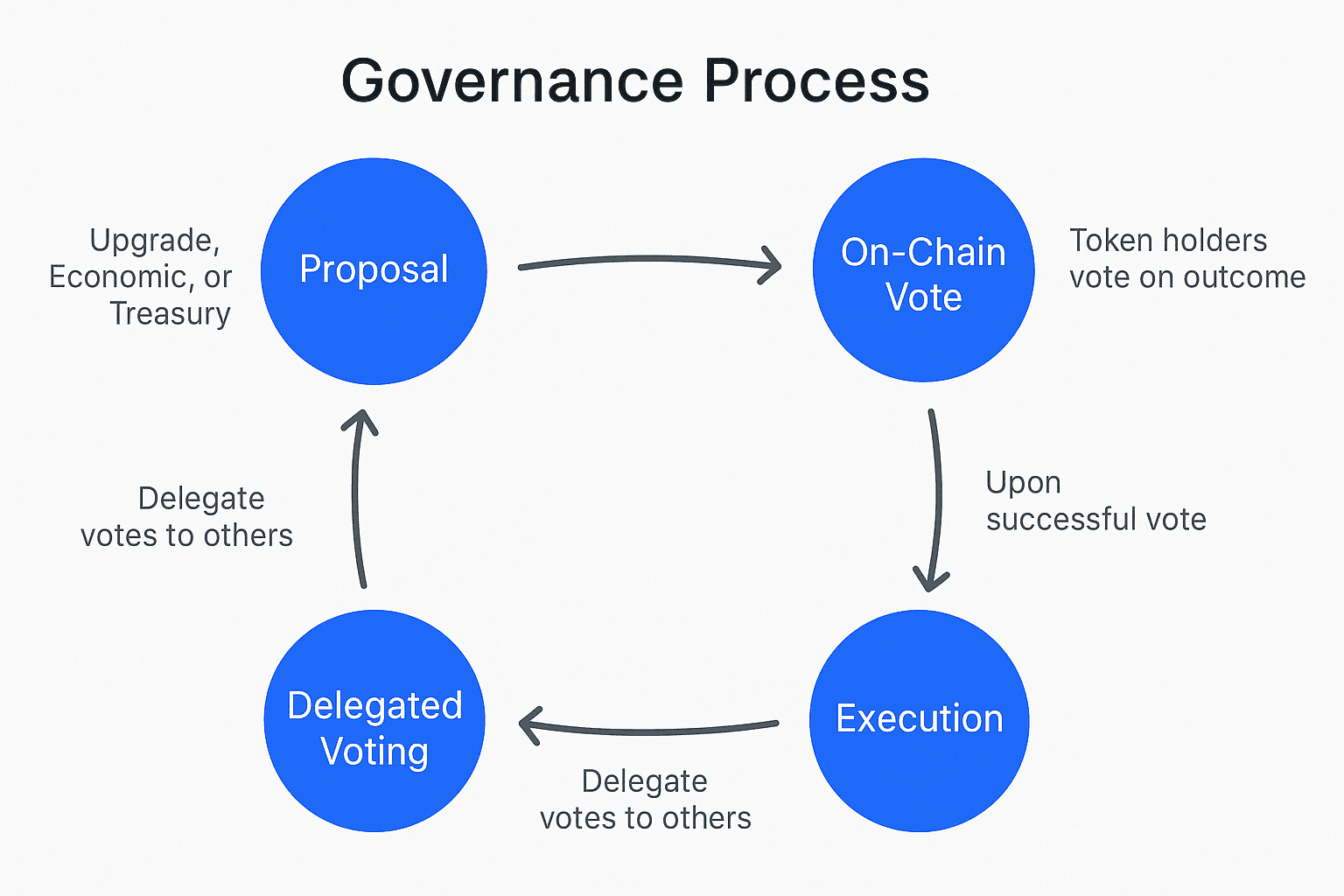
- Governance is a Mechanism of Direction, Not Decoration
At its core, governance on TradeView enables token holders to participate in the stewardship of the protocol. But it goes far beyond simple parameter toggling:
-
Upgrade Proposals: Community-driven proposals can initiate upgrades to core protocol logic, such as adding new perpetual markets, updating risk parameters, or modifying execution rules.
-
Economic Adjustments: Governance can approve or adjust emission schedules, staking rewards, fee rebates, or insurance fund policies, maintaining long-term equilibrium and sustainability.
-
Treasury Allocation: Token holders can vote on treasury deployments — including grants to ecosystem tools, liquidity incentives, or infrastructure partnerships — ensuring that capital is used to grow protocol value.
This approach transforms TradeView into a self-correcting system, capable of adapting without centralized gatekeepers.
- Delegated Voting & Participation Pools
Recognizing that not all token holders are active or technical enough to vote directly, TradeView supports:
-
Delegated Governance: Token holders can delegate their voting power to trusted representatives or governance pools, allowing informed actors to act on their behalf.
-
Meta-Governance Wrappers: Vaults, DAOs, or structured governance funds can aggregate user voting rights and signal outcomes based on community alignment or pre-defined strategies.
This architecture creates a governance structure that is both representative and scalable, preventing capture by inactive holders or short-term traders.
- Validator Accountability and Emission Transparency
TradeView also brings validator behavior and system-level emissions into the governance surface:
-
Slashing and Behavior Audits: Validators can be monitored and challenged via on-chain reports, with misbehavior triggering slashing or removal proposals.
-
Real-Time Emission Tracking: All token emissions, staking rewards, and treasury spend are tracked on-chain and auditable in real time, allowing governance to act based on verifiable metrics rather than vague roadmaps.
This transparency ensures that TradeView operates not just as a decentralized system, but as a trustworthy and auditable economic machine.
In Summary TradeView’s governance isn’t a side module — it is the engine through which the protocol adapts, allocates, and evolves. Token holders are not passive investors but co-architects of the system, empowered with real tools to steer outcomes. As the platform matures — from perpetual trading to collateralized vaults, to structured DeFi products — the governance system is built to scale alongside it.
3.7.5 Outcome: A Sustainable, Incentive-Aligned Economy
TradeView’s native token transforms from a simple utility asset into the keystone of a resilient, high-performance trading ecosystem. Every element from execution, governance, staking, to user incentive, is anchored by a unified economic design that prioritizes sustainability, alignment, and programmability.
At its core, this isn’t just about decentralization — it’s about building economic interdependence across user classes:
-
Traders benefit from zero or near-zero gas fees, access to discounts, and the ability to use the token as margin, improving capital efficiency and lowering barriers to high-frequency activity.
-
Validators and Delegators receive meaningful, long-term staking yields that directly tie their financial incentives to the platform’s uptime, security, and throughput.
-
Governance Participants — whether individual holders or DAO-like collectives — actively shape the protocol’s future through proposals that have tangible downstream effects: fee changes, asset listings, treasury allocations.
-
Institutions and Protocol Integrators see predictability in fee logic, settlement, reward structures, and strategic programmatic alignment, all enforced through open smart contracts and transparent tokenomics.
More importantly, value doesn’t leak. Traditional DeFi models often rely on external incentives or siloed governance tokens that serve one function (voting, perhaps) but fail to reinforce the full lifecycle of protocol health. TradeView’s token does the opposite — it creates a closed-loop economy where:
-
Usage drives utility.
-
Utility feeds governance.
-
Governance shapes policy.
-
Policy impacts participation.
-
Participation fuels growth.
This creates what can only be described as a “flywheel economy” — where the native token plays every key role, but does so under sound risk controls, non-inflationary design principles, and transparent reward mechanics.
Ultimately, TradeView’s token economy isn’t just a mechanism — it’s a manifestation of the protocol’s ethos: inclusive, high-performance, secure, and co-governed. The result is not just a DEX, but a programmable economic layer for perpetual trading — one where stakeholders don’t just use the system, they become a part of it.