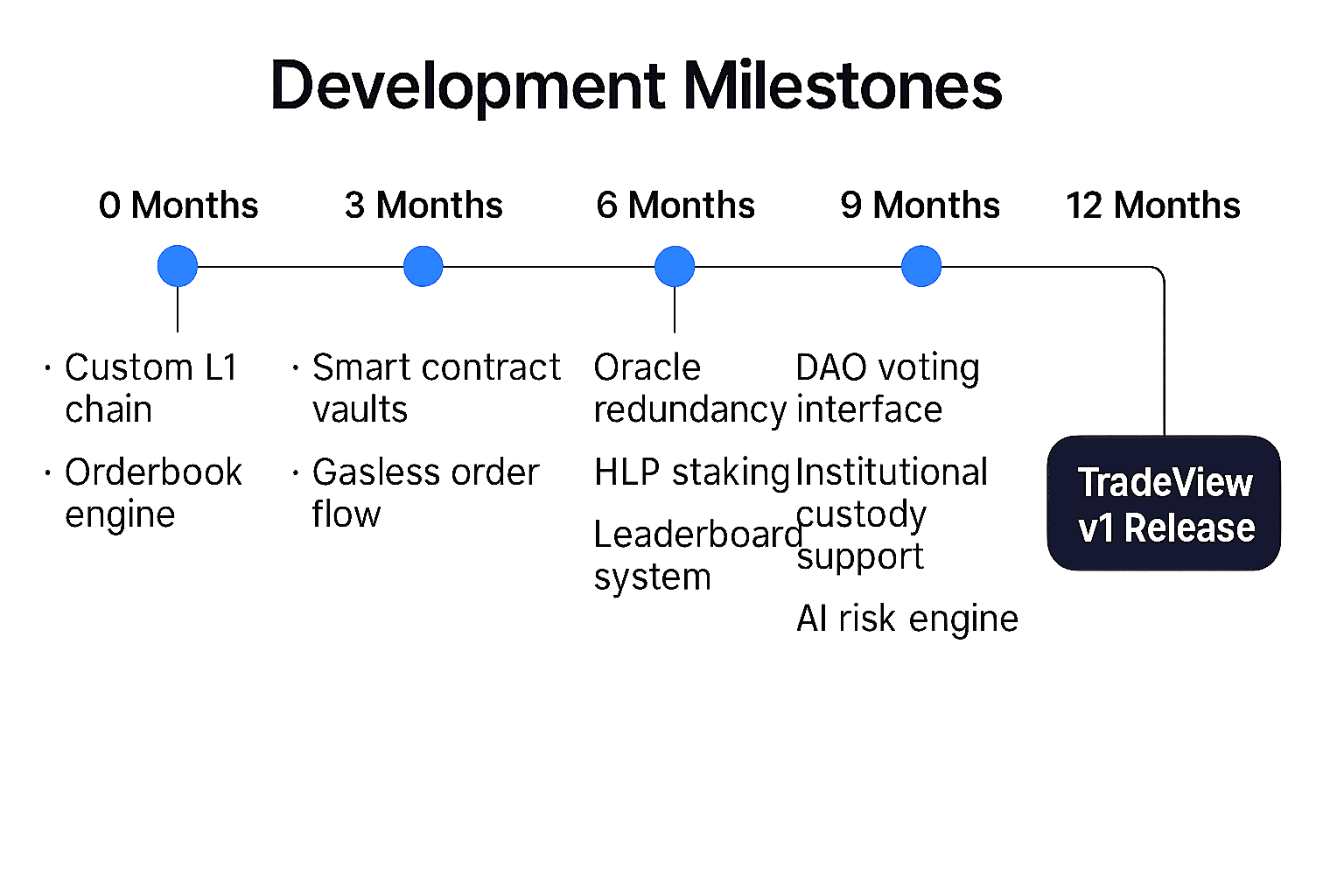












TradeView’s roadmap is structured around delivering a robust, on-chain perpetual trading platform with progressive decentralization, modular feature rollouts, and strong community handoff. The timeline balances technical rigor with user-first milestones, ensuring core functionality is delivered early while reserving advanced modules for agile iterations post-launch.
17.1 Development Timeline (6 / 9 / 12 Months)
TradeView follows a phased development roadmap structured around three key objectives: functional reliability, user accessibility, and market scalability. The timeline reflects how the protocol transitions from a secure core foundation to a fully operational, DAO-governed trading ecosystem equipped with advanced tools and institutional-grade access.
Each milestone in this timeline is not just a technical step—it’s a signal of increasing protocol maturity, ecosystem trust, and monetization potential. Below is a detailed breakdown:
- Phase I: Foundation (0–6 Months): Core Protocol & L1 Deployment
| Milestone | Description |
|---|---|
| Custom L1 Chain Live | Genesis of TradeView Layer-1 powered by Tendermint BFT; testnet validators onboarded. |
| On-Chain Orderbook Engine | Deterministic matching, order persistence, vault-compatible settlement layer. |
| Smart Contract Vaults (MVP) | Vault deployment, copy logic, slippage config, and follower sync. |
| Gasless Trading via Meta-Tx | Relayer network and EIP-712 signing for wallet-agnostic UX. |
| TradeView's Native Token Token Launch & Staking | Emission logic, validator bonding, and delegation contract release. |
| Initial Oracle Integration | Pyth & TWAP logic for BTC/ETH/USDC pairs. |
This phase establishes the bedrock infrastructure—custom Layer-1 blockchain, on-chain trading engine, and core vault logic.
-
*Custom L1 Chain Live* Launching the proprietary Layer-1 gives TradeView full control over finality, throughput, and gas economics. Investors should note this enables long-term independence from Ethereum congestion or Layer-2 limitations, positioning TradeView as an L1-native trading protocol with CEX-grade speed.
-
*On-Chain Orderbook Engine* Deploying a deterministic matching engine directly onto the L1 is a rare technical feat—most DEXs outsource this off-chain. This ensures tamper-proof execution, eliminates frontrunning, and supports transparency, which is particularly attractive to institutional traders.
-
*Smart Contract Vaults (MVP)* The vault MVP enables copy-trading strategies with customizable settings like slippage tolerance and fee logic. This unlocks early network effects: creators attract followers, followers get automation, and the protocol starts generating transaction and vault fees.
-
*Gasless Trading via Meta-Tx* Wallet-agnostic UX is crucial for onboarding non-crypto-native users. By covering gas fees using relayers and EIP-712 signatures, TradeView radically lowers friction, especially important in regions where onboarding to Ethereum is cost-prohibitive.
-
*Token Launch & Staking* The launch of TradeView’s native token establishes the governance layer and staking incentives. It initiates protocol ownership distribution and sets up emissions logic that aligns long-term contributors with token value.
-
*Initial Oracle Integration* Integrating TWAP and Pyth oracles for BTC/ETH/USDC is the first step toward robust price feeds. These feed the risk engine, liquidation logic, and funding rate calculations.
Phase II. Feature Expansion & Public Beta: 6–9 Months
| Milestone | Description |
|---|---|
| Vault Marketplace Launch | Leaderboard, ROI filtering, public vault stats, and one-click copy flow. |
| Advanced Order Types | Stop-limit, trailing stop, OCO (one-cancels-other), and iceberg support. |
| Non-Custodial & Email Wallet UX | Session-based key abstraction; onboarding for both retail and institutions. |
| Cross-Chain Collateral Bridges | Ethereum → TradeView bridge for USDC, ETH, and TradeView's Native Token with Wormhole + Axelar. |
| DAO Voting Portal | On-chain proposal system with voting rights tied to TradeView's Native Token staking. |
| Referral & XP Systems | Trading quests, leaderboard badges, and token-based tier access |
This phase expands protocol functionality, broadens the user base, and prepares for DAO governance.
-
*Vault Marketplace Launch* A discoverability layer for vaults is crucial for scaling. Public metrics, ROI filters, and one-click copy flow make TradeView vaults feel like a curated ETF dashboard—appealing to passive investors and DeFi newcomers alike.
-
*Advanced Order Types* The addition of trailing stops, OCOs, and iceberg orders provides traders with tools that are typically CEX-exclusive. This helps TradeView compete with centralized exchanges on UX and strategy granularity.
-
*Non-Custodial & Email Wallet UX* With MPC-based wallets and session abstraction, TradeView blends security with familiarity. Institutional traders and retail users alike can onboard using email without surrendering private keys, making the protocol inclusive and enterprise-ready.
-
*Cross-Chain Collateral Bridges* By integrating bridges like Wormhole and Axelar, TradeView allows USDC, ETH, and native tokens from Ethereum to be used seamlessly on its custom L1. This multiplies capital inflow without forcing users to leave their preferred networks.
-
*DAO Voting Portal* Launching the governance UI formalizes the transition toward community-driven development. Staked token holders can now influence fee models, feature upgrades, and treasury allocation—creating transparent political capital.
-
*Referral & XP Systems* These gamified systems incentivize daily activity, vault creation, and social engagement. They’re particularly powerful for bootstrapping communities and reinforcing long-term protocol usage over one-off trades.
Phase III: Maturity: AI Systems, Institutional APIs & DAO Transition: 9–12 Months
| Milestone | Description |
|---|---|
| AI Risk Management Modules | Portfolio alerts, funding risk warnings, whale tracking dashboards. |
| Token-Gated Premium Access Tiers | Unlock AI tools, creator perks, and analytics overlays via staked TradeView's Native Token. |
| Institutional Onboarding API Suite | Secure API keys, OMS integrations, and sub-account support. |
| Multi-Chain Asset Support | Vaults and collaterals from Polygon, Solana, Arbitrum via cross-chain vault logic. |
| DAO Treasury Control | Treasury budget voting, contributor reward streams, and slashing logic moved to DAO. |
| TradeView v1 Official Launch | Protocol transitions from beta to full launch under DAO governance. |
The final phase transitions TradeView into a scalable, DAO-owned public good with enterprise features and predictive analytics.
-
*AI Risk Management Modules* Advanced dashboards with portfolio alerts, on-chain anomaly detection, and predictive liquidation risk change the game for pro traders. These tools generate high-value engagement and can be monetized via token-gated tiers.
-
*Token-Gated Premium Access Tiers* This introduces utility-based demand for TradeView’s native token. Users must hold or stake tokens to access the most powerful AI tools and dashboards—shifting value accrual from speculative holding to feature-based necessity.
-
*Institutional Onboarding API Suite* Robust APIs with key management and OMS integrations make it viable for trading firms and fintech platforms to plug into TradeView. Sub-account support is a key requirement for institutional asset managers.
-
*Multi-Chain Asset Support* Expanding vault logic to include Polygon, Arbitrum, and Solana allows TradeView to become a true cross-chain platform. This introduces millions in potential TVL from users who prefer alternative ecosystems.
-
*DAO Treasury Control* Handing over treasury functions and grant streams to on-chain governance signals protocol decentralization is complete. Investors should interpret this as a maturity milestone—removing core team dependence.
-
*TradeView v1 Official Launch* The transition from public beta to full DAO-governed deployment marks protocol graduation. At this point, TradeView becomes a self-sustaining, modular infrastructure layer for decentralized trading at global scale.
17.2 TradeView v1 Launch Milestones
These mark the minimum deliverables for the official v1 tag and full decentralization commitment:
| v1 Requirement | Status Target | Notes |
|---|---|---|
| Custom L1 Chain (Mainnet) | ✅ Month 6 | Already validated and audited |
| Orderbook Engine (On-Chain) | ✅ Month 6 | Deterministic and composable |
| Vault Copy Trading with Slippage Guard | ✅ Month 7 | Vaults must meet loss-prevention benchmarks |
| Gasless Meta-Transaction Layer | ✅ Month 6 | Fully wallet-agnostic order submission |
| Oracle Infrastructure (Redundancy) | ✅ Month 8 | Pyth + Chainlink + Internal TWAP |
| TradeView's Native Token Staking + Validator Elections | ✅ Month 6 | Active validator set live |
| Leaderboard & Vault Discovery Portal | ✅ Month 8 | Gamified XP, badges, and trader ranks |
| DAO Voting Interface | ✅ Month 9 | Minimum quorum, slashing proposals, budget voting |
| Institutional Custody Support | ✅ Month 10 | Fireblocks/Copper via signed access |
| AI Risk Engine + Premium Features | ✅ Month 10–11 | Sentiment, drawdown, alerts, etc. |
17.3 Feature Prioritization (Core vs Add-Ons)
To streamline development and ensure early usability, features are bucketed by deployment priority:
Core (v1 Required Features)
| Core Feature | Justification |
|---|---|
| On-Chain Matching Engine | Ensures censorship resistance and transparency |
| Smart Contract Vaults | Enables copy trading, creator monetization |
| Gasless Order Flow | Improves UX, unlocks non-crypto-native onboarding |
| Oracle Aggregation | Prevents liquidation abuse, guarantees fairness |
| TradeView's Native Token Token Emissions & Staking | Secures the network, supports governance |
| Leaderboard System | Incentivizes high-performing traders |
| Basic DAO Voting | Enables decentralized governance decisions |
Add-Ons (Post-v1, Rapid Iteration)
| Feature | Description |
|---|---|
| AI Risk Modules | Premium alerts, PnL dip prediction, drawdown analytics |
| Copy-Trading Vault Analytics | Advanced stats for followers (e.g., max DD, trade freq) |
| Seasonal Engagement Systems | XP resets, battle pass quests, social competitions |
| Custom Strategy Backtesting UI | Visual tool for vault creators to test logic |
| Multi-Language UX | Global expansion to non-English audiences |
| DAO Grants Portal | Apply for funding via integrated dashboards |
17.4 DAO Handoff & Governance Scaling
TradeView is committed to a progressive decentralization roadmap, starting with core protocol governance and gradually expanding DAO responsibilities:
Phase I: Validator & Token Governance (0–6 months)
-
Validators elected via TradeView's Native Token staking
-
On-chain voting launched for protocol changes (slashing, fees, emissions)
-
Treasury remains multisig-controlled (with DAO oversight)
Phase II: Treasury & Upgrade Control (6–9 months)
-
DAO votes on budget allocations and community grants
-
Smart contract upgrades pass through governance-protected upgrade logic
-
Initial slashing events governed by validator+DAO quorum
Phase III: Full DAO Handoff (9–12 months)
-
All treasury transactions require DAO approval
-
Governance expands to:
-
Vault ranking algorithms
-
Reward allocation
-
Feature prioritization
-
Protocol parameters (e.g., liquidation ratio)
-
DAO Scaling Initiatives
To support long-term governance success:
-
Contributor Reputation System: XP-based voting boosts for active community members
-
Delegate Voting Model: Token holders can assign voting rights to trusted strategists
-
Off-Chain Discussion Hub: Forum + governance simulators for early feedback
-
DAO Treasury Dashboard: Track revenue, emissions, pending grants, and historical vote.