














Decentralized trading platforms face a persistent challenge: how to drive long-term user engagement without relying on centralized control or heavy advertising. TradeView solves this through a modular gamification framework that transforms trading into a progressive, social, and rewarding journey.
As a decentralized, user-driven perpetual protocol, TradeView requires robust trust infrastructure to safeguard users from misrepresentation, manipulative actors, and performance distortion—challenges historically plaguing Web2 social trading systems.
The Trust Layer on TradeView is composed of transparent on-chain data, community-driven social signals, risk scoring mechanisms, and future economic slashing modules to ensure that vault creators and traders are held accountable and rewarded fairly based on long-term, risk-adjusted value.
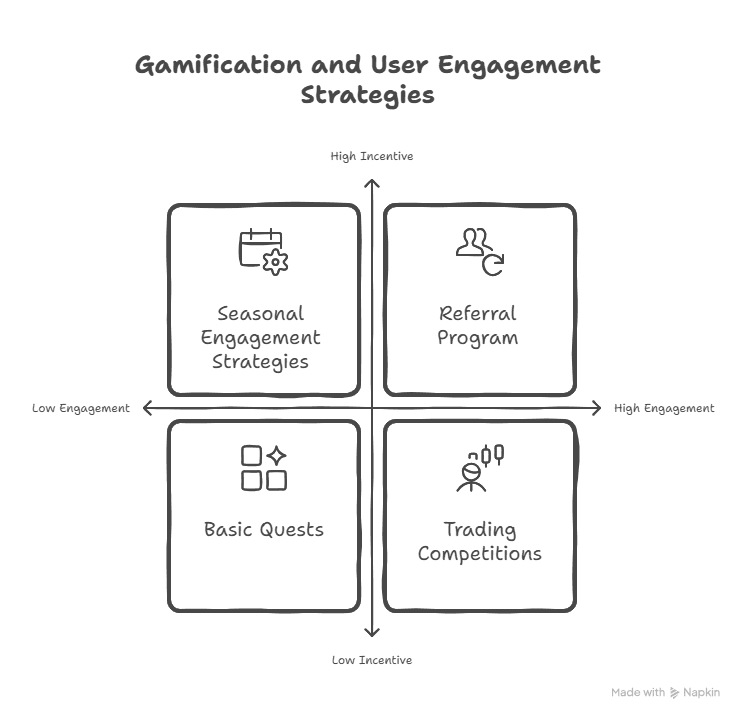
10.1 Quests, Badges, and Progression Systems
TradeView integrates a sophisticated gamification layer that transforms trading into a structured, goal-driven experience. Through modular quests, collectible badges, and progression tiers, the protocol incentivizes user activity, encourages responsible trading, and builds a sticky user community. All rewards are transparent, merit-based, and opt-in—preserving TradeView’s no-friction ethos while introducing additional layers of engagement.
10.1.1 Overview
TradeView’s quest engine functions as a structured achievement and milestone system for traders. It introduces:
-
Quests: Daily, weekly, and event-based trading missions.
-
Badges: Permanent collectibles representing user skill, discipline, or strategic achievements.
-
Progression Tiers: Account-wide rank upgrades based on consistent performance, on-chain activity, and community contribution.
These elements are smart contract-driven and verifiable, avoiding artificial restrictions or platform lock-in.
10.1.2 Quest Engine
Quests are automatically assigned based on a user's account tier, interaction style, and trading frequency. They are verifiable on-chain, with rewards distributed in a gas-efficient and auditable manner. Quests may be cumulative or binary and tied to both individual performance and seasonal events.
Types of Quests:
| Type | Example Objective |
|---|---|
| Volume Quests | "Trade $50,000 notional in 24 hours" |
| Asset-Specific | "Open a position in PEPE or DOGE within 12 hours" |
| Risk Discipline | "Maintain margin ratio > 1.5 for 5 consecutive trades" |
| AI Feature Use | "Respond to an AI risk alert and de-risk exposure" |
| Vault Quests | "Join and remain in a copy vault for 3 days" |
Quest Characteristics:
-
Tracked using on-chain event logs and signatures.
-
Adjust dynamically by performance tier and behavior model.
-
Offer XP, native token rebates, and cosmetic or badge rewards.
-
Periodically refreshed to reflect market conditions or community events.
10.1.3 Badges and Account Progression: A Game-Like Trading Experience
Users accumulate XP (Experience Points) through:
-
Successful quest completions.
-
Avoiding risk events like liquidation.
-
Participating in DAO governance.
-
Early discovery or use of new features (e.g., AI alerts, copy vaults).
XP determines access to Progression Tiers, each offering expanded privileges:
| Tier | Required XP | Benefits |
|---|---|---|
| Bronze | 0 | Access to basic quests, public profile visibility |
| Silver | 500 | Unlock badge claiming, XP multipliers for referrals |
| Gold | 2,000 | Access to limited-time quests, exclusive vaults, AI personalization |
| Platinum | 5,000 | Gas-free access to AI alerts, DAO proposal co-sign rights |
| Diamond | 10,000 | Priority access to beta features, governance boost, prestige NFT drops |
Badges are Soulbound Tokens (SBTs) that highlight a user's skill, consistency, or strategic insight. Examples include:
-
High Volatility Survivor – Executed 50+ trades during 60%+ volatility periods.
-
Liquidation-Free 100 – Completed 100 consecutive trades without liquidation.
-
Vault Leader – Created a copy vault exceeding $500k TVL.
Badge Properties:
-
Non-transferable and non-sellable.
-
Publicly visible on leaderboards and DAO portals.
-
May influence future DAO voting weight or unlock governance roles.
Together, TradeView’s quests, badges, and progression mechanics deliver an experience that rewards consistency, risk-awareness, and strategic exploration—without gamifying for its own sake. This system also reinforces user retention, knowledge growth, and protocol alignment.
10.2 Trading Competitions (Volume, ROI-Based)
TradeView’s trading competition engine offers an automated, on-chain framework for incentivizing performance, precision, and consistency. These contests may be initiated by the core protocol team, community DAOs, or external sponsors—ranging from DeFi projects and analytics platforms to fintech brands and venture funds.
10.2.1 Overview
TradeView’s tournament system is designed to be:
-
On-chain auditable: All entries, performance stats, and prize allocations are verifiable on-chain.
-
Smart contract-enforced: No centralized entity decides winners—rules are encoded in transparent contract logic.
-
Permissionless to launch: Once the competition templates are DAO-approved, anyone can deploy a new contest.
10.2.2 Competition Formats
Competitions can be structured in several formats:
| Format Type | Description |
|---|---|
| Volume-Based | Rank users by total notional traded over a period |
| ROI-Based | Rank users by return on investment (P&L %) from starting capital |
| Vault Performance | Rank copy-vault creators by follower returns or TVL growth |
| Streak Challenges | Reward longest liquidation-free streaks or best consecutive trades |
Each format supports:
-
Custom duration (e.g., 3-day sprint, 30-day league, seasonal circuit).
-
Entry constraints (e.g., tiered by experience, AI usage, vault-following behavior).
-
Private vs Public: Sponsors may restrict entries (e.g., VIP traders, DAO delegates).
10.2.3 Reward Structures
Reward mechanics can be tuned dynamically:
-
Native token rewards (fixed pool, proportional to rank).
-
XP multipliers for seasonal progression.
-
Sponsored airdrops or NFTs by external partners.
-
Soulbound accolades (e.g., "Seasonal Champion") permanently stored on-chain.
Leaderboard visibility is real-time, with:
-
Privacy mode for users who wish to hide identity but compete anonymously.
-
Verification options (e.g., vault-linked profiles) to ensure trust in ranking legitimacy.
10.2.4 Automation, Fairness, and Anti-Gaming Logic
The engine integrates protections to ensure fairness:
-
Sybil-resistance: Uses wallet activity history, stake-weighting, and behavioral heuristics.
-
Slippage-aware ROI: Accounts for trade execution quality, not just paper gains.
-
Vault segregation: Prevents manipulation via internal vault-following loops.
All competitions emit public logs and leaderboard hashes to IPFS at regular intervals for tamper-proof transparency.
10.2.5 Sponsor Tools & DAO Co-Creation
-
Customizable Templates: DAO-approved modules enable sponsors to deploy contests with configurable parameters.
-
Whitelist Mode: Restrict access to curated communities (e.g., top traders, vault strategists).
-
Branded Leaderboards: Display partner logos, themes, and optional prize extensions.
All sponsor metadata is stored on-chain or via IPFS, preserving transparency.
10.2.6 Cross-Competition Meta Layer
-
XP Cumulative Ranking: Users build long-term reputation through aggregated performance.
-
Seasonal Prestige Metrics: Top performers earn profile medals and historical leaderboard recognition.
-
Event Series (e.g., Vault Wars): Multi-stage tournaments spanning several weeks or thematic phases.
This promotes ongoing engagement beyond one-off contests.
10.2.7 Real-Time Broadcast Layer (Planned)
-
Public API Endpoints: Embed real-time updates in Discords, dApps, or partner dashboards.
-
Streaming Integrations: Create commentary overlays and live competition feeds.
-
Viewer Interactions: Let audiences track favorite traders or vote on surprise challenge rounds.
These features elevate TradeView competitions into interactive, on-chain trading esports.
10.3 Referral Program and Loyalty Rewards
TradeView integrates a fully permissionless, transparent referral program with loyalty mechanisms that reward organic user growth, long-term engagement, and protocol alignment.
10.3.1 Multi-Level Referral Program
-
Referral Tracking: Users receive a unique referral code linked to wallet signatures.
-
No KYC Required: The referral system operates entirely on-chain, with pseudonymous participation.
| Level | Description | Reward Mechanism |
|---|---|---|
| L1 | Direct referrals | Up to 15% of referred user’s trading fees |
| L2 | Referrals-of-referrals | Up to 5% of second-tier referral fees |
-
Referral Dashboard: Tracks signups, conversion rates, rewards earned.
-
Custom Links: Users can generate shortened URLs or QR codes for campaign tracking.
10.3.2 Loyalty Multipliers
Loyalty is rewarded through behavior-based multipliers:
-
Active Trading Streaks: Bonus XP and fee rebates for trading 7, 30, or 90 days consecutively.
-
Protocol Engagement: Higher APY and XP rewards for users who:
-
Participate in governance votes.
-
Complete AI-driven insights.
-
Stake tokens or follow copy vaults.
-
-
Gas Points: Users who consistently trade—even with gasless meta-tx—accrue loyalty markers used for seasonal boosts.
These loyalty traits grant access to:
-
Higher referral fee tiers (e.g., from 10% to 20%).
-
Early access to seasonal rewards and exclusive quests.
-
Boosted staking yields during promotional windows.
10.3.3 Seasonal Retention System
To reinforce cyclical engagement:
-
Seasonal Progression: XP and referral points reset partially at season end (e.g., every 8 weeks), while prestige remains.
-
Streak Carryovers: Longest trading streaks are highlighted across seasons.
-
Referral Ladder Tournaments: Competitions based on referral volume + retention performance.
TradeView’s referral and loyalty stack not only promotes organic user growth but also deepens community alignment and turns network expansion into a measurable, gamified layer of protocol contribution.
10.4 Seasonal Engagement Strategies
10.4.1 Thematic Seasons & Leaderboards
Every TradeView season is themed around a unique narrative or trading style, offering distinct objectives and community goals. Seasonal cycles reset global leaderboards, unlock new quests, and distribute exclusive digital assets.
- Core Elements of Each Season:
-
Unique Quest Modules: Seasonal-specific tasks (e.g., “Vault Creator Bounties,” “Slippage Avoidance Challenge”) drive novel user behavior.
-
Rotating Incentives: Trading rebates, reward multipliers, and loot drops change with the theme—encouraging strategy diversification.
-
Leaderboard Reset (Soft): Core ROI/XP-based rankings are reset every season to give newcomers a fair entry, while prestige metrics are retained.
-
NFT Airdrops: Top traders, vault creators, and voters receive seasonal collectible NFTs—with art/themes matching the narrative.
Example Seasons:
| Season Name | Description |
|---|---|
| Season Zero: The Genesis Traders | Early contributors and testnet participants earn OG NFT badges and loyalty boosts. |
| Season One: AI vs Human | Dual leaderboard tracks—users using AI signal integrations vs. manual trading strategies. |
| Season Two: Vault Wars | Vault creators compete in bracketed performance battles; followers earn XP multipliers. |
Each season is designed to explore and promote a different aspect of the TradeView ecosystem—from technical tooling and AI to trader behavior and community collaboration.
10.4.2 Prestige & Season Carryover
To prevent seasonal resets from erasing user history, TradeView introduces a Prestige System—a cumulative meta-score tied to user impact, XP, and leaderboard performance.
- Prestige Mechanisms:
-
XP Multipliers: High-ranking users receive bonuses to XP in the next season, helping them climb faster.
-
Early Access Perks: Top performers are granted access to experimental features, beta tools, and DAO proposal pre-reviews.
-
Legacy Medals (NFTs): Unique “seasonal trophy NFTs” (e.g., Vault Champion S1, Risk-Tamer S2) are issued to top-tier users.
-
Governance Impact: Prestige may be factored into vote weighting during reputation-based governance votes (e.g., protocol upgrades).
- Continuity Without Gatekeeping:
While prestige offers progressive privileges, TradeView avoids creating exclusive hierarchies by:
-
Rotating quests to spotlight new types of contributions.
-
Resetting leaderboards each season.
-
Allowing all users to “catch up” through double XP events and bounty quests.
10.4.3 Ecosystem-Wide Airdrops & DAO Vote Bonuses
Seasons also serve as cross-protocol activation windows—where partner projects, wallets, and oracles collaborate to reward high-value contributors across the ecosystem.
- End-of-Season Airdrops:
-
Top 1–5% of users (by engagement score or verified trades) receive:
-
Partner tokens (e.g., dApp integrations, oracle tokens).
-
Protocol-native credits (e.g., gasless order allowance, vault rebate multipliers).
-
-
NFT holders from seasonal drops may qualify for future partner airdrops or vault boosts.
Governance Boosts:
-
Season MVPs (top 100 by XP or performance) receive temporary TradeView's Native Token governance boosts:
-
Extra vote weight on protocol improvement proposals.
-
Priority consideration for DAO grant submissions.
-
DAO “Senator” tagging on voting interfaces.
-
These mechanics tie short-term participation directly into long-term value creation and governance control—making seasonal performance both financially and politically meaningful.
Summary: Seasonal Flywheel Impact
| Component | Purpose |
|---|---|
| Thematic Seasons | Drives novelty, experimentation, and campaign flexibility |
| Leaderboard Resets | Keeps new users competitive while preserving legacy prestige |
| Prestige Carryover | Encourages compounding reputation without locking out new participants |
| DAO Voting Boosts | Aligns gamified behavior with protocol decision-making |
| Airdrops & NFTs | Strengthens multi-protocol partnerships and social identity signaling |