














1.1 Introduction to TradeView
1.1.1 What is TradeView?
TradeView is a next-generation decentralized perpetual trading platform bringing together the speed, reliability, and trading experience of centralized exchanges and the trustless security, transparency, and composability of blockchain technology. The high-performance perpetual DEX (decentralized exchange), powered by a custom Layer 1 (based on TenderBFT consensus mechanism) that supports completely on-chain operations, delivers global accessibility and institutional-grade functionality. It offers a CEX-grade trading experience with fully on-chain order placement, matching, and settlement, while adhering to core principles of decentralization, transparency, and user sovereignty. 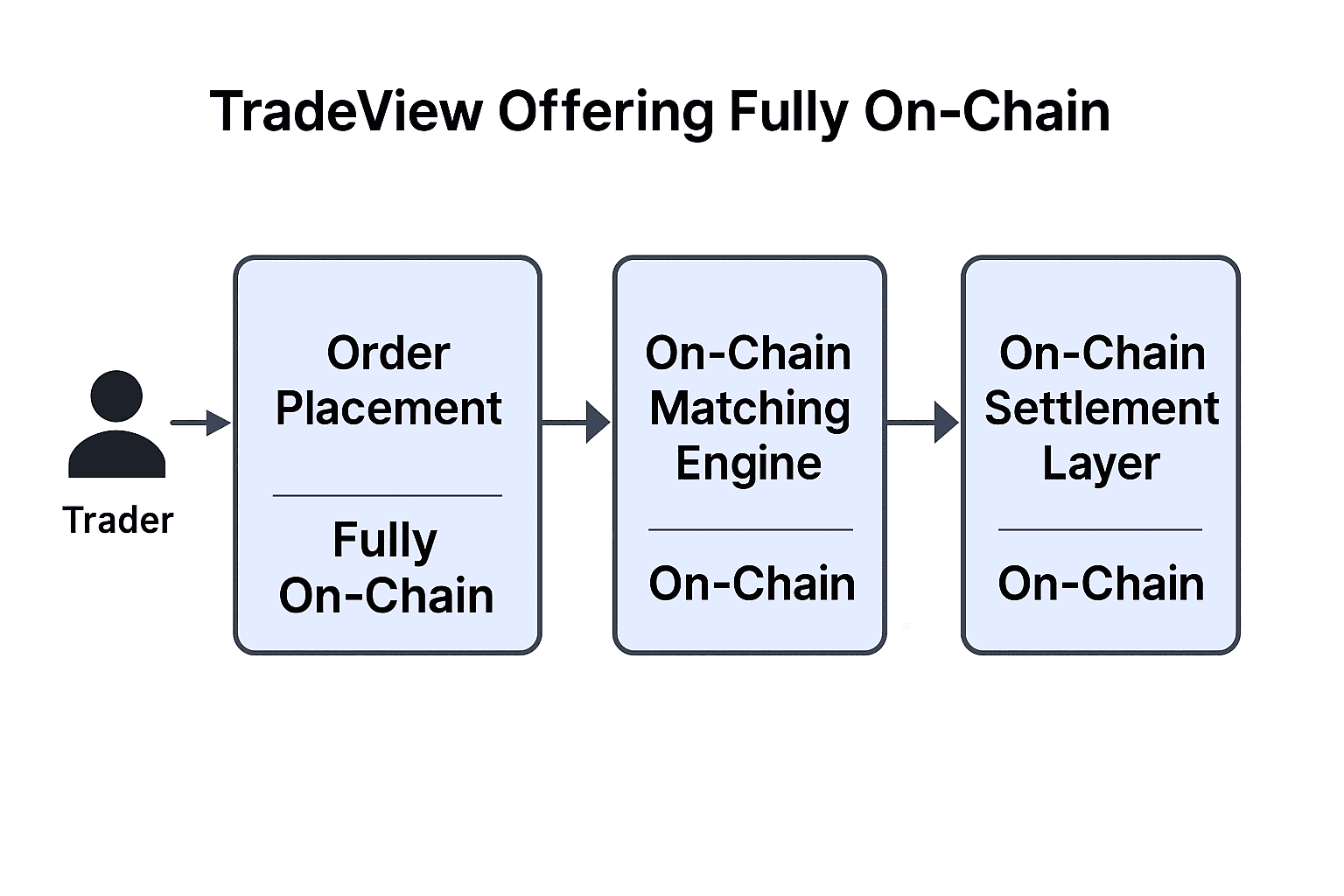 In a market shaped by the collapse of trusted CEXs (centralized exchanges) and constraints of current DEX architectures, TradeView therefore brings a transformative shift to derivatives trading models. Unlike most DEXs that compromise on speed, functionality, or user experience, the pioneering perpetual trading platform reimagines the trading stack with an entirely on-chain experience, advanced order types, seamless user onboarding, risk management, and cutting-edge features. This ensures a reliable, trust-minimized, and performant high-frequency trading infrastructure for traders and institutions.
1.1.2 How TradeView Tackles the Core Problems of CEXs and DEXs?
At its core, TradeView addresses the following major pain points in both centralized and decentralized exchanges:
-
Centralized exchanges pose significant custodial, regulatory, privacy-related, and operational risks, as highlighted by historical failures such as Bybit, FTX, DMM Bitcoin, WazirX, and Mt. Gox.
-
Decentralized exchanges often suffer from low throughput, delayed execution, limited order types, and fragmented liquidity, making them unappealing to professional or high-volume traders.
1.1.3 What TradeView Brings to the Table?
TradeView eliminates this dichotomy by delivering:
-
A high-speed, on-chain matching engine with sub-second finality
-
One-click trading experience, as no repeated transaction confirmations are needed
-
Advanced trading features such as OCO orders, trailing stops, TWAP Algorithms, iceberg orders, and more
-
Nearly gasless transactions, powered by native tokens, subsidization, whitelisting, and other mechanisms
-
Globalized, non-KYC access, lowering entry barriers for users
-
Risk management modules, such as a funding rate mechanism, an insurance fund, and a liquidation engine to handle under-collateralized positions autonomously
-
Non-custodial execution with a seamless web3 wallet/email login
-
50X leverage capability with cross/isolated margin
-
**Cross-chain trading and asset support (**Ethereum, BSC, Solana)
-
A native token for on-chain governance and utility.
-
AI-based analytics tools for real-time risk visibility and market sentiment.
-
Seamless integration with popular wallets Metamask, Wallet Connect, Coinbase Wallet, etc.
-
Social trading capabilities that enable copy-trading, vault mirroring, etc.
-
A gamified trading module that features public trader leaderboards, trading quests, badges, etc.
-
White label exchange suite to list token at no cost, add utility, build a sub-DAO governance model, offer custom fee discounts and earn from users directly.
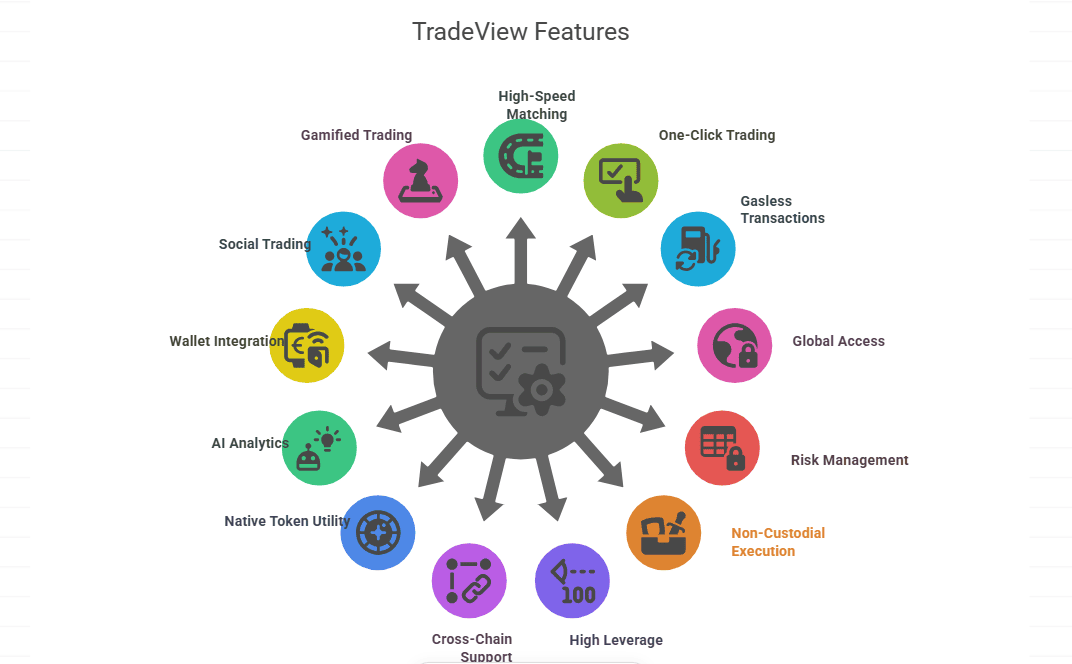
Through a composable, modular architecture, TradeView is built not only as a perpetual DEX but as a decentralized financial infrastructure layer capable of supporting retail traders, professional quant firms, social finance communities, and protocol-level integrations.
The platform is accessible globally, with no KYC necessity, and ensures full transparency through open-source smart contracts, public auditability, and non-custodial fund management.
Whether you’re a casual trader, an active DeFi trader, or an institution looking for an efficient derivatives trading infrastructure, TradeView is all you need. It provides the performance, security, and extensibility of a next-generation trading ecosystem without the trust assumptions of centralized venues.
This whitepaper presents the rationale, architecture, and innovation driving TradeView’s mission to redefine how perpetual futures are traded in decentralized finance.
1.2 Project Vision and Goals
1.2.1 Vision Statement
The vision behind TradeView is bold and foundational:
To deliver a decentralized trading experience indistinguishable from that of centralized exchanges, while being trustless, transparent, permissionless, and globally accessible.
TradeView is not just a decentralized exchange for perpetual contracts.
It is a purpose-built, high-performance on-chain trading infrastructure designed to power the next wave of decentralized finance, where speed meets sovereignty, and performance meets permissionlessness.
The platform envisions a world where users no longer have to choose between:
-
The convenience, responsiveness, simplicity, and speed of a centralized exchange
-
And the integrity, security, and transparency of decentralized protocols.
TradeView brings the best of both worlds by building everything — order placement, matching, and settlement- directly on-chain, without any compromise.
1.2.2 What TradeView Is Engineered to Deliver?
The pioneering trading platform is built to:
- Meet the latency, reliability, and feature-set expectations of professional traders
-
Sub-second execution with real-time responsiveness
-
Advanced order types and risk tooling
-
Seamless onboarding for market makers and HFT bots
- Preserve the decentralization and transparency that DeFi promises
-
Non-custodial, KYC-free access
-
Open and verifiable smart contracts
-
Community-driven protocol governance and evolution
- Empower developers, DAOs, and institutions to extend the platform’s capabilities
-
Modular smart contract design for custom integrations
-
APIs, SDKs, and real-time data feeds leveraging oracles
-
Vaults, bots, and plugins can be built directly on top
- Support a scalable, standout user experience
-
Dual-mode access (wallet or email) for broad user adoption
-
Mobile-ready frontends, push notifications, and gamified UX
-
Multi-asset custody and trading with bridges and interoperability mechanisms
-
Copy-trading, social reputation, and community engagement tools built in
- Surpass the limitations of existing DEXs and modular stacks
-
On-chain matching engine instead of off-chain workarounds or layer 2 transaction handling.
-
Performance and UX are not bottlenecked by EVM, despite comprehensive compatibility and support.
-
A vertical approach from Layer-1 to the frontend, ensuring tight integration
As centralized exchanges continue to dominate market volume while failing on security, user rights, and transparency, there is an urgent need for infrastructure-level innovation in decentralized perpetual trading. TradeView addresses that gap using a custom Layer-1 blockchain designed specifically for trading at scale.
1.2.3 Core Platform Goals
- Operate at Scale with Sub-Second Finality and 10,000+ TPS
TradeView’s custom Layer-1 is engineered using a Tendermint BFT consensus in Go for infallible performance. Unlike generalized L1s that are often bottlenecked by diverse workloads (NFTs, DeFi, DAOs), TradeView’s custom L1 focuses solely on the high-throughput, low-latency needs of perpetual trading, facilitating real-time responsiveness.
| Metric | Target Value |
|---|---|
| Block Finality | < 1 second |
| Order Throughput | 10,000+ orders/sec |
| Latency from Match to Settle | < 500 milliseconds |
| Max Open Orders (Scalable) | Millions |
This ensures:
-
Real-time responsiveness in all terms, making the UX feel like a modern fintech app and not a DeFi app.
-
Bots and market makers can submit and cancel thousands of orders per second without congestion.
-
Real-time trading is possible without frontend hacks or order book caching
-
On-chain infrastructure doesn’t slow down the trader experience
-
Near-instant order placement, matching, and settlement, zero latency
-
Allows for automated scalping, arbitrage, TWAP, and grid strategies — directly on-chain.
-
The platform can flawlessly handle millions of transactions without a hitch
-
No lag between UI and actual blockchain state
-
Features like trailing stops, TWAP/VWAP, or iceberg orders require multiple micro-interactions, and with high TPS capability, it’s possible.
-
Higher TPS typically reduces network congestion, which keeps fees low.
-
Can support near-gasless transactions without compromising UX or leveraging layer 2 solutions.
-
Traders can't game the system by reacting between oracle updates and liquidation triggers.
-
Other DeFi protocols (lending, yield optimizers, DAOs) interact with TradeView without delay.
-
Trading competitions, peak activity, token listings, or market volatility will not freeze the chain.
-
More users, more orders, more integrations — without architectural refactoring.
- Fully On-Chain Matching & Settlement With MEV-Mitigation
Unlike DEXs that offload matching to off-chain servers, TradeView executes the following functions entirely on-chain using audited smart contracts and a native consensus layer. This makes Tradeview censorship-resistant and transparent (since all trades are verifiable in real time).
-
*Order placement*
-
*Matching*
-
Settlement
But the system still needs to consider fairness and anti-front-running mechanisms. The leading perpetual DEX may implement the following MEV-mitigation strategies:
-
TradeView will use batch auctions, where all orders in a block are matched at the same price. This helps prevent traders from reordering transactions just to gain an unfair advantage (known as front-running).
-
Validators will be required to either include transactions in the exact order they’re received or shuffle them randomly. This stops anyone from always being first just because of how the system is set up.
-
Together, these steps create a fair and transparent trading environment, even though everything happens on-chain.
-
Also, self-trading will be blocked by default to prevent fake volume or wash trades.
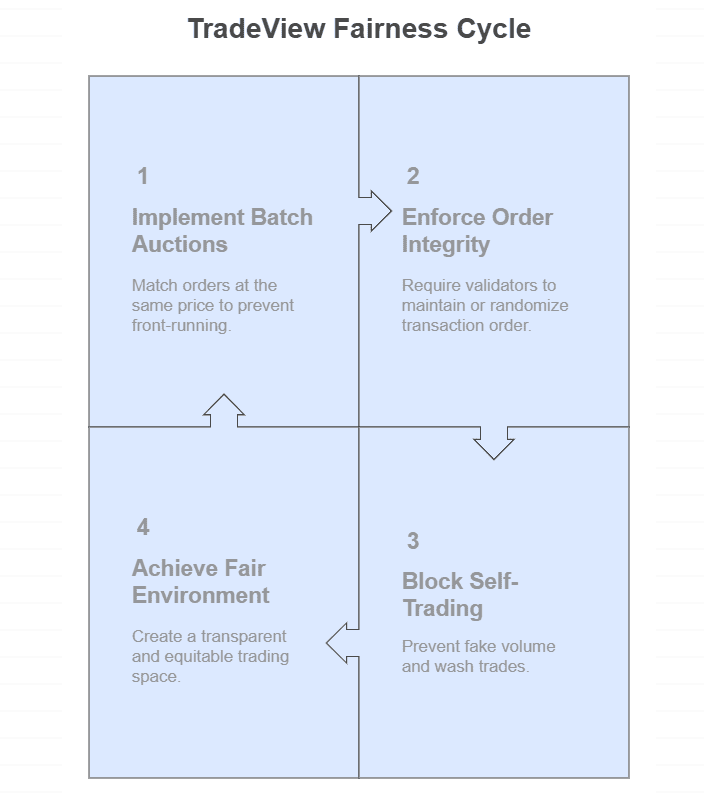
Every user interaction — from submitting an order to receiving settlement — passes directly through the blockchain, and appropriate MEV-mitigation mechanisms are in place to avoid any underlying challenges associated with on-chain matching and settlement.
- Flexible Margin System (Isolated + Cross) with Advanced Strategy Support
To attract sophisticated traders, TradeView implements both isolated and cross-margin mechanisms. The platform will allow users to switch between both modes or assign an isolated margin on a per-position basis. The clearinghouse module will track and manage margin at the account level accordingly.
-
Isolated Margin: In isolated margin mode, each position is backed by its dedicated collateral. This keeps risk contained, as if a trade goes wrong, only the margin assigned to that specific position is affected, leaving the rest of the account untouched. Traders may prefer this mode for high-risk trades to limit potential losses.
-
Cross Margin: In cross-margin mode, a user’s entire account balance (per wallet) is used as shared collateral across all open positions. This approach enhances capital efficiency as losses in one trade can be covered by available funds from the entire account. However, the downside is that a significant loss in one position can impact all other positions, increasing overall risk.
-
Risk Engine: TradeView’s risk management module ensures platform stability through automated and intelligent liquidation processes. It continuously monitors margin ratios and automatically flags undercollateralized positions for liquidation. To minimize user impact, the system first attempts smart partial closeouts, reducing position size just enough to restore healthy margin levels. If that fails—or for isolated-margin trades—a full liquidation is executed at market price. Trigger-based alerts will also notify users in advance, giving them the chance to adjust positions before liquidation.
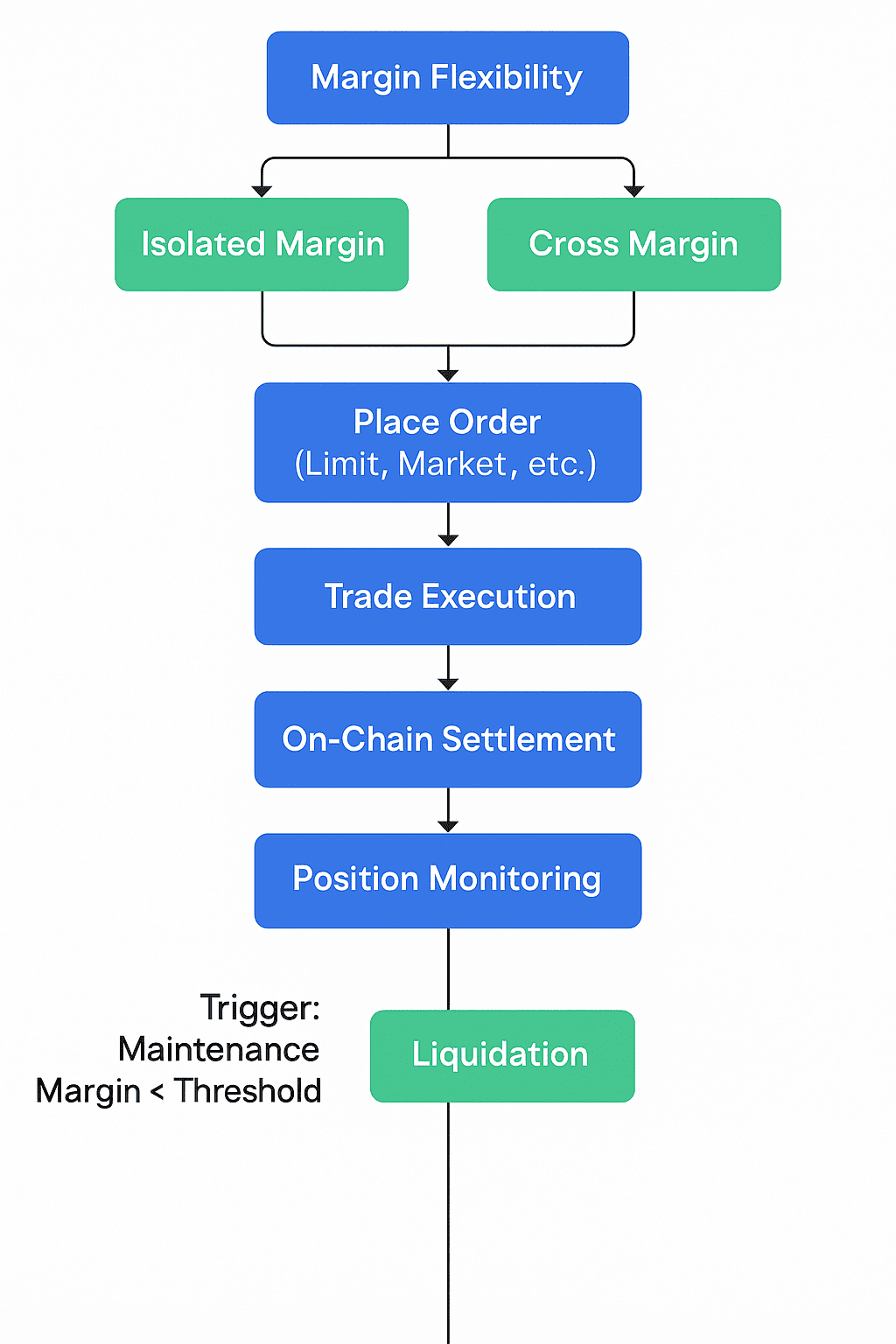
Flowchart Representing Margin modes → Trade lifecycle → Liquidation logic
Combined with a robust risk management comes the ability to process advanced order types. TradeView allows:
-
Traders to execute complex strategies on-chain (e.g., Iceberg, OCO, trailing stops, TWAP, and more)
-
Institutions to replicate CEX trading behavior in a trustless environment (everything from order placement to settlement moves on-chain, significantly enhancing user experience)
-
Algorithmic bots to operate without workarounds or shadow infrastructure (TradeView supports high-frequency algorithmic trading, offering a transparent, low-latency access to on-chain order flow and execution.)
- Serve Global Users via Non-KYC, Email/Wallet-Based Onboarding
TradeView is built for open, borderless access:
-
No KYC required: A globalized and seamless access lowers entry barriers for users.
-
Users can connect via familiar web3 wallets, MetaMask, WalletConnect, or Coinbase Wallet, no identity verification required.
-
Or simply sign up using an email/password (custodial key abstraction)
TradeView's dual onboarding system is more than a convenience feature. It is a critical product design decision aimed at maximizing accessibility, reducing friction, and optimizing engagement across a spectrum of user personas.
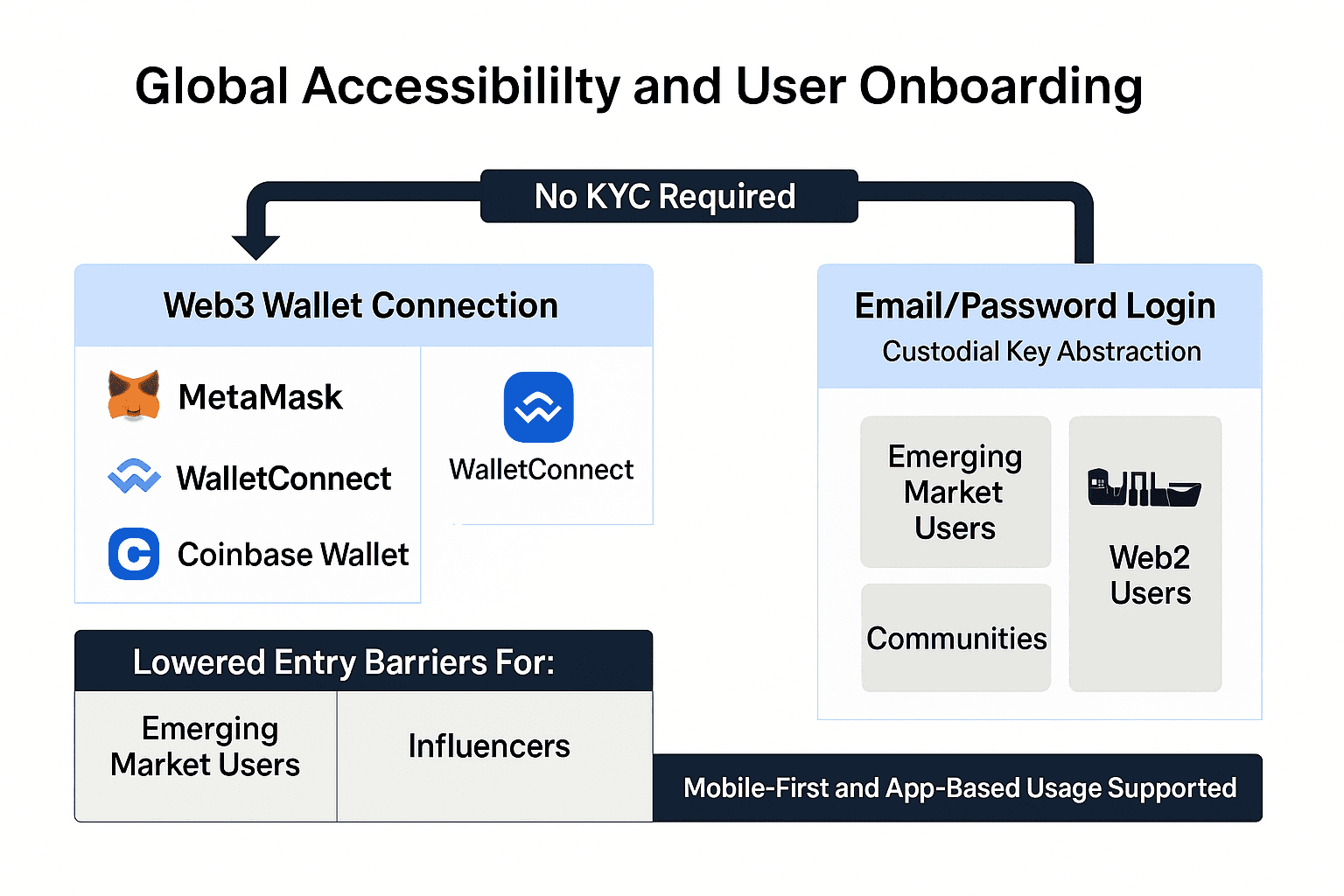 No KYC Required: Unlocking True Global Access
As TradeView requires no identity verification to access the trading platform, it is built to:
-
Respect individual privacy and sovereignty.
-
Reduce onboarding friction to near-zero
-
Align with the foundational values of decentralized finance
No user will be intimidated by the overwhelming KYC procedures or the tiring, manual checks. Users can keep their privacy and trade seamlessly with all the features they choose CEXs for, all under a DeFi perpetual trading protocol.
Besides enhancing user experience, these multiple sign-up modules eliminate the traditional KYC/AML requirement for a significant segment of crypto users. Therefore, as mentioned earlier, the leading Perpetual DEX makes trading accessible for the following ideal customer profiles.
-
Users in emerging economies with limited access to formal financial infrastructure
-
Crypto-curious Web2 users unfamiliar with wallet setups or seed phrases
-
Influencer-driven community onboarding campaigns, where speed and simplicity are key
- Modular, Composable Architecture for Builders
Unlike conventional DeFi platforms that act as static, siloed products, TradeView is architected as a composable protocol layer enabling developers, communities, and institutions to build on top of, extend, and integrate with its infrastructure.
This composability philosophy ensures that TradeView evolves not as a closed system but as an ecosystem-ready foundation for innovation.
What Does Composability Mean in Practice?
Composable means that every part of the protocol, from trading logic to user interfaces to liquidity engines, is modular, accessible, and programmable. TradeView doesn’t lock users into a fixed experience but keeps on evolving with an architecture that supports and welcomes any new additions.
Here’s how different actors benefit:
- For Developers & Builders
-
Plug in new trading logic (e.g., volatility scalpers, grid bots, AI integrations, etc.)
-
Build custom frontends for niche communities or UI experiments
-
Deploy trading scripts or automated agents directly through smart contract APIs
Example: A developer could build a Telegram bot that lets users place TWAP orders on TradeView with preset leverage profiles.
- For Communities
-
TradeView developers can fork the UI, apply custom branding, or add region-specific languages, build local leaderboards, and run incentive campaigns.
-
They can also create social extensions, e.g., community vaults where profits are shared or strategies voted on by token holders.
Example: The TradeView team can build a target-specific DeFi community in Brazil by launching "TradeView Brasil" with translated UI and local influencer leaderboards.
- For Protocol Integrators
Tradeview’s liquidity and execution can be later combined with:
-
Risk dashboards showing portfolio health in real-time.
-
Copy trading dashboards using on-chain vault mirroring
-
Arbitrage monitors for cross-DEX inefficiencies
-
Automated liquidation services or liquidation alerts
-
Referral-based leaderboards that track volume, ROI, and social score.
Example: A third-party dev can create an analytics app showing “Top 10 Most Copied Traders” across TradeView smart vaults.
- For Institutions & Advanced Users
-
Launch structured products: options overlays, leveraged indices, delta-neutral vaults
-
Build custom margin engines or settlement flows for OTC transactions
-
Construct index derivatives using TradeView price feeds and exposure tools
Example: An institution might tokenize a “Top 5 Perp Index Fund” and settle its NAV using TradeView’s order and funding APIs.
The Composability Stack: What We Provide
TradeView exposes a full developer toolkit, ensuring both low-code and advanced integrations are possible.
| Tool / Interface | Description |
|---|---|
| SDKs | JavaScript/TypeScript SDKs for frontend development and wallet integrations |
| GraphQL / REST APIs | High-performance APIs for querying orders, trades, prices, PnL, and vaults |
| Webhooks | For monitoring liquidation triggers, trade confirmations, or margin changes |
| Smart Contracts | Fully documented and composable contracts for order placement and cancellation, vault strategy execution, funding rates modules, liquidation logic, and automation. |
All interfaces are:
-
Publicly accessible
-
Versioned for stability
-
Audited for security
-
Backed by developer support and documentation
Why This Matters
In DeFi, the protocols that win are not those with the most features but those with the most extensible, programmable foundations.TradeView aims to become “the Uniswap of Perpetuals”, a base layer that powers:
-
Apps
-
Bots
-
Communities
-
Institutions
-
Autonomous strategies
By being composable by design, TradeView serves both traders and builders.
1.2.4 A Strategic Outlook
TradeView is built on the belief that financial infrastructure must be fast, open, and unbreakable.
It envisions a trustless trading layer for derivatives and perpetuals that can rival centralized exchanges, not by mimicking them, but by outperforming them in transparency, accessibility, and extensibility. The protocol, therefore, acts as an infrastructure shaping the next generation of trading experiences for individuals, teams, and global DeFi communities.
To put it simply, TradeView’s goals align with a broader movement to:
-
Disintermediate financial markets and deseat the centralized giants
-
Facilitate fast, open, perpetual trading environments
-
Return ownership and control to traders without a trade-off (security, speed, decentralization, etc.)
-
Offering the highest levels of transparency, accessibility, and extensibility
-
Allow composability across DeFi layers (lending, vaults, automation)
By combining performance, decentralization, extensibility, and user experience, TradeView aspires to be the default infrastructure for perpetual trading in DeFi, whether for the next 100M users or the next 100 protocols.
1.3 Summary of Competitive Differentiators & Market Positioning
1.3.1 Unique Features and Innovations That Set TradeView Apart
TradeView stands apart in an increasingly crowded perpetual trading landscape by redefining what a decentralized trading experience can offer. While existing solutions either compromise on decentralization (e.g., hybrid rollups) or lack the user experience and tooling required by serious traders, TradeView takes a fundamentally different approach.
Here are the features with which the platform is aiming to reshape the perpetual trading experience.
- Fully On-Chain Execution Pipeline
Most DEXs claim decentralization but still rely on off-chain order matching.
TradeView is one of the only platforms to place the following entirely on-chain:
-
Order submission
-
Order Matching
-
Settlement
Backed by a purpose-built L1, the decentralized perpetual trading platform ensures immutability, censorship resistance, and real-time verifiability.
- Performance-Grade Custom Layer-1
General-purpose chains can’t match trading speed.
TradeView’s custom Layer-1 blockchain includes built-in logic for
-
Order placement to settlement
-
Real-time liquidation enforcement
-
Block-level funding rate adjustments
-
Seamless vault-level trading execution
All of these are handled directly by the chain’s execution layer. This offers CEX-level speed with decentralized reliability, without relying on rollups or shared sequencers.
- Institutional-Grade Order Types
TradeView introduces order types beyond limit, market, and stop orders that are rarely found on-chain, such as;
-
TWAP (Time-Weighted Average Price)
-
OCO (One-Cancels-the-Other)
-
Trailing Stop Orders
-
Iceberg Orders
-
Customizable slippage and post-only/IOC options
These features empower:
-
Algo traders, who rely on programmable strategies
-
Institutional desks that want to execute large trades without visible slippage
- Integrated AI-Driven Risk Management
TradeView embeds AI advisors that:
-
Alert traders to volatility, overexposure, or funding risks
-
Perform portfolio stress testing
-
Analyze user behavior to provide personalized, non-financial guidance
-
Detect market anomalies via real-time sentiment feeds
-
Facilitate sentiment analysis powered by on-chain + off-chain signals
-
Available as part of the premium feature set, unlockable via token staking or a subscription model.
These are not mere UX add-ons but a new frontier and benchmark for DEXs that are implementing AI for smart trading experiences.
- Social Trading Infrastructure
Rather than relying on off-platform communities, TradeView builds social dynamics into its core:
-
Copy-trading via vaults (on-chain mirroring)
-
Public trader leaderboards ranked by ROI, volume, or followers
-
Incentivized following mechanics (e.g., share % of copied vault profits)
This lowers the skill barrier and turns expert traders into ecosystem growth drivers.
- Seamless Dual Onboarding (Web3 + Web2)
TradeView supports both:
-
Wallet-based login for Web3 natives
-
Email/password-based onboarding for crypto-curious or mobile-first users
This ensures maximum conversion from referral campaigns, influencer-led funnels, or ad-driven traffic in emerging markets.
- Gasless, Session-Based UX
Using gas-mitigation mechanisms and session signing, TradeView eliminates:
-
Wallet pop-ups on every action
-
Huge gas fee surprises for retail users
The result is a smooth, CEX-like experience in a decentralized environment, a rarity in today’s DeFi platforms.
- Up to 50× Leverage with Smart Margin Management
The perpetual DEX aims to offer a rare derivatives trading experience with:
-
Isolated margin for position-specific control
-
Cross margin for more efficient capital deployment
-
Native liquidation engine with precision triggers, partial closes, and user alerts
- Perpetual Funding + On-Chain Insurance
TradeView’s core trading model includes
-
A robust perpetual funding rate mechanism integrated with an oracle for real-time funding rate calculation and liquidation triggers.
-
A self-sustaining, on-chain insurance fund to handle liquidation shortfalls
The 100% transparent, open to community auditing and governance, hourly funding rate system automates payment flows between long and short traders based on open interest imbalance and price deviation.
- Copy Trading via Smart Vaults
TradeView brings an all-new on-chain copy trading experience for users where:
-
Users can allocate collateral to top traders' smart vaults
-
Vaults reflect lead trader activity in real time
-
Profits (or losses) are distributed transparently
This unlocks passive trading strategies and DeFi-native fund management.
- Gamification Module
The unique and engaging gamification twist unlocks retention, excitement, and viral loops with the following:
-
Quests: Trade streaks, volume achievements, seasonal badges
-
Referral programs with fee rebates and leaderboard exposure
-
Competitions with token rewards for ROI, volume, or social impact
- Cross-Chain Compatibility
-
Trust-minimized bridging from Ethereum and EVM chains to TradeView’s custom L1 with bi-directional flow enabled
-
Future-proofed for non-EVM chain support (e.g., BSC, Solana via Wormhole)
-
Enables a unified, L1-based collateral vault across ecosystems
-
Enables on-chain asset entry and exit without relying on custodians or centralized ramps
- USDC Collateral and Multi-Collateral Expansion
-
USDC-first model ensures deep liquidity, simplicity, and institutional compatibility
-
Minimizes onboarding complexity for both new and pro traders
-
Post-MVP roadmap includes multi-collateral flexibility with ETH, DAI, and other stablecoins
- Mobile-Centric UX
The leading decentralized perpetual trading platform plans to target billions of smartphone users worldwide with:
-
Fully responsive web UI
-
Optional mobile app (post-MVP) with biometric login and push notifications
-
Designed for global users with low data or unfamiliarity with wallets
- Token Utility Infrastructure
The Native token will power the following:
-
Trading fee discounts and VIP Tiers
-
Collateralization in the future
-
Governance participation
-
Network security, staking rewards, and yield multipliers
-
Access to AI tools, vault creation, and premium analytics
- Modular Developer Toolkit
-
SDKs for wallet + UI integrations
-
GraphQL + REST APIs for real-time trade data
-
Webhooks for automated liquidation, vault status, and trade alerts
-
Smart contracts for vaults, triggers, bots, and beyond
- White Label Ready Infrastructure
Launch your own branded perpetual DEX in days, not months.
TradeView’s White-Label Suite enables fast, compliant, and fully modular exchange deployments with:
-
No-Code UI Customization — Deploy a uniquely branded frontend with theme files and layout toggles.
-
Fully On-Chain Trading — Order submission, matching, and settlement run on TradeView’s audited smart contracts.
-
Token-Aware Revenue Engine — Support TradeView’s token, or plug in your own for rewards, governance, or discounts.
-
Sub-DAO Governance — Partners retain sovereignty over listings, fees, vaults, and referral mechanics.
-
DAO-Governed Security — Share infrastructure with TradeView’s live bug bounties and incident response protocols.
Ideal for DAOs, trading communities, asset managers, or fintechs building region-specific or strategy-centric DEXs—without the need to rebuild core infrastructure.
1.3.2 Market Positioning
In a landscape dominated by either slow, clunky DEXs or opaque, custodial CEXs, TradeView positions itself as the first-mover hybrid that delivers both decentralization and user-centric performance. The trading infrastructure protocol transcends the traditional trading function and becomes a social finance layer, an AI-enhanced risk engine, and much more, all merged into one seamless, permissionless product.
| Landscape | TradeView Stance |
|---|---|
| DEXs with slow matching | Real-time on-chain matching |
| CEXs with full custody | Non-custodial, transparent execution |
| DeFi without features | Institutional-grade toolset |
| DEXs with clunky UX | App-ready, mobile-first experience |
| Protocols with limited composability | Modular APIs, SDKs, and contracts for builders |
By bundling a collection of technical, social, and experiential innovations, the perpetual DEX delivers performance-grade trading while preserving core DeFi values. This unique positioning makes TradeView a new category of decentralized trading infrastructures for the derivatives-dominated performance age.