














Security in a fully on-chain perpetual trading platform like TradeView is non-negotiable. Unlike centralized exchanges, where backend vulnerabilities may remain obscured until failure, decentralized platforms must adopt a transparent, provable, and multi-layered security model — capable of defending against both smart contract exploits and behavioral manipulation.
TradeView employs a comprehensive security framework spanning code-level assurances, validator behavior enforcement, continuous monitoring, and community-driven accountability — 12.1 On-Chain Verification & Public Auditability
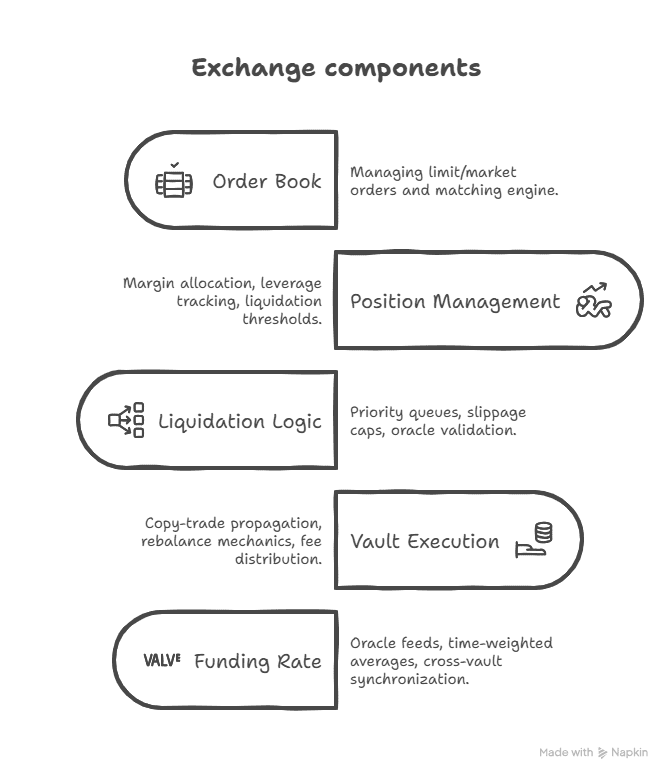
TradeView’s core protocol logic is implemented entirely on-chain, encompassing:
-
Order Book Logic: Limit/market orders, matching engine dynamics
-
Position Management: Margin allocation, leverage tracking, liquidation thresholds
-
Liquidation Logic: Priority queues, slippage caps, oracle validation
-
Vault Execution: Copy-trade propagation, rebalance mechanics, fee distribution
-
Funding Rate Calculations: Oracle feeds, time-weighted averages, cross-vault synchronization
This architecture ensures:
-
Complete Trade Traceability: Every user action—trades, liquidations, vault joins, exits—is recorded as verifiable on-chain transactions. Third parties can reconstruct full user histories using event logs and transaction data.
-
Auditability by Design: There is no reliance on opaque backend databases. Every computation and state transition can be validated externally by researchers, auditors, or users.
-
Decomposable State Analytics: Data such as net trader P&L, drawdown trajectories, margin calls, and copy-trade lag can be extracted using open APIs or directly from event streams.
-
Self-Verification by Users: Individual users can independently verify their account state—checking margin ratios, calculating vault returns, and auditing performance metrics directly from chain state and contract interfaces.
-
Public Monitoring Tools: Community dashboards and analytics platforms can monitor slippage deviations, liquidation frequencies, funding rate behavior, and execution health in real time without API access.
-
Security via Transparency: By exposing every layer of protocol behavior to the public, TradeView invites security researchers and users alike to participate in proactive validation and bug detection.
This commitment to full-state transparency makes TradeView not only a decentralized trading platform but a verifiable, trust-minimized public utility for perpetual markets.
12.1.2 Deterministic Execution Proofs
TradeView uses Merkle-rooted proofs and hashed triggers for:
-
Order Book Snapshots: Each block emits a hashed representation of the order book state.
-
Vault NAV Adjustments: Vaults publish NAV deltas per epoch, hashed into event logs.
-
AI Event Signatures: AI-driven alerts are hashed and signed, proving non-repudiation of logic triggers.
This deterministic architecture allows:
-
Decentralized Frontend Reconstruction: Lightweight clients can verify order placement and execution locally.
-
Trustless Indexing: Anyone can build or run archive nodes and indexers using emitted events and Merkle paths.
-
Instant Dispute Resolution: Validators or auditors can replay vault logic deterministically to resolve edge-case disputes.
All execution-critical logs are timestamped, hashed, and signed on-chain to support fully trust-minimized environments.
12.2 Smart Contract Audits & Formal Verification
12.2.1 Multi-Tiered Audit Approach
TradeView applies a layered audit methodology for maximum assurance:
| Stage | Description |
|---|---|
| Internal Security Review | Conducted by protocol engineers using static analysis (e.g., Slither), fuzzing via Foundry, and gas optimization passes. |
| Third-Party Audits | All critical contracts are reviewed by at least two top-tier firms (e.g., Trail of Bits, Zellic, OpenZeppelin). |
| Community Scrutiny | Open-source codebase is available for peer review with reward incentives through community bug bounties. |
| DAO Audit Challenges | Modules nearing deployment may be submitted to governance-driven bounty campaigns, inviting whitehats to attack unreleased logic. |
TradeView enforces:
-
100% Critical Logic Coverage: All liquidation paths, matching logic, and vault flows must be tested.
-
CI/CD Enforcement: GitHub Actions and coverage checks block merges if test coverage or linting is inadequate.
-
No Mainnet Deployment Without Audit Sign-Off: All audited code must be published with PDF reports, test artifacts, and reproducible builds.
This layered system ensures early vulnerability detection, broad accountability, and high-assurance deployments.
12.2.2 Formal Verification
For components deemed highly critical—such as liquidation calculations, vault syncing, and matching engine logic—TradeView performs formal verification using industry-standard tools:
-
Certora: For automated model checking and specification-based fuzzing.
-
SMTChecker: Via Hardhat or Foundry for symbolic execution and invariant analysis.
-
Mythril: Used for detecting symbolic flaws and business logic edge cases.
Verification specifications include:
-
Invariant Maintenance: Ensures that no execution state violates essential rules (e.g., collateral ratio must always exceed liquidation threshold).
-
Behavioral Boundaries: Validates bounded trade results, preventing infinite gain/loss loops.
-
Reentrancy Protections: Ensures vault and execution logic are non-reentrant across nested call paths.
Deliverables from formal verification are published as:
-
Machine-readable specification sheets
-
Annotated source code with formal annotations
-
Audit trail summaries and verification logs
These proofs provide verifiable guarantees around mission-critical behaviors, reinforcing the protocol’s trustless foundation.
12.3 Slashing & Validator Misbehavior Protection
TradeView’s custom Layer-1 blockchain, built on Tendermint BFT, relies on a validator set for consensus, state finality, and oracle data relay. To maintain trust and accountability within this validator set, the protocol enforces strict slashing penalties and behavioral monitoring.
12.3.1 Slashing Conditions
Validators may be penalized for four main categories of misbehavior:
| Offense | Penalty |
|---|---|
| Double Signing (Equivocation) | 5–20% of staked tokens slashed + automatic jailing for a set block duration |
| Downtime > Threshold | 1–5% of stake slashed + temporary exclusion from active set |
| Oracle Misreporting (Intentional) | Up to 100% stake slashed via DAO vote; potential blacklist from oracle rotation |
| Invalid Block Proposal | Immediate ejection from validator set and report to governance council |
TradeView continuously monitors validator behavior via:
-
Tendermint Telemetry: Real-time p2p monitoring and consensus diagnostics
-
On-Chain Slash Events: Automatically emitted for all jailing and penalties
-
Sentry Node Alerts: Off-chain observability layer for liveness and equivocation
All slashing decisions are deterministic, auditable, and enforced via governance-adjustable parameters.
12.3.2 Oracle Reliability Enforcement
Given the sensitivity of pricing data to liquidation and PnL calculations, oracle accuracy is paramount. TradeView enforces:
-
Deviation Bands: Each oracle report must stay within ±0.5% of the median price, calculated across multiple providers
-
Liveness Windows: Missed updates beyond allowed block intervals are flagged and punished
-
Governance Escalation: Multiple misreports or liveness violations can trigger DAO review, slashing, and possible rotation from the oracle set
Additionally, validators assigned to oracle duties may be required to stake additional collateral, which can be slashed upon proven misconduct.
Together, these mechanisms ensure that validators not only maintain consensus integrity but also uphold pricing accuracy and data availability for all protocol functions.
12.4 Bug Bounty and Incident Response
Security in decentralized systems must extend beyond smart contract audits and into real-time threat response and proactive community participation. TradeView adopts a multi-layered approach that includes a live bug bounty program, structured vulnerability intake process, and clearly defined incident recovery protocols.
This section outlines how TradeView incentivizes ethical disclosures, manages critical exploit scenarios, and involves the community transparently in both remediation and protocol hardening.
12.4.1 Public Bug Bounty Program
To continuously surface vulnerabilities from diverse security researchers and white-hat developers, TradeView runs a tiered bug bounty program, paying rewards in its native token based on severity and exploit complexity.
- Goals:
-
Proactively identify vulnerabilities before they are exploited in the wild.
-
Engage the white-hat community through fair incentives and respectful crediting.
-
Keep protocol surface areas (smart contracts, frontend, API, bots) under continuous review.
- Severity Levels and Payouts:
| Severity | Example Exploit | Max Payout |
|---|---|---|
| Critical | Full fund theft, bypassing liquidation engine | 1,000,000 Native Tokens (~$1M+) |
| High | Fee siphoning via orderbook manipulation, vault desync, incorrect slippage application | 250,000 Native Tokens |
| Medium | Unintended order routing from UI, incorrect margin reporting | 50,000 Native Tokens |
| Low | Frontend bugs, cache poisoning, gas inefficiencies | 5,000 Native Tokens |
- Report Requirements:
Each valid submission must include:
-
Exploit Path: Step-by-step technical breakdown showing how the vulnerability can be triggered.
-
Reproduction Steps: Local testcases, payloads, or UI walkthroughs for verification.
-
Impact Analysis: Severity classification, affected contracts/modules, and potential damage.
-
Suggested Fix (Optional): For contributors with mitigation ideas, implementation guidance is welcome but not mandatory.
Submissions without adequate detail or without demonstrated impact may be downgraded in reward tier.
12.4.2 Responsible Disclosure Process
TradeView prioritizes coordinated vulnerability disclosure and provides multiple secure channels for researchers:
Submission Channels:
-
Direct Email: security@tradeview.xyz (PGP key available on official docs)
-
Bug Bounty Partner: Immunefi platform integration allows structured disclosure workflows, time-stamping, and reward management.
Disclosure Lifecycle:
-
Initial Triage (<24h): All reports are acknowledged within one business day.
-
Verification & Fix Design (<48h for critical):
-
If confirmed as valid, a proposed patch is created.
-
Critical issues are escalated to core developers and multisig operators immediately.
-
-
Patch Deployment:
-
Minor fixes are rolled out via CI/CD pipelines (frontend/API).
-
Smart contract patches are deployed through either:
-
Governance multisig (emergency upgrade route), or
-
DAO proposal (if non-urgent or planned).
-
-
-
Acknowledgment:
-
Optional contributor credit is offered on bug leaderboard or within the TradeView community forums.
-
High-tier reporters may be invited into private testing groups.
-
12.4.3 Incident Response Protocol
When a security incident occurs on-chain or in the infrastructure stack, TradeView executes a rapid containment and recovery protocol. This protocol is sim-tested monthly with failover drills and real-time response simulations.
If a live exploit is detected:
-
Emergency Response Activation:
-
For blockchain-layer issues (e.g., validator misbehavior or consensus flaw), the protocol can trigger a block production pause via a BFT-based emergency halt signal.
-
For protocol-level issues (e.g., vault manipulation or liquidation race conditions), circuit breakers instantly pause trade execution, vault updates, and liquidation events.
-
-
Core Governance Multisig Mobilization:
-
Composed of developers, community representatives, and external auditors.
-
Initiates emergency patch deployment or triggers recovery contracts.
-
Escalates to DAO-level ratification for permanent resolutions.
-
-
Incident Transparency & Logging:
-
Within 72 hours, a public incident report is released detailing:
-
Timeline of the exploit
-
Funds affected
-
Remediation steps
-
Root cause (if identified)
-
-
Incident reports are published on the governance forum, Github, and protocol docs.
-
-
DAO Action Items:
-
The DAO votes on:
-
User compensation strategy (e.g., restitution pool from treasury)
-
Audit follow-up requirements
-
Temporary governance freeze (if exploit involved governance modules)
-
-
-
User Fund Protection:
- If vault or margin users are affected, snapshots are taken immediately and funds are earmarked for distribution upon DAO approval.
These procedures are simulated in sandbox environments monthly, ensuring validators, devs, and multisig signers are ready to act during zero-day threats.
Summary: Bug Bounty & Response Stack
| Component | Details |
|---|---|
| Bug Bounty Program | Tiered TradeView's Native Token rewards, up to 1M TradeView's Native Token per report, via direct or Immunefi submission |
| Disclosure Process | 24–48h triage & patch turnaround; optional public credit; governance deployment optional |
| Emergency Protocols | Circuit breakers, block production pause, DAO-triggered compensation or code freeze |
| Transparency Standards | Public postmortems within 72h, monthly sim-testing, audit logs made public |