














In decentralized perpetual trading, alpha generation is often siloed, and social trust is fragmented. TradeView transforms this dynamic by integrating native social trading mechanics, allowing high-performing traders to earn followings and monetize strategies, while new or passive users can allocate capital transparently via on-chain copy trading vaults.
This system is fully permissionless, smart contract-controlled, and DAO-governed. It introduces:
-
Public leaderboards and trader analytics,
-
Vault-based strategy mirroring,
-
Performance-based rewards and revenue sharing,
-
Community-driven trust and reputation signals.
The architecture enables seamless discovery of profitable trading strategies, verifiable execution records, and secure delegation of capital — all without compromising self-custody or on-chain transparency.
9.1 Leaderboards and Public Trader Profiles
9.1.1 Overview
TradeView implements a global leaderboard system, displaying anonymized or pseudonymous public profiles of top-performing traders based on verifiable on-chain metrics. This enables organic discovery of credible trading personas across various trading styles — from scalpers to swing traders, low-risk hedgers to high-leverage momentum players.
9.1.2 Core Metrics for Ranking
Leaderboards are sortable by:
| Metric | Description |
|---|---|
| ROI (Return on Initial Margin) | Net realized PnL divided by starting margin over a selected window |
| Win Rate | % of profitable trades |
| Max Drawdown | Largest equity loss from peak |
| Avg Leverage | Typical leverage used per trade |
| Liquidation Avoidance Score | Inverse metric of liquidation frequency, normalized by activity |
| Vault ROI (if copyable) | Aggregate PnL of all users copying this trader's vault |
All metrics are fully verifiable and backed by signed position/transaction data stored on-chain.
9.1.3 Trader Profile Pages
Each trader (by wallet or pseudonym) may opt to publish a public profile, containing:
-
Bio or trading style (optional)
-
Vault links (if offering copy trading)
-
Historical performance charts
-
Risk/volatility scores
-
Trading timeline (when trades were opened, closed)
-
Follower count and community comments
Private traders may remain anonymous, while strategy leaders can use profiles to attract followers and build influence.
9.1.4 Access Control & Privacy Options
-
Traders can choose:
-
Private mode (no leaderboard listing, hidden stats)
-
Public analytics only (visible stats, no vault)
-
Copyable vault + full stats (monetized strategy)
-
-
Profiles are non-custodial — vaults are not managed by the trader, only mirrored.
9.2 Smart Contract Vaults for Copy Trading
9.2.1 Vault Design Overview
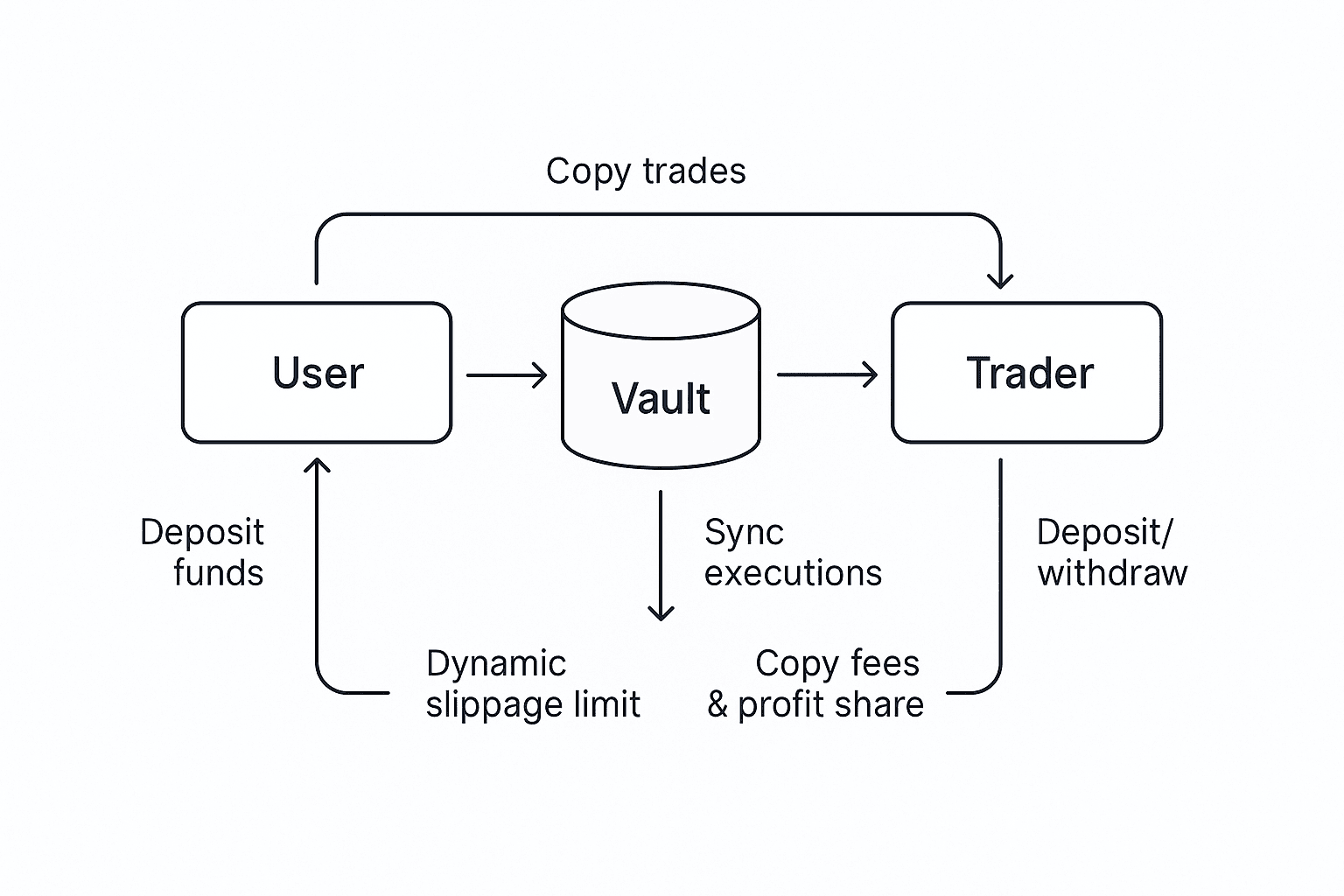
At the core of TradeView's social trading system are smart contract-based copy trading vaults, which allow any user to delegate capital to mirror a trader’s strategies in real time, without giving up custody or control.
Vaults act as non-custodial strategy wrappers, linking a trader’s on-chain actions to mirrored execution in user-owned capital pools.
9.2.2 How Vaults Work
-
Trader creates vault: Sets parameters like strategy type (manual, algo), access mode (open/invite), and fee model.
-
Followers deposit into vault: Users commit collateral (e.g., USDC, ETH) and mint vault tokens representing share ownership.
-
Trader trades from reference account: Every execution (open/close/modification) is tracked.
-
Vault replicates trades: Smart contract mirrors position sizing and execution logic across all vault participants.
-
Vault NAV updates: Vault token price fluctuates based on PnL performance.
-
Users redeem anytime: Vault tokens can be burned to withdraw underlying assets + gains (minus fees).
9.2.3 Execution Logic & Constraints
-
Vaults enforce:
-
Delay windows (e.g., copy trades only after 1–3 blocks) to prevent frontrunning.
-
Slippage guards: Copy-trades are skipped if slippage exceeds user-defined tolerance.
-
Trade size normalization: Followers execute proportionally based on vault share, not raw notional.
-
-
Vaults cannot:
-
Perform unauthorized withdrawals
-
Control funds outside of position actions
-
Modify parameters after creation (immutability enforced or DAO-governed for advanced vaults)
-
9.2.4 Vault Types
| Vault Type | Description |
|---|---|
| Manual Copy Vault | Mirrors manual trading of the lead trader in real time. |
| Bot-Linked Vault | Linked to algorithmic or signal-based bot (via API or on-chain bot registry). |
| DAO Vault | Strategy managed by multi-sig or DAO, not a single wallet. |
All vaults are verified before being listed on the Discover page to prevent malicious or rug-prone vault setups.
9.3 Incentive Sharing: Copy Fees & Profit Sharing
TradeView introduces a programmable and fully on-chain fee-sharing mechanism to align incentives between strategy leaders (vault creators) and their followers. By transparently codifying performance-based, management-based, and entry-based revenue flows, the protocol supports a sustainable creator economy while preserving user trust through immutable smart contract enforcement.
9.3.1 Monetization Models for Strategy Leaders
Strategy vault creators (i.e., traders) can monetize their trading expertise through three primary fee types:
| Fee Type | Trigger | Recipient |
|---|---|---|
| Performance Fee | % of net realized profit per follower | Trader’s wallet (claimable on exit) |
| Management Fee | % of AUM accrued daily or weekly | Trader’s wallet (streamed automatically) |
| Vault Entry Fee | One-time fee on initial deposit | Trader and/or protocol (split logic) |
Key Details:
-
Performance Fee: Collected only on realized profit (high-water mark logic). Followers pay the fee only when they exit with net positive returns.
-
Management Fee: Calculated as a time-based fee on assets under management (AUM), streamed proportionally over the vault lifecycle.
-
Vault Entry Fee: Applied once per deposit, programmable by vault creator within governance-defined boundaries (e.g., max 1–2%).
Enforcement Guarantees:
-
Fees are immutable per vault—once a vault is deployed, the trader cannot adjust the fee structure.
-
All logic is executed via audited smart contracts, preventing off-chain manipulation or opaque overrides.
-
Follower wallets retain full control to exit at any point; fees apply only at trigger conditions (not during idle holding).
This design ensures creator incentives remain aligned with follower returns and limits the risk of predatory vault fee models.
9.3.2 Protocol Revenue Split
To support ecosystem sustainability, TradeView takes a minimal protocol-level fee share from trader earnings.
| Revenue Source | Protocol Fee Applied | Allocation |
|---|---|---|
| Performance Fees | ~5–10% | Protocol Treasury, Insurance Fund |
| Vault Entry Fees | ~5–15% | Treasury, DAO Rewards, Staking Pool |
| Management Fees | 0% | Fully to Trader (to promote long-term vaults) |
Mechanism Details:
-
Protocol Share is Hardcoded: Cannot be modified after vault deployment. The split logic is encoded in the fee-collection functions.
-
Distribution Routing:
-
Treasury: Funds DAO operations, community grants, and governance-approved development.
-
Staking Pool: TradeView’s native token stakers may earn a share of collected protocol fees (governance controlled).
-
Insurance Fund: A portion may be directed to backstop extreme events (e.g., vault-wide liquidation scenarios).
-
This model ensures the protocol benefits from trading activity without diluting trader earnings unfairly and incentivizes the creation of vaults that maximize net value creation.
9.3.3 Claiming & Transparency
TradeView ensures fully transparent, trustless revenue flows across both trader and follower sides.
For Strategy Leaders:
-
Claim Process:
-
Fees are accumulated on-chain.
-
Traders initiate a claim transaction to withdraw available fees.
-
Fees are transferred directly to the trader’s connected wallet without intermediaries.
-
-
Claim Schedule:
-
Performance Fees: Claimed after follower exits or after a time-locked interval (e.g., weekly snapshot).
-
Management Fees: Streamed and claimable at any point.
-
Entry Fees: Accumulated on deposit and available immediately post-deposit.
-
For Followers:
-
Auditable Dashboard:
-
Shows fee breakdowns in real-time.
-
Displays cumulative claimed amounts by the trader.
-
Lists protocol fee percentages and vault-level fee configuration.
-
Includes a historical log of fee transactions per vault and per trader.
-
Security Constraints
-
Traders cannot:
-
Retroactively modify vault fees after deployment.
-
Drain follower funds or claim fees outside designated logic triggers.
-
Hide or suppress fee events from public vault dashboards.
-
-
All fee-related smart contracts:
-
Emit detailed event logs.
-
Are indexed by TradeView’s public API and off-chain data aggregators.
-
Are open-source and independently auditable.
-
This transparent system enables followers to make informed decisions based on true historical performance and cost, while giving successful traders meaningful, scalable revenue opportunities without compromising decentralization or safety.
9.4 Community Trust Mechanisms
Trust is critical in social and copy trading systems—especially when users are delegating capital to vault operators or copying strategies based solely on public performance. Unlike opaque Web2 systems where statistics can be manipulated or faked, TradeView establishes a transparent and verifiable trust layer built on on-chain data, community social signals, and long-term reputation metrics.
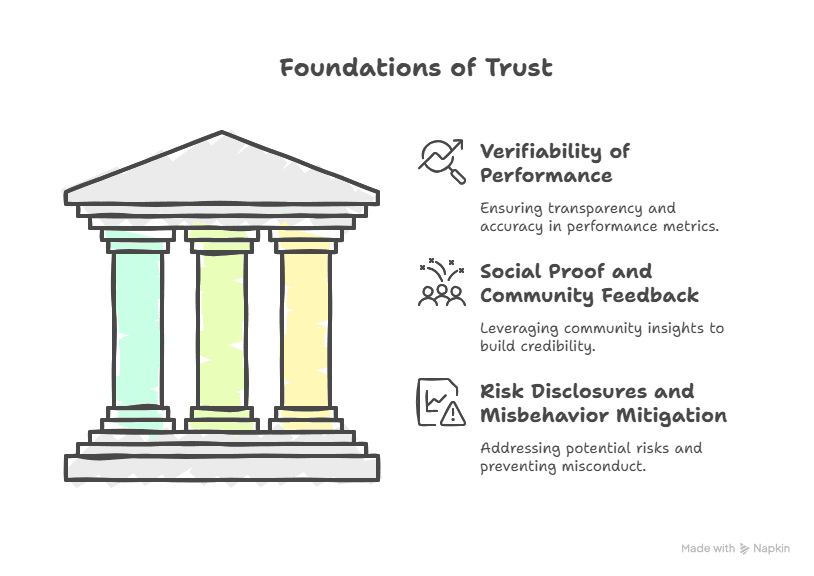
TradeView’s trust mechanisms are built on three pillars:
-
Verifiability of Performance
-
Social Proof and Community Feedback
-
Risk Disclosures and Misbehavior Mitigation
9.4.1 Verifiability of Performance
Most centralized copy-trading platforms operate on unverifiable, opaque data—leaving users vulnerable to fabricated stats, fake ROI, and cherry-picked trade logs. TradeView solves this by enforcing fully on-chain transparency for all performance metrics:
-
Signed Position Histories: Every trade, position change, and margin adjustment is tied to the user’s address and confirmed via on-chain logs.
-
Liquidation Events: Liquidations are timestamped and published on-chain, with full slippage records and funding costs.
-
Execution Price Auditing: Users can compare actual execution prices against oracle prices to measure fairness.
-
Immutable Trade Logs: Vault trade histories can be exported, verified, and independently audited by third parties.
-
Leaderboard Immunity to Censorship: No admin edits, deletions, or score tampering. Rankings are computed programmatically based on pre-agreed metrics.
This ensures that users are copying real, verifiable performance—not marketing slides or backtested illusions.
9.4.2 Social Proof Systems
To create an organic reputation layer around traders and vault creators, TradeView incorporates several social proof signals that help users evaluate credibility beyond just numbers:
| Signal Type | Description |
|---|---|
| Endorsements | Users can “vouch” for a trader’s ethics, transparency, or teaching value. |
| Vault Follower Count | Number of active wallets copying a trader—a social signal for trust and traction. |
| Discord/Twitter Links | Traders may link their public social profiles to build transparency. |
| Strategy Ratings | Vault followers can rate strategies after defined evaluation periods (e.g., 30 days). |
| DAO Feedback Tags | DAO members can attach community-voted tags (e.g., “Drawdown Degen,” “Risk Smart”). |
These systems build trader credibility over time while enabling the community to surface emerging talent. Importantly:
-
Ratings can’t be spammed or sybil-attacked due to wallet history-based gating.
-
Traders who engage in harmful behavior (e.g., pump-and-dump orchestration, misleading trade setups) may be flagged or shadowbanned via DAO consensus.
9.4.3 Risk Disclosure & Ranking Transparency
TradeView enables copy-traders to evaluate not just performance, but also the risk profile and strategy characteristics of vaults and traders. Each vault has a risk card published alongside its ROI and follower stats, including:
| Metric | Explanation |
|---|---|
| Volatility Rating (1–5) | Based on standard deviation of PnL across rolling periods. |
| Drawdown History | Shows the largest peak-to-trough loss in the last 30/90/180 days. |
| Max Slippage Exposure | Tracks largest slippage per trade during high volatility. |
| Trade Frequency | Helps users assess whether the strategy is low-touch (e.g., weekly rotation) or high-frequency (e.g., scalping). |
In addition to raw ROI, vaults can be sorted and filtered by:
-
Sharpe Ratio: ROI adjusted for volatility.
-
Sortino Ratio: ROI adjusted for downside volatility.
-
Consistency Score: Rolling month-over-month profitability.
These risk-adjusted metrics help surface responsible traders, not just high-risk gamblers who happened to outperform temporarily.
9.4.4 Slashing & Collateral for Vault Operators (Future Roadmap)
While TradeView currently operates without requiring vault operators to post collateral, future versions of the protocol may introduce economic slashing systems to align trader incentives with community trust:
A. Collateral Slashing
-
Vault creators may be required to stake a minimum amount of Tradeview’s native tokens when launching a strategy.
-
If the vault triggers defined catastrophic events (e.g., 80% drawdown, failed slippage checks, repeated loss flags), a portion of this stake may be slashed and redistributed to affected followers or burned.
B. Reputation Slashing
Even without capital penalties, the system will:
-
Auto-delist vaults that fall below trust thresholds.
-
Reduce discoverability of vaults with consistent underperformance or high complaint frequency.
-
Add negative DAO tags to vaults (e.g., “Risk Flagged”, “Delayed Syncs”, “Poor Exit Discipline”).
Both slashing mechanisms are enforced via smart contract logic and community DAO votes, ensuring a fair, transparent penalization system for abuse.
Summary Table: Trust Enforcement Matrix
| Component | Enforcement Layer | Outcome |
|---|---|---|
| Performance Verifiability | On-Chain Logs | No stat manipulation possible |
| Social Proof | User Activity + Wallet History | Organic reputation, sybil resistance |
| Risk Disclosure Transparency | Vault Analytics Engine | Smarter decisions, less blind copying |
| Collateral & Reputation Slashing | Future DAO Modules | Strong alignment between trader success and safety |
9.4.1 Verifiability of Performance
Unlike traditional platforms that rely on centralized backend APIs to simulate trading performance, TradeView’s model ensures immutability and full verifiability of trader actions and vault results:
-
Signed Execution Logs: Every trade made by a trader or vault is cryptographically signed and recorded on-chain. This guarantees the authenticity of trade history and eliminates any chance of data manipulation.
-
On-Chain Performance History: ROI, PnL, funding rate costs, liquidations, and leverage metrics are drawn directly from vault smart contracts and oracle feeds. This enables users, DAOs, and third-party dashboards to independently compute and verify performance.
-
Liquidation and Slippage Transparency: TradeView discloses all liquidation events, execution slippage, and post-trade effects (e.g., price impact on orderbooks), making it impossible to hide poor performance or cherry-pick trades.
-
Auditability and Export Support: Every vault's trading history can be exported for backtesting, 3rd-party audit, or strategy analysis—supporting both transparency and education.
Key Differentiator: No admin or platform operator can modify leaderboards, erase vault losses, or inject “fake trader accounts” with fictitious success.
9.4.2 Social Proof Systems
Trust in decentralized environments is reinforced through community-driven endorsements and non-financial social signals. TradeView builds this in with multiple sybil-resistant mechanisms:
| Signal Type | Description |
|---|---|
| Endorsements | Any user with on-chain trade history or a verified vault can “vouch” for another trader. These are non-monetary and limited per wallet to avoid spam. |
| Vault Follower Count | Visible tally of real, active wallet addresses copying a given vault, segmented by timeframes (e.g., 24h, 30d). |
| Linked Profiles | Optional social integrations (e.g., Twitter/X, Discord) allow traders to link their crypto identity with public channels, fostering transparency. |
| Strategy Reviews | Vault followers can leave post-period reviews (e.g., after 7 or 30 days), rating strategy discipline, communication, and performance accuracy. |
| DAO-Moderated Tags | The TradeView DAO can assign community feedback labels such as “Reliable Risk Manager,” “Late Syncs,” or “Volatile Strategy,” which influence visibility and trust ratings. |
To mitigate abuse:
-
Endorsements require minimum wallet/trading age or follower count.
-
DAO tags must be proposed and passed by vote.
-
Vault reviews are only allowed after defined evaluation periods, ensuring fairness and reducing short-term bias.
This layered system prevents “false influencers” and instead promotes long-term transparency.
9.4.3 Risk Disclosure & Ranking Transparency
Performance without context is misleading. TradeView equips users with deep analytical data to understand a vault’s true risk profile—not just ROI headlines.
Every vault and trader profile includes the following metrics:
| Metric | Description |
|---|---|
| Volatility Rating (1–5) | Quantified from rolling standard deviation of returns. Helps categorize vaults as “conservative,” “moderate,” or “high risk.” |
| Drawdown History | Shows worst-case peak-to-trough loss percentages over 30/90/180 days. Exposes periods of rapid equity decline. |
| Max Slippage Exposure | Records largest per-trade slippage based on execution vs. oracle reference. Useful for identifying thin-liquidity strategies. |
| Trade Frequency | Daily/weekly execution count and average trade duration. This informs users if the vault is scalping, trend following, or rotating. |
Advanced Metrics:
-
Sharpe Ratio: Measures risk-adjusted return by comparing excess returns against portfolio volatility.
-
Sortino Ratio: Focuses on downside deviation, ideal for detecting aggressive vaults with asymmetric loss profiles.
-
Consistency Score: A proprietary metric combining frequency of profitable weeks/months with volatility behavior.
Sorting & Filtering
-
Users can filter vaults by “low drawdown, > 10% 30-day ROI” or “Sharpe > 1.5, min 50 followers,” making discovery practical and risk-aware.
-
Rankings are not static; they evolve in real time based on new trade logs and risk performance.
9.4.4 Slashing & Collateral for Vault Operators (Future Roadmap)
To align vault creators with long-term, responsible strategy management, TradeView is designing a staking and slashing framework to be introduced after DAO ratification.
A. Collateral Staking for Vault Creators
-
Vault creators must stake a configurable minimum amount of TradeView’s Native Token (e.g., 2,000–10,000 TradeView's Native Token).
-
This stake is held as collateral against reckless or abusive behavior such as:
-
Failure to execute intended strategy (e.g., sync delays, wild deviation).
-
Catastrophic drawdown (>80% in 7 days) not disclosed in advance.
-
Misleading communications or exit scams.
-
B. Slashing Logic
-
A portion of the creator’s TradeView's Native Token stake is slashed upon:
-
DAO vote post-incident.
-
On-chain trigger condition (e.g., vault breaks stop-loss limits 3 times in a week).
-
-
Slashed tokens are either:
-
Redistributed to affected copiers.
-
Burned permanently, reducing supply.
-
Added to the DAO’s insurance or community fund.
-
C. Reputation Slashing (Non-Economic)
Even without capital penalties, the system also imposes:
-
Soft Delisting: Vault removed from discovery pages for 14–30 days.
-
Reputation Decay: Endorsement scores and visibility reduced.
-
Rebuilding Mechanism: Creators can stake more TradeView's Native Token or complete DAO quests to re-earn trust.
These deterrents ensure that vault creators maintain high standards and build long-term credibility rather than short-term performance spikes.
Summary: Trust Integrity Framework
| Layer | Component | Purpose |
|---|---|---|
| Data Integrity | On-chain trade logs | Verifies every trade and ROI |
| Social Signals | Endorsements, follower counts | Builds non-monetary credibility |
| Risk Transparency | Sharpe, drawdown, volatility | Enables informed vault discovery |
| Slashing Framework | TradeView's Native Token staking + performance penalties | Economic deterrents for reckless behavior |
| DAO Oversight | Feedback tags, delisting proposals | Community-led enforcement and trust calibration |