














TradeView prioritizes frictionless onboarding while maintaining decentralized integrity and composability. Whether a user prefers the full control of a non-custodial wallet or the simplicity of an email signup, TradeView’s multi-pronged access system ensures inclusivity without compromising security or performance.
6.1 Non-Custodial Wallet Integration (MetaMask, WalletConnect, Coinbase Wallet)
TradeView ensures complete support for the most widely adopted non-custodial wallets by building a modular, provider-agnostic wallet integration layer. This provides seamless user authentication, message signing, and transaction execution — without requiring custody of user keys.
6.1.1 Protocol Architecture for Wallet Abstraction
Wallet Abstraction Layer (WAL):
-
Acts as the intermediary between the client-side user interface and the backend execution layer.
-
Implements a dynamic provider resolution logic at runtime to detect and initiate supported wallet types.
-
Ensures that no wallet-specific logic leaks into the core dApp logic; provider changes or upgrades remain modular.
| Component | Function |
|---|---|
| walletResolver() | Determines wallet type from browser context or WalletConnect payload |
| signingModule() | Handles EIP-712 structured data signing, EIP-191 fallback |
| sessionTracker() | Maintains ephemeral session information (per-chain nonce, auth context) |
| fallbackModule() | Provides recovery prompts, e.g. user signs a transaction but closes the tab before confirmation |
Key Features:
-
Stateless by design — all session context lives client-side or within ephemeral browser storage.
-
Allows unified UX for injected (browser) wallets, mobile wallets, or standalone extensions.
-
Engineered for chain-specific behavior (e.g., different signer interfaces for Cosmos-based vs EVM chains).
Supported Wallet Protocols:
-
MetaMask: EIP-1193 compliant, most widely supported Ethereum wallet.
-
WalletConnect: v2 is compatible with multi-chain support and QR code session initiation.
-
Coinbase Wallet: Injected provider integration and standalone SDK supported.
| Wallet Provider | Connection Type | Chains Supported | Session Management | Recovery Mechanism |
|---|---|---|---|---|
| MetaMask | Injected EIP-1193 | EVM Chains Only | Single session per browser tab | User-controlled |
| WalletConnect v2 | QR Code + Mobile Deep Link | EVM + Custom Chains | Cross-device multi-session | Key rotation enabled |
| Coinbase Wallet | Injected or SDK | EVM Chains Only | Mobile-first persistent session | Social recovery opt-in |
6.1.2 Signing Protocols and Message Standards
-
EIP-712 Signing for gasless trading, session auth, and structured approvals.
-
Chain Agnostic Improvement Proposal (CAIP-10) is used to standardize user identifiers across chains.
-
Replay Protection using hashed nonce + domain separator logic to prevent cross-dApp leakage.
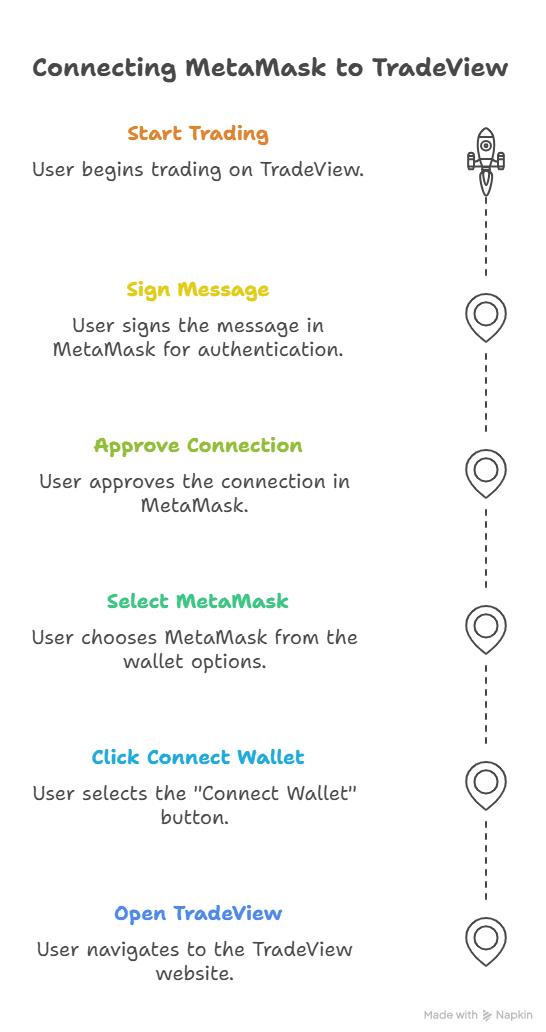
6.1.3 Simple User Flow: Connecting MetaMask to TradeView
-
*User Opens the TradeView Website* → Sees a “Connect Wallet” button in the top-right corner.
-
*User Clicks "Connect Wallet."* → A pop-up appears with wallet options:
-
MetaMask
-
WalletConnect
-
Coinbase Wallet
-
(Or "Continue with Email")
-
-
*User Selects MetaMask* → MetaMask browser extension opens automatically.
-
*MetaMask Prompts for Approval* → User clicks “Next” and then “Connect” to approve the connection.
-
*TradeView Requests Signature for Authentication* → MetaMask shows a "Sign Message" prompt (to verify it's the user).
-
*User Clicks "Sign"* → TradeView confirms the wallet is now connected securely.
-
*User Can Now Start Trading* → Place orders, view balance, adjust margin, etc.
→ No need to sign again unless logging out or the session expires.
6.1.4 Smart Contract Wallet Compatibility (V2 Implementations)
-
TradeView is future-proofed to integrate with ERC-4337 (Account Abstraction).
-
Enables contract wallets (e.g., Safe, Argent) with:
-
Sponsored gas
-
Multisig recovery
-
Session key rotation
-
Role-based permissions
-
6.15 Integration Logic For Order Placement and Signing
| Operation | Wallet Function | Protocol Method | Return Payload |
|---|---|---|---|
| Place Limit Order | Sign typed data | eth_signTypedData_v4 | Signed order blob |
| Cancel Order | Send transaction | eth_sendTransaction | Transaction hash |
| Withdraw Collateral | Sign & Send | Meta tx or direct | Bridge call payload |
| Join Vault Strategy | EIP-712 typed signature | Vault nonce domain | Auth payload |
Advantages of Signed Payloads Over Direct TXs:
-
Enables gasless submission via relayers.
-
Minimizes unnecessary transaction fees for order creation/cancellation.
-
Retains full user control — no backend wallet or session management.
6.1.5 Deep Wallet Integration for UX Enhancements
TradeView takes advantage of specific wallet SDK features for a smoother user experience:
-
MetaMask Snap Support (Future): Enables custom snap modules for notifications, risk alerts, and TradeView-native signing domains.
-
Coinbase SDK Bridge: Detects the Coinbase app via user-agent and deep-links back into the app after wallet connection.
-
WalletConnect Session Recovery: Maintains session context across tabs or device switches via session_restore() hooks.
6.1.6 Security & Fallback Handling
Fallback Paths:
-
If a wallet fails to connect (e.g., user rejects signature), the frontend reverts to an unsigned state with a retry mechanism.
-
TradeView uses deterministic error codes to indicate:
-
Signature mismatch
-
Invalid nonce
-
Expired session
-
Chain mismatch
-
Unsupported method
-
Signature Verification:
-
All signatures are verified on-chain before order routing.
-
Signature recovery is used to derive the public address and match against the session state.
Attack Surface Mitigation:
-
No backend storage of user wallet data or keys.
-
Replay protection via nonce, timestamp, and domain separation per signature payload.
6.1.7 Summary: Why Wallet Abstraction Matters
| Feature | Impact |
|---|---|
| Modular Provider Support | Easy expansion to new wallets (e.g., Rabby, Phantom) |
| Stateless Sessions | No backend session management or wallet custody |
| Deterministic Signing | Reliable UX for both advanced traders and new users |
| Cross-Chain Compatibility | Potential support for Cosmos, Solana via WalletConnect v2 |
| Seamless Auth | One-click wallet login vs multi-step custodial onboarding |
6.2 Email/Password Signup (Custodial Key Abstraction)
TradeView aims to bridge Web2 usability with Web3 infrastructure by offering seamless onboarding through a familiar email/password interface, abstracting private key management while preserving user sovereignty through smart contract security. This is vital to onboard the next billion users without forcing them to understand seed phrases, wallets, or gas.
6.2.1 Custodial Key Abstraction Architecture
Abstract Account Layer (AAL):
-
A middleware layer that abstracts away cryptographic key generation and storage.
-
Each user account is mapped to a smart contract wallet (SCW) managed under a multi-tiered custody model.
-
The custody model includes:
-
Ephemeral session keys (short-term, browser memory)
-
Recovery guardian modules (email verification or biometric-based)
-
Platform-managed vaults (with limited control and programmable constraints)
-
Flow Breakdown:
| Component | Functionality |
|---|---|
| Email Authentication | Email-password credentials are hashed and verified through an OAuth2-style module. |
| Key Generation Service | Generates a new ECDSA key pair per user. The private key is encrypted and stored securely. |
| Smart Contract Wallet (SCW) | Deployed upon first trade, linked to the user’s unique key. All trading, deposits, and withdrawals route through this. |
| Relayer Bridge Layer | Converts user intents into on-chain calls through a trusted relayer. |
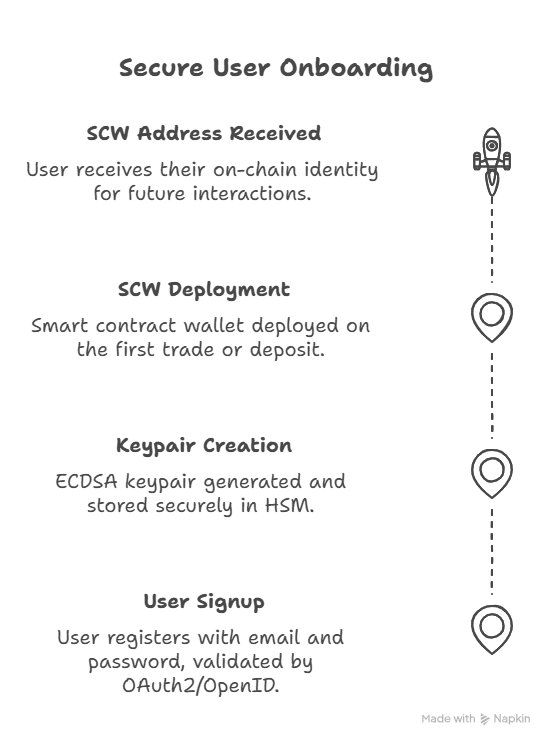
6.2.2 Signup & Key Provisioning Workflow
Step-by-Step Flow:
-
User signs up with email/password
-
Credentials validated using OAuth2/OpenID-compatible auth module.
-
An optional 2FA layer is integrated for enterprise-grade security.
-
-
A custodial keypair is created
-
ECDSA keypair generated in HSM-backed service (Hardware Security Module).
-
Encrypted private key stored in the platform key vault.
-
The public key is associated with a deterministic smart contract wallet address.
-
-
Smart Contract Wallet deployed
-
Lazy deployment on the first trade or deposit.
-
Incorporates upgradable logic modules for trade authorization, withdrawal limits, and session control.
-
-
User receives SCW address
- This acts as their on-chain identity for all future TradeView interactions.
6.2.3 Security Guarantees & Recovery Logic
Multi-Layer Security Stack:
-
Key Escrow Limitations: No single party has full access. All transactions require multi-layer approval.
-
Biometric + Email Recovery: Users can recover access via biometric unlock or email-based guardian logic.
-
SCW Access Policies: Time-based rate limits, withdrawal limits, and 2FA checks embedded in wallet logic.
Smart Contract Wallet Protections:
| Security Feature | Description |
|---|---|
| Guardian Delegation | A designated fallback guardian (like email or social login) can recover access. |
| Rate-limiting | Prevents large withdrawals in short timeframes unless multi-signed. |
| Time Locks | Delay critical changes (e.g., adding a new device, withdrawing large funds). |
6.2.4 Use Cases and Benefits
Web2 Familiarity + Web3 Sovereignty:
-
Ideal for newcomers: Sign up in seconds without needing seed phrases.
-
Protocol-level composability: Despite custodial appearance,the backend is non-custodial and interoperable.
-
Upgrade Path: Users can “graduate” to full self-custody by exporting keys or linking MetaMask.
Institutional Use Case:
- Role-based key abstraction with controlled access per employee (trader, risk manager, compliance).
6.3 Gasless Trading via Meta Transactions
Gasless trading is a cornerstone of TradeView’s seamless user experience. By removing the need for end-users to hold or manage native gas tokens, it creates an experience that rivals centralized exchanges while retaining the security guarantees of fully on-chain execution. This is accomplished through a robust meta-transaction architecture and a decentralized relayer network.
6.3.1 Meta Transaction Protocol Design
Key Design Overview:
-
Meta transactions enable a user to submit a trade intent by signing a message off-chain.
-
A trusted relayer then executes this signed transaction on-chain using its gas.
-
TradeView subsidizes gas via its treasury, allowing for zero-fee UX while keeping trade execution deterministic and fully verifiable.
Meta Transaction Lifecycle Breakdown:
| Component | Technical Detail |
|---|---|
| User Intent | Trade is encoded using EIP-712 typed data format (structured data signing). |
| Relayer Role | Validates signature, appends replay nonce, and broadcasts the transaction. |
| Execution Module | Smart contract validates signature, ensures nonce validity, and executes logic. |
| Gas Payment Flow | Paid from TradeView’s subsidy pool managed by a DAO-controlled smart wallet. |
Infrastructure Integration:
-
Gasless Intent Layer is embedded in the order book submission interface.
-
Trusted Relayer Network (TRN) uses staking and slashing to deter abuse.
-
Orders are executed through TradeView’s core execution engine with sub-second finality.
6.3.2 Security Features
Ensuring the integrity and fairness of the gasless execution layer is paramount. TradeView integrates multi-dimensional security logic:
Replay & Front-Running Protection
-
Every user’s intent includes a monotonically increasing nonce.
-
Meta transactions expire after a pre-set timestamp (e.g., 10 minutes).
-
Ensures no duplicate or manipulated transactions can be relayed later.
Rate Limiting & Fair Usage
-
Each wallet address is assigned a session quota (e.g., X gasless trades per hour).
-
Optional IP throttling or device fingerprinting prevents bot spam in UI-generated meta txs.
Relayer Reputation Model
-
Relayers must stake tokens to participate.
-
Slashing or banning applies to nodes submitting malformed, manipulated, or malicious transactions.
-
Future: DAO-based whitelist and performance-based incentives for relayers.
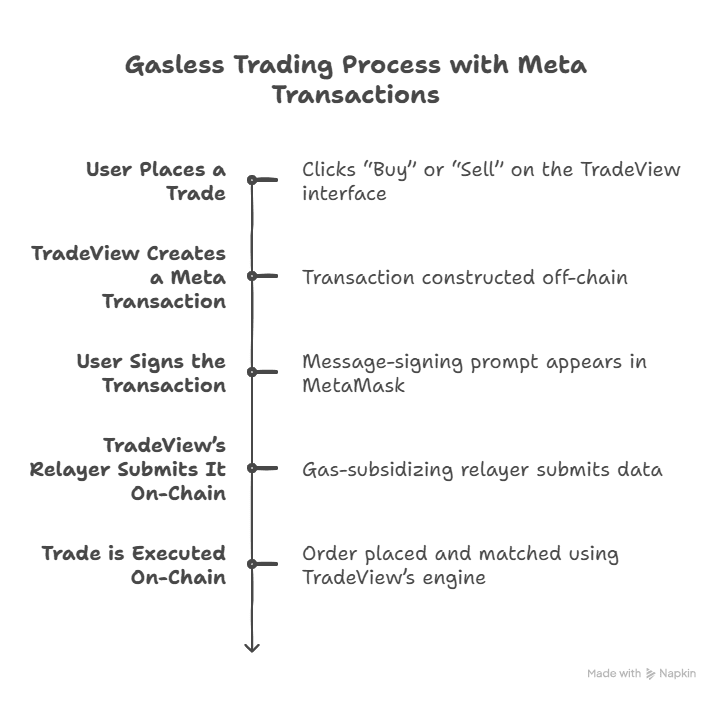
6.3.3 Simplified User Flow: Gasless Trade With Meta Transactions
This flow outlines how a gasless trade is submitted, signed, and executed — all without the user ever paying gas.
| Step | Description |
|---|---|
| 1. User Places Trade | User clicks “Buy” or “Sell” via the frontend. No MetaMask or wallet pop-up appears. |
| 2. Intent Constructed | UI generates an EIP-712 typed payload containing trade parameters. |
| 3. Signature Prompt | MetaMask or any Web3 wallet prompts the user to “Sign” the intent, not approve or pay gas. |
| 4. Relayer Submits Tx | The signed payload is picked by a relayer, broadcast on-chain using its own ETH/TradeView's Native Token. |
| 5. Trade Executed | Trade is atomically placed → matched → settled using on-chain logic. |
| 6. User Confirmation | UI updates in real-time, trade logs emitted, PnL and balances adjusted instantly. |
6.3.4 Governance Controls on Gas Subsidy
TradeView’s DAO retains full authority over how, when, and to whom gas subsidies apply.
DAO Configurable Parameters:
-
Max Subsidy Per User:
- Daily and monthly caps to prevent draining.
-
Eligibility Requirements:
-
Gasless trades may be limited to:
-
Verified traders (via trading volume).
-
Stakers of TradeView’s Native Token.
-
Users acquired via referral programs.
-
-
-
Treasury Allocation Logic:
-
A percentage of protocol revenue may be routed to a Gas Subsidy Pool.
-
Emergency halts or dynamic subsidy curves can be activated via governance votes.
-
Monitoring & Feedback Systems:
-
Real-time dashboards track:
-
Top gasless traders.
-
Relayer performance.
-
Pool depletion rates.
-
6.3.5 Benefits of Meta Transaction Integration
For Users:
-
No Gas Costs: Barrier-free access even for new users without crypto experience.
-
CEX-like UX: Seamless interaction flow with no interruptions or technical hurdles.
-
Security Intact: Funds never leave wallet custody unless explicitly signed.
For TradeView:
-
User Acquisition: Smooth onboarding of first-time users unfamiliar with crypto gas mechanics.
-
Increased Retention: Lower friction leads to higher engagement, especially in emerging markets.
-
Granular Control: DAO can throttle, expand, or contract gas subsidies with surgical precision.
6.4 Session Signing and Seamless UX
TradeView introduces Session Signing to streamline the perpetual trading experience without compromising security or decentralization. This architecture enables users to interact with the dApp seamlessly, with minimal signing interruptions, supporting features like batching, silent re-authentication, and session-level controls.
6.4.1 Purpose of Session Signing
-
Eliminate friction for high-frequency traders who would otherwise sign every transaction.
-
Reduce cognitive overload for new users not familiar with constant wallet prompts.
-
Maintain security boundaries through scoped and time-limited approvals.
6.4.2 Session Signing Architecture
| Component | Description |
|---|---|
| Session Token | Cryptographic proof of user authorization, derived from wallet signature. |
| Expiration Timer | Each session has a pre-set expiration (e.g., 1 hour), configurable per user. |
| Scoped Access | The session is only valid for specific actions (e.g., placing trades, viewing PnL). |
| Re-auth Logic | Session auto-renews upon user inactivity or action limits, without logout. |
Underlying Standards Used:
-
EIP-4361 (Sign-In With Ethereum) to authenticate wallets
-
EIP-712 typed data for explicit scoping and verifiability
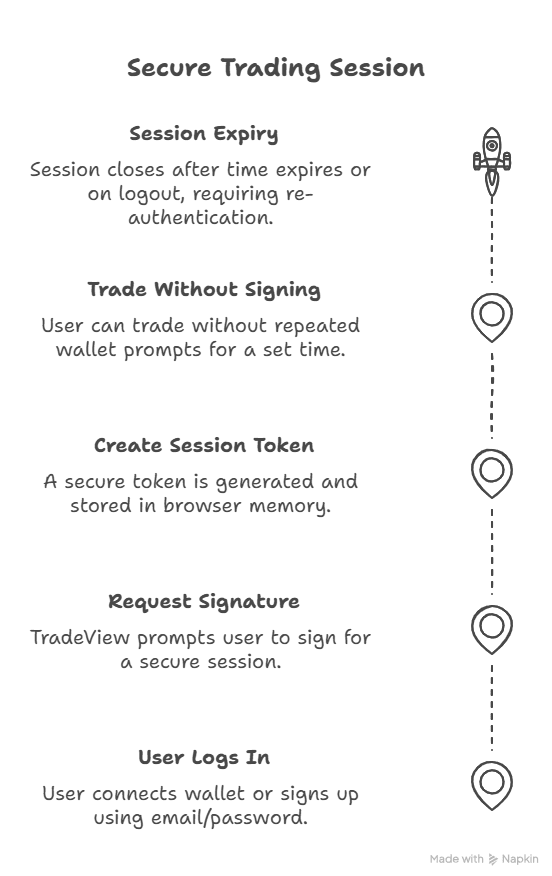
6.4.3 Session Initialization Flow
-
*User Connects Wallet*
- MetaMask, WalletConnect, or another injected provider connects to the dApp.
-
*Sign-In Prompt Triggered*
-
TradeView prompts the user to sign a “session” message using the EIP-4361 standard.
-
No transaction is broadcast — only an off-chain signature is captured.
-
-
*Session Token Created*
-
A sessionToken is generated with:
-
User address
-
Timestamp
-
Valid scopes (e.g., trading, transfer, liquidation view)
-
Expiry time (e.g., 60 mins)
-
-
-
*Stored Temporarily*
-
Held in:
-
Browser memory for frontend dApps
-
Volatile session store for APIs/bots
-
-
No sensitive keys or tokens are stored on backend servers.
-
-
*Used for Fast UX*
-
Every user action checks for the sessionToken.
-
If valid, executes immediately (e.g., place a trade without re-signing).
-
If expired or invalid, the re-sign prompt is triggered.
-
6.4.4 Session Permissions and Scoping
| Scope Type | Use Case Examples |
|---|---|
| Trading | Place/Cancel orders, set take-profit/stop-loss |
| Balance Access | View wallet and margin balances |
| Vault Access | Opt into structured strategies or lending pools |
| Read-Only API | Bot or third-party UI access |
Scoped Signing Benefit:
Users grant only what’s needed, unlike full wallet access or persistent login tokens.
6.4.5 Bot and API Access via Session Keys
TradeView supports programmatic trading bots through:
-
Ephemeral API keys are bound to session tokens.
-
WebSocket + REST endpoints for trade automation.
Bot Session Flow:
-
Trader signs a one-time EIP-712 payload.
-
The backend generates a session key valid for a limited scope and time.
-
Bot uses a key for rapid trade submission without repeated signing.
6.4.6 Session Renewal and UX Considerations
| Event Trigger | Result |
|---|---|
| User returns after timeout | Re-sign prompt triggered for new session. |
| Session expires during trade | Silent failover → session refresh required, message alert shown. |
| User logs out manually | Session is invalidated instantly, requiring full re-authentication. |
6.4.7 Security & Anti-Abuse Mechanisms
-
Session Tokens Are Nonce-Based: Cannot be reused or replayed across sessions.
-
Expiration Enforcement: Sessions cannot be extended beyond hard-coded limits without re-signing.
-
Revocation Mechanisms:
-
Users can manually revoke active sessions.
-
Suspicious behavior (e.g., bot abuse) leads to protocol-level blacklisting.
-
6.4.8 Benefits of Session Signing for All Users
| Stakeholder | Benefit |
|---|---|
| Retail Users | Fewer interruptions, no repeated signing every 30 seconds |
| Power Traders | Efficient batch execution without latency or popups |
| Bot Integrators | API key logic mapped to session token security |
| Mobile Users | Smooth UX without back-and-forth wallet approvals |
| Protocol Security | Scoped logic minimizes attack vectors and wallet misuse |
6.4.9 Future Upgrades
-
Session NFT: Tokenized session NFTs that can be passed to mobile apps or bot runners for temporary access.
-
Multi-Device Session Management: Users can view and manage active sessions across devices from a UI dashboard.
-
Hardware Wallet Support: Enable session-signing logic compatible with Ledger/Trezor UX flows.
-
Adaptive Session Lifetimes: Based on user behavior — longer sessions for active users, shorter for idle users.
6.5 Summary Table: Access Paths at a Glance
TradeView's wallet and access strategy blends DeFi flexibility with CEX-like ease, without compromising on-chain security. Whether you are an institutional fund seeking smart-contract vault permissions or a retail user logging in with FaceID, TradeView's access layer is engineered for all — secure, scalable, and intuitive.
| Access Method | Custody Model | UX Complexity | Trade Permissions | Recovery Options | Session Support |
|---|---|---|---|---|---|
| MetaMask | Non-Custodial | Moderate | Full | User backup | Yes |
| WalletConnect | Non-Custodial | Moderate | Full | External wallet | Yes |
| Coinbase Wallet | Non-Custodial | Easy | Full | Coinbase recovery | Yes |
| Email/Password (MPC) | Semi-Custodial | Very Easy | Tiered | Email/Biometrics | Yes |