














2.1 A Market Ripe for Disruption: The Rise of On-Chain Derivatives
The DeFi landscape has undergone profound evolution over the past two years, marked by explosive growth in volume, user interest, and institutional participation, and no segment reflects this better than the surge in on-chain derivatives.
Once treated as speculative experiments or niche alternative to centralized exchanges, perpetual swaps on blockchain-native protocols now represent a powerful market shift toward transparency, trustworthiness, and composability.
This section explores the data-driven growth of perpetual DEXs, key drivers of adoption, evolving institutional-retail dynamics, and the innovation landscape shaping the future.
2.1.1 Explosive Growth in On-Chain Derivatives
Across all major metrics including trading volume, open interest, user growth, and capital allocation — decentralized perpetual markets are experiencing exponential momentum.
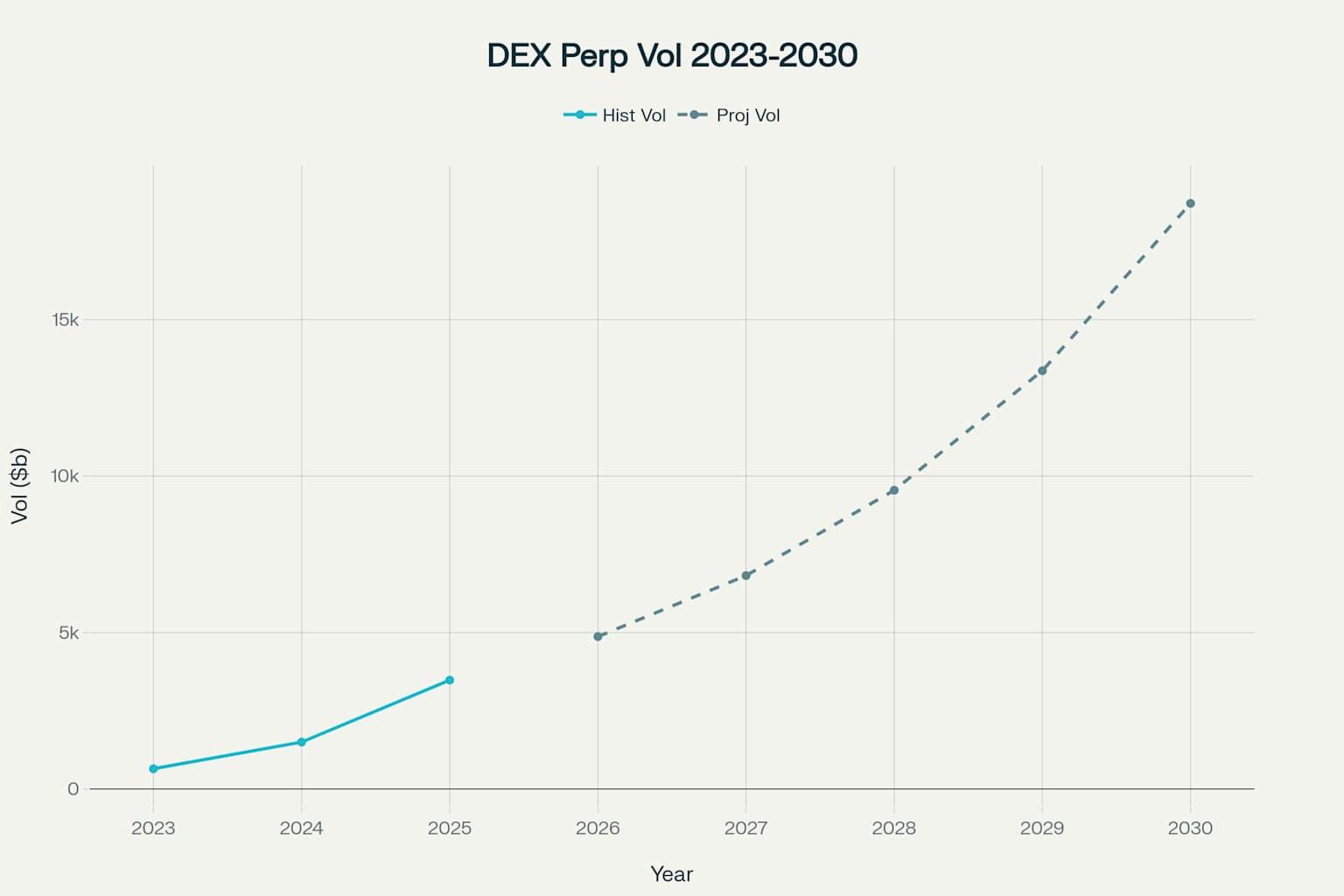
Total trading volume on decentralized perpetual exchanges surged from $647.6 billion in 2023 to $1.5 trillion in 2024, representing a remarkable 131.6% year-over-year increase. This exponential growth trajectory is projected to continue, with volumes expected to reach $3.48 trillion by the end of 2025, maintaining an impressive compound annual growth rate (CAGR) of 75.16%.
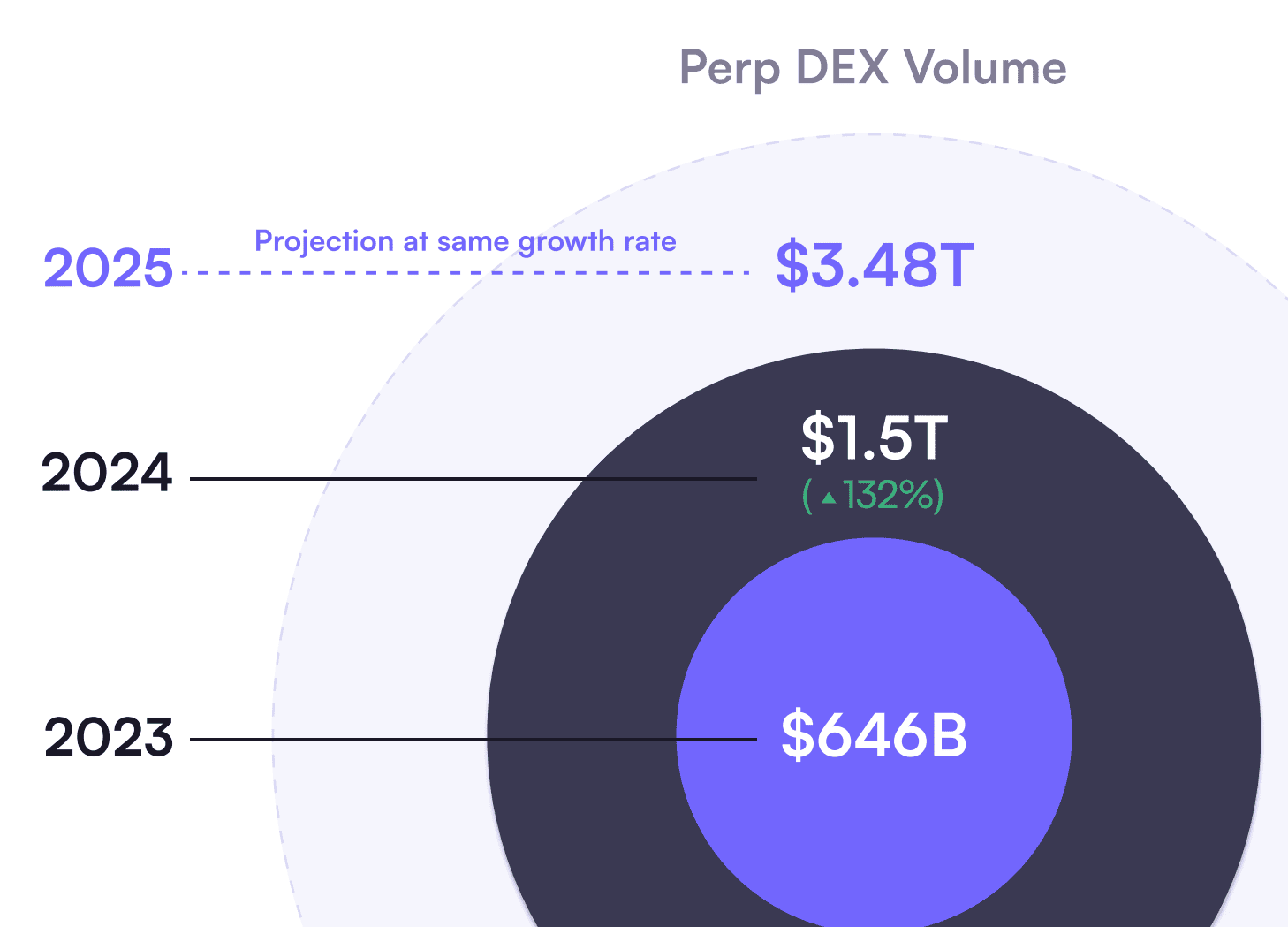
This explosive growth can be attributed to several key factors driving trader migration from centralized to decentralized platforms. Perpetual DEXs offer traders the ability to engage in leveraged trading without intermediaries, providing enhanced security, transparency, and control over their assets. The elimination of counterparty risk and custody concerns has particularly resonated with traders following high-profile centralized exchange failures in recent years. Given the growth trends of Perp DEXs, here we predict the future trajectory and projected volume parameters:
Other Key Stats
-
DEX perpetual contracts’ combined trading volume reached a record $382.3 billion in May 2025, up from $234.2 billion in May 2024.
-
Over the last year, DEXs saw their share of total crypto derivatives volumes climb to over 10%, reflecting growing confidence from all user segments.
-
Much like perpetual CEX platforms, the top 10 perpetual DEXes saw their open interest hit an all-time high of $6.7 billion in December, before ending the year at $4.8 billion. Overall, open interest grew by an impressive 333.6% over the course of 2024.
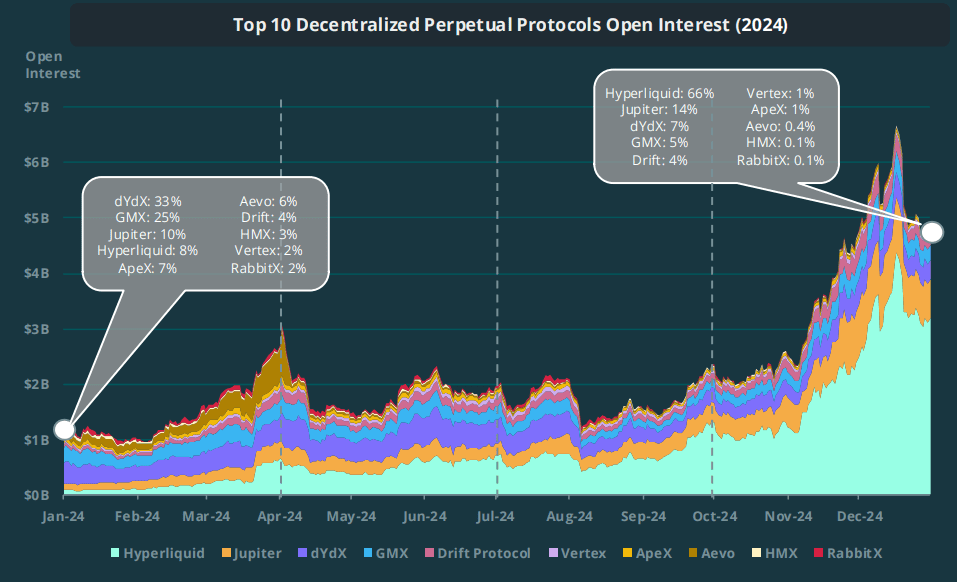
Source: https://assets.coingecko.com/reports/2025/CoinGecko-State-of-Crypto-Perpetuals-Market.pdf
- In 2024, the Total Value Locked (TVL) across the top 10 perpetual DEXes grew nearly 3.5×, closely following the surge in open interest. However, despite this growth, perpetual DEXes still account for just about 3.2% of DeFi’s overall TVL.
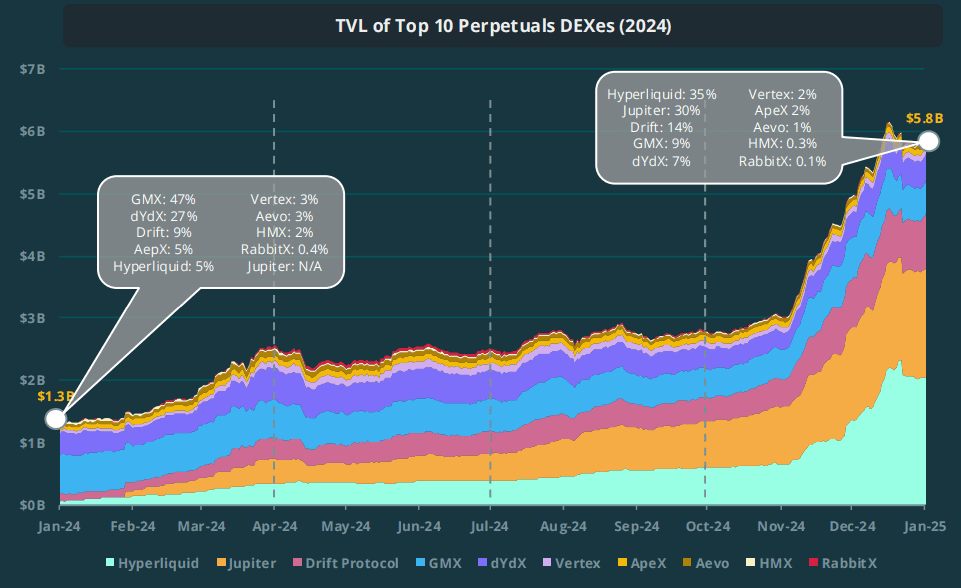
Source: https://assets.coingecko.com/reports/2025/CoinGecko-State-of-Crypto-Perpetuals-Market.pdf
This exponential growth reflects maturing infrastructure and a strong migration from custodial to permissionless venues. Traders are increasingly prioritizing transparency, composability, and self-custody — all of which are default in DeFi-native models.
2.1.2 Institutional + Retail Momentum
The early days of DeFi were dominated by crypto-native retail users. Today, however, both retail and institutional players are pushing into the on-chain derivatives space, often for different but complementary reasons.
- Institutional Catalysts:
The growing participation of major players—both from within the crypto ecosystem and traditional finance—signals a clear recognition of the vast potential in the on-chain derivatives market. This influx underscores the presence of a sizable and largely untapped user base that these entities are actively positioning themselves to serve.
The institutional demand, however, has risen dramatically due to:
-
*Integration with On-Chain Liquidity & Infrastructure:* Institutions are drawn by the ability to execute block trades and deploy sophisticated trading strategies, thanks to advanced, low-latency on-chain infrastructure.
-
*Incentive Programs Driving Adoption:* Programs like SynFutures’ Institutional Adoption Program have played a crucial role in onboarding professional traders, helping push volumes beyond $80 billion.
-
*Institutional-Grade Product Design:* Modern perpetual DEXes are now built to meet to match the needs of professional and institutional traders, who are:
-
High-speed execution
-
Custodial separation
-
Enhanced risk-management frameworks
-
Key Stats:
-
[GFO-X (UK)](https://www.globenewswire.com/news-release/2025/05/13/3079834/0/en/GFO-X-Launches-Regulated-Digital-Asset-Derivatives-Trading-Venue.html#:~:text=LONDON%2C%20May%2013%2C%202025%20(,digital%20asset%20futures%20and%20options.) is a crypto derivatives venue, greenlit by regulators, giving institutions regulated access routes into decentralized asset classes.
-
CME dominates ETH and BTC futures in the regulated world, but significant inflows are now visible on decentralized perps, especially for exotic tokens and altcoins.
-
Revolut announced its move into derivatives trading with direct integration into DeFi protocols, targeting “crypto-native” wealth users in EMEA.
- Retail Behavior:
Perpetual DEXes are increasingly capturing the attention of retail traders by offering features that centralized exchanges often can't match:
-
*Early Access to New Tokens:* Traders can gain exposure to emerging assets before they’re listed on centralized exchanges, giving them a competitive edge.
-
*Lower Fees & Direct Wallet Integration:* With no intermediaries involved, users benefit from reduced trading fees and can execute trades directly from their wallets.
-
*Non-Custodial, 24/7 Trading Access:* Around-the-clock, permissionless access appeals strongly during bull markets and times of high volatility, when speed and control matter most.
For retail users seeking agility, lower costs, and early exposure, perpetual DEXes offer an increasingly compelling alternative to traditional CEX platforms.
Key Stats:
-
Emerging markets like India, Brazil, and Nigeria show 50 %+ of DeFi usage is mobile-first, indicating strong adoption among non-institutional traders.
-
The following is a snapshot of the top countries ranked as per the DeFi transaction volumes.
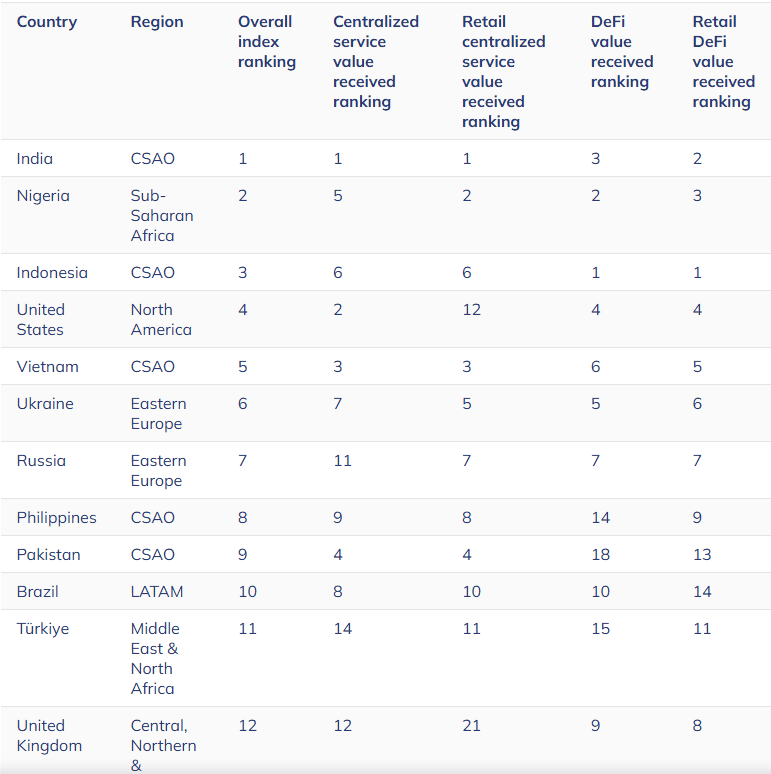
Source: https://www.chainalysis.com/blog/2024-global-crypto-adoption-index/
- Meme coin volatility (e.g., PEPE, WIF) has led to massive retail speculative flows on decentralized perps, with new retail accounts on-chain growing by over 600k wallets in Q1 2025 alone. This reflects a growing risk appetite.
The overall growing adoption of DeFi products and platforms among retail traders automatically pushes demand for DEXs for perps trading.
2.1.3 Rise in On-Chain Collateralization
The evolution of DeFi is marked not just by innovation in trading interfaces but by foundational shifts in how capital is utilized across protocols. One of the most transformative trends is the rise in on-chain collateralization, where user assets are not only stored but actively composed, reused, and leveraged across multiple financial primitives. This is reshaping how liquidity flows and how risk is managed on-chain.
Why On-Chain Collateral Matters
In traditional finance, collateralization is fragmented across custodians, clearing houses, and margin providers. In contrast, DeFi introduces the possibility of programmatic collateral reuse, where a single asset, such as ETH or USDC, can simultaneously fuel lending, perpetual margin, yield strategies, and structured products.
This concept is not theoretical — it’s happening now, and it has the following benefits:
-
Transparency and Auditability: All collateral flows and risk ratios are verifiable on-chain in real-time.
-
Efficient Risk Management: Protocols can offer cross-margin and isolated margin models backed by on-chain logic.
-
Capital Efficiency: It unlocks idle liquidity. Users earn yield while maintaining collateral exposure.
Key Stats and Adoption Trends
-
Over 90% of ETH collateral used in decentralized perpetual platforms remains locked on the Ethereum mainnet. This shows trust in base-layer security and aligns with Ethereum's dominance in DeFi TVL.
-
Composability of collateral has become a key value proposition:
-
ETH → stETH → used in lending protocols → redeployed as margin
-
USDC bridged from Ethereum → used for vault deposits, LPing, and perps collateral simultaneously
-
-
Smart contract vaults like those used by protocols such as Rage Trade and Lyra allow for aggregated strategies, where margin collateral can be pooled, split, and redeployed dynamically without manual intervention.
2.1.4 Catalysts for Continued Growth
| Catalyst | Impact on Derivatives Adoption |
|---|---|
| Product Integrations | Unlocks new use cases like copy trading, vault replication, and structured derivatives |
| Regulatory Clarity | Drives institutional confidence and enables licensed integrations |
| On-chain Leverage Infrastructure | Supports risk-managed trading via composable vaults and smart contracts |
| Market Volatility | Increases trading volume and speculation activity |
| UX Improvements | Reduces user friction and accelerates adoption, especially in mobile-heavy markets |
The convergence of these catalysts is forming a self-reinforcing loop — more users drive liquidity, liquidity enables better products, and better products drive institutional adoption.
2.1.5 Sentiment & Ecosystem Signals
While much of the public crypto narrative focuses on banking integrations or tokenized real-world assets (RWAs), deeper analysis of protocol-level activity and capital flow reveals a more strategic shift: the ecosystem is quietly aligning around derivatives as the next core primitive of DeFi.
Let’s unpack the key signals pointing to this trend.
2.2.5.1 A Quiet Builder Boom in Derivatives
Despite surface noise, the most active DeFi development over the past 12 months has concentrated in perpetual trading protocols, leverage engines, and capital-efficient vault systems.
“The smartest devs aren’t working on memes — they’re building next-gen trading infrastructure.”
This is visible in:
-
Protocol GitHub commits
-
DAO proposal volumes
-
Audit queues for derivatives platforms
-
Growth of open-source trading SDKs
Platforms like Aevo, Vertex, Level, and Drift have recently received consistent upgrades, audits, and VC-backed grants to scale core trading infrastructure.
2.2.5.2 Top Ecosystem Trends: Where Capital and UX Are Merging
- Higher Leverage Trading with Smart Liquidations
Platforms are offering up to 50× leverage, but with more sophisticated control:
-
Dynamic liquidation buffers
-
Real-time portfolio health tracking
-
Insurance fund-backed partial liquidations
This allows professional and retail traders to take smarter, risk-adjusted positions, not just brute-force margin.
- Cross-Chain Liquidity & Intent Routing
Traders are no longer confined to a single chain. This increases demand for:
-
Bridges (like LayerZero, Wormhole) that move USDC/ETH instantly
-
Intent-based routers that find the best venue for trade execution
-
Aggregators (like Socket or LI.FI) that pull liquidity from GMX, Aevo, and others
These create a seamless experience across chains without manual bridging.
- AI-Native Trading Tools
As real-time data becomes available via oracles and subgraphs, a new generation of AI tooling is emerging:
-
Sentiment detection (e.g., bearish shifts based on Twitter/X and on-chain flow)
-
Portfolio monitoring agents (e.g., "your margin ratio dropped below 1.5x")
-
Execution assistants that optimize order types based on volatility
These tools offer real-time guidance, bringing professional-grade intelligence to every user.
- Smart Vaults & Copy Trading Infrastructure
Vaults are evolving into multi-layered ecosystems that combine:
-
Margin management
-
Automated risk controls
-
Social delegation (e.g., follow this trader’s vault strategy)
-
Rewards and performance fees
For new users, this means earning like a pro without complex position management. For top traders, it creates monetizable visibility and community trust.
2.2.5.3 Signals Beyond the Charts: TVL and Product Velocity
TVL (Total Value Locked) in derivatives protocols is rising faster than in lending or DEX segments. Platforms like:
-
Vertex: Introduced market-neutral strategy vaults and saw *45% QoQ TVL growth*
-
Level Finance: Integrates structured products and leaderboard strategies
All of them focus on more than just trading — they’re building full-stack ecosystems.
2.2.5.4 What This Means
-
Derivatives are no longer experimental — they’re monetizing faster and with stronger user retention than traditional AMMs or lending.
-
Vault-based products and AI-driven analytics are becoming investable verticals within DeFi.
-
Cross-chain composability is breaking siloed protocol dominance, allowing for thematic, chain-agnostic exposure.
-
Integrations with wallets, custodians, and compliance layers will define the next wave of institutional DeFi.
These themes point toward a maturing sector that is increasingly capable of supporting not just experimentation, but professional, high-frequency, and institutionally aligned trading.
To Summarize "What wallets did for crypto storage, derivatives will do for crypto strategy." The rise of on-chain derivatives is not a one-off cycle. It's the logical evolution of programmable finance. Perpetual DEXs are: - No longer UX-limited experiments - No longer liquidity-starved ghost towns - No longer retail-only playgrounds They are evolving into capital-efficient, programmable, and transparent trading systems — suitable for everything from meme coin leverage to institutional hedging.
The perpetual trading model can and should therefore be rebuilt from the ground up with decentralization as its native state, not a bolt-on. TradeView addresses systemic gaps through a high-performance, on-chain-first design and positions itself at the forefront of this paradigm shift. It not only replaces the best of centralized performance but also pioneers as a decentralized protocol architecture fit for the next trillion dollars in on-chain trading volume. Let’s now dive into the problems with Perp DEXs and how TradeView addresses these challenges.
2.2 Problems in Decentralized Perpetual Trading Today
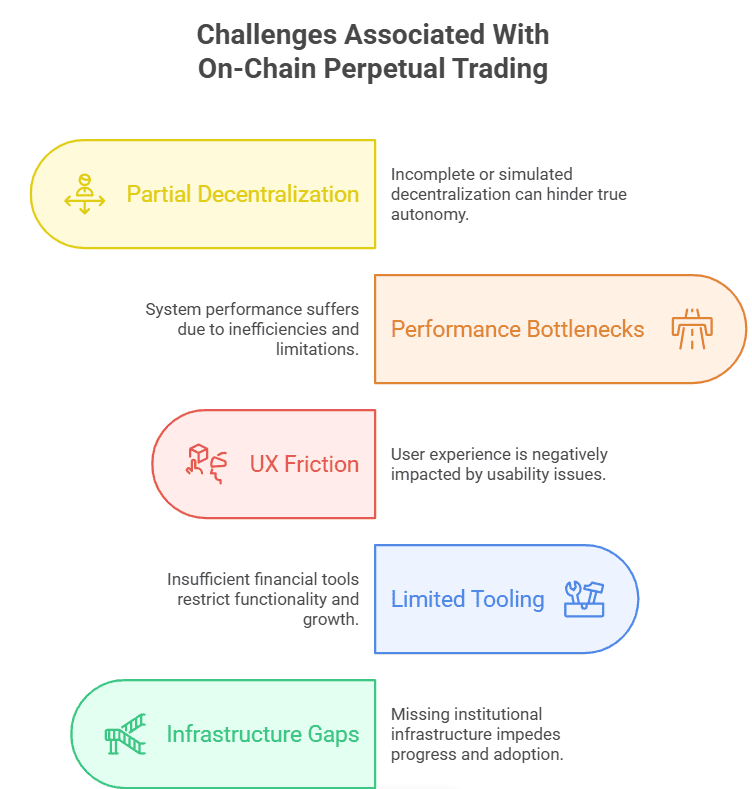
While decentralized finance has made significant strides, with total value locked nearing $200B in Q2 2025, most perpetual DEXs still face structural limitations that hinder mass adoption. Despite increased user awareness and institutional interest in on-chain derivatives, the following four fundamental constraints continue to restrict their potential:
-
Decentralization Tradeoffs
-
Performance Ceilings
-
Usability friction
-
Tooling gaps
This section provides a deep dive into these challenges, supported by data, technical context, and design implications.
2.2.1 Partial or Pseudo-Decentralization
Despite being branded as decentralized, many perpetual trading platforms, on closer inspection, are still found to depend heavily on off-chain or centralized components. This undermines the ethos of DeFi and introduces systemic risks:
- Off-chain Order Books:
Many platforms still maintain order books and matching logic off-chain. While trade settlement may be on-chain, users have no visibility into how trades are matched. This leads to a black-box environment where users cannot verify matching fairness or price priority.
This centralization undermines fairness, opens the door to front-running, and offers no recourse in case of manipulation.
Even in rollup-powered solutions, trade matching often relies on centralized operators. These entities have unchecked control over order sequencing and can manipulate fill priority. This architecture is a fundamental break from the DeFi ethos.
- Centralized Matching Engines:
In many decentralized trading platforms, decision-making regarding trade execution remains under the control of a core team or entity, introducing counterparty risk.
Even in rollup-powered solutions, trade matching often relies on centralized operators. These entities have unchecked control over order sequencing and can manipulate fill priority. This architecture is a fundamental break from the DeFi ethos.
- Sequencer-Based Rollups
Optimistic and zk-rollups depend on sequencers that can become points of censorship or downtime. Unless decentralized sequencing becomes mainstream, these platforms will always carry a trust tradeoff as they introduce control points and limit transparency.
These models, therefore, defeat the purpose of DeFi.
Expert Opinion Both Vitalik Buterin and research from Messari have repeatedly highlighted the inherent risks in current Layer-2 architectures, particularly those reliant on large cross-chain bridges. These bridges often act as single points of failure, exposing the system to significant risk. A compromised or malicious sequencer, or even a vulnerable governance multisig, could potentially censor transactions or misappropriate user funds. Recent exploits and incidents of sequencer downtime on testnets have further exposed the weaknesses of centralized sequencer models, emphasizing the urgent need for more resilient and decentralized alternatives.
Trust Implications Associated With These Mechanisms
-
Hidden execution rules
-
Single points of failure
-
Regulatory exposure for operators
-
No verifiability of trade fairness
Decentralization must go beyond custody — it must include execution, visibility, and governance. Without that, DeFi is just another walled garden with new branding.
2.2.2 Performance Bottlenecks
The speed and throughput of on-chain trading systems are the most visible roadblocks for real-time traders. Despite innovation in L2 scaling and parallelization, real-world bottlenecks persist:
- High Latency
Block confirmation times on Ethereum range from 12 to 15 seconds. Rollups may reduce this to ~1–2 seconds, but even that pales in comparison to centralized exchanges that operate with sub-10ms execution latency.
-
Throughput Limits
-
Ethereum processes ~15 TPS (transactions per second).
-
Arbitrum/Optimism is capable of facilitating 400–2,000 TPS, depending on load.
-
Solana has a higher TPS capability but faces reliability issues during congestion.
-
In contrast, Binance and Coinbase effortlessly process thousands of trades per second during peak volumes.
- Congestion During Volatility Spikes
During market volatility (e.g., CPI releases or liquidations), block space demand skyrockets. Gas fees surge, orders stall, and slippage increases. Traders get priced out of execution windows. This disqualifies DEXs for use cases requiring millisecond execution or high-frequency trading.
- High Gas Fees:
In periods of network congestion, users are forced to outbid each other with higher gas fees to get their transactions processed promptly. For derivatives or perpetual trading, where speed and precision matter, this becomes a major hurdle.
Actions like placing or canceling orders, updating positions, or triggering liquidations involve multiple steps and need to happen quickly. The result? Trading becomes costly, inefficient, and nearly unviable for active traders and institutions.
- Volatility-Induced Chain Bottlenecks
During event-driven volatility spikes (e.g., CPI drops, liquidations), block space demand soars. This leads to:
-
Transaction failures
-
Exploding gas fees
-
Struck Orders
-
Delayed or missed liquidations
For active traders, this means missed entries, slipped exits, or full-blown liquidation despite margin sufficiency.
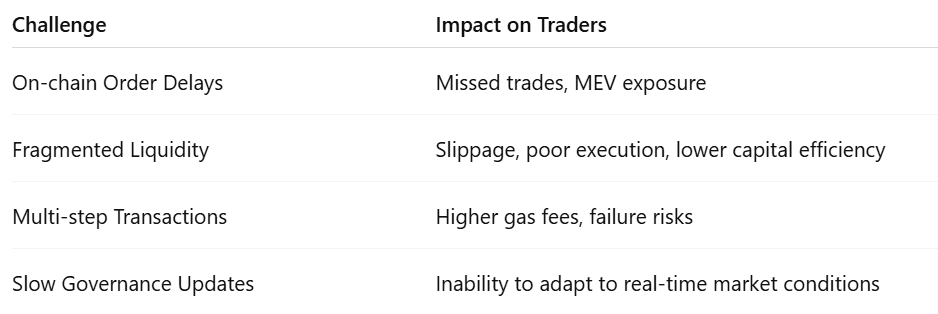
Apart from these, various other challenges plague on-chain derivatives trading. Some of those are:
2.2.3 UX Friction
User experience is a silent killer in most DeFi protocols. Despite offering freedom and self-custody, many platforms inadvertently create intimidating and broken flows, disrupting the high-speed world of derivatives trading.
- Gas Management Pain
One of the most frustrating aspects for traders is manual gas management. A technical burden is imposed on users for every on-chain interaction:
-
Manual Gas Price Selection: Traders must estimate the right gas fee based on current network activity. Underpricing leads to failed transactions; overpricing burns capital.
-
Gas Token Requirements: Most DeFi platforms require users to hold ETH (or other chain-native tokens, such as MATIC or AVAX) to pay gas fees, even if their collateral and profit and loss (P&L) are denominated in USDC or stablecoins. This forces additional conversions and wallet juggling.
-
Lack of Predictability: In periods of volatility, gas prices can spike 5X–10X in minutes. Users attempting to place or cancel trades during such spikes often see their transactions stuck in the mempool or reverted entirely.
Result: Missed trades, wasted gas, and trader frustration — especially damaging for scalpers or leverage users.
- Lack of Mobile Optimization
According to Messari, the mobile experience will be central to crypto user engagement in 2025, with leading platforms launching, upgrading, and refining their apps to offer security, flexibility, and streamlined access. DeFi’s user interfaces are notoriously desktop-centric, ignoring global realities:
- Emerging Market Reliance on Mobile:
According to a recent study by Juniper Research, a leading authority in fintech and payments, mobile money spending in emerging markets is projected to grow from $1.58 trillion in 2024 to $2.37 trillion by 2029.
The State of Mobile 2025 report from Sensor Towers reveals mobile app usage ranked by country. It is therefore clear that a huge population is reliant on mobile for fintech applications.
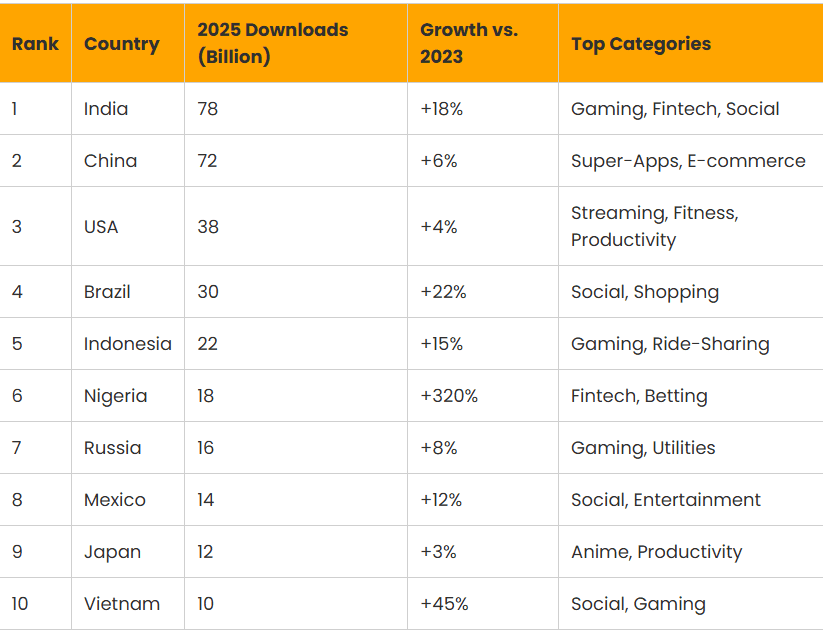
Source: https://sensortower.com/state-of-mobile-2025
-
Clunky Wallet Connections on Mobile: Mobile wallet connections (especially via dApp browsers or WalletConnect) are slow, error-prone, and inconsistent across devices.
-
Unresponsive Interfaces: Many DEX interfaces break layout or become unreadable on small screens, particularly complex trading dashboards with charts, leverage sliders, and margin data.
-
High Abandonment Rate: Users accessing a DEX from mobile and encountering a broken UI or non-native wallet flow are more likely to abandon the platform entirely.
- No Session Persistence
Web3 UX is five years behind Web2. And just five seconds is too late in volatile markets.
One of the most jarring aspects of DeFi UX is the lack of persistent sessions and a constant barrage of signatures and pop-ups disrupting the user's focus and deterring high-volume traders. Unlike CEXs, where users stay logged in for days and months, DEX users must re-sign every action.
-
Repetitive Wallet Signatures: Every smart contract interaction, entailing order placement, cancellation, or margin adjustment, requires a manual signature, resulting in constant prompts and reapproval dialog boxes appearing.
-
Session Loss on Refresh: Refreshing the page or returning to the dApp often logs users out, requiring a full reconnect.
-
Time-Critical Workflow Disruption: During fast markets, these delays cause users to miss optimal entries, lose hedging windows, or experience liquidation risks due to delayed reactions.
-
Complexity multiplies for users running multiple positions or high-frequency strategies.
-
User confusion and fatigue increase dramatically, especially on mobile, where pop-ups are slower and more intrusive.
These UX flaws cumulatively result in reduced efficiency, high cognitive load, broken user flow, and abandonment of decentralized trading platforms. TradeView’s architecture and design solve these with a laser focus on usability, performance, and accessibility.
2.2.4 Limited Financial Tooling
While centralized exchanges (CEXs) have spent years refining advanced trading infrastructure, most perpetual DEXs remain barebones in their offerings. They lack both the depth and sophistication of financial tooling required by serious traders and institutions.
- Only Basic Orders
Perpetual DEXs are often limited to rudimentary execution types:
-
Market Orders: Immediate execution but often high slippage in volatile or shallow markets.
-
Limit Orders: Provide better control, but require constant monitoring and manual adjustment.
What's missing?
Advanced Execution Tools such as:
-
TWAP (Time-Weighted Average Price) — essential for executing large trades over time without excessive slippage.
-
VWAP (Volume-Weighted Average Price) — commonly used by institutional desks to mimic real-world price curves.
-
Trailing Stops — dynamically follow price movement for automated take-profits.
-
OCO (One Cancels the Other) — a must-have for managing profit-taking and risk simultaneously.
-
Iceberg Orders — critical for hiding order size and reducing market impact.
These tools are either absent or poorly implemented in most on-chain platforms.
The absence of automation also forces manual adjustments and monitoring, increasing effort, missed entries, and human error. For example, without conditional or algorithmic execution logic, traders must manually cancel and re-place limit orders when price moves, monitor funding rate swings, and actively manage take-profit/stop-loss combinations. This reactive model increases the cognitive load and reduces trading efficiency, especially during volatile periods or when managing multiple positions.
- No Copy Trading or Social Trust Layers
Trading can be intimidating, especially for new users. CEXs and modern fintech platforms offer social features to flatten the learning curve:
-
Leaderboards and Public Profiles: Let traders evaluate and follow proven strategies.
-
Copy Trading: Allow new users to allocate funds under professional strategies.
-
Incentive Sharing: Top-performing traders monetize their expertise by earning a fee on copied positions.
In most DEXs:
-
These features are non-existent or fragmented across experimental protocols.
-
There’s no reliable way to build trust or discover trading talent.
Social trading is, therefore, more than a mere feature. It’s a growth loop that onboards users faster and makes platforms sticky.
- No Real-Time Insights or Portfolio Intelligence
In high-speed markets, data and visibility are critical. CEXs offer full dashboards with analytics, heatmaps, and liquidation alerts. DEXs, however, fall short:
-
No real-time portfolio dashboards with live margin ratios and P&L summaries.
-
Lack of automated liquidation risk monitoring.
-
No access to historical trade analytics across assets and timeframes.
Traders operate blindly — unaware of exposure, unable to optimize performance, and vulnerable to rapid liquidation.
- Institutional Gaps
The lack of production-grade infrastructure is more than a UX flaw. It’s a barrier to capital.
Institutional adoption of DeFi remains limited, and much of it traces back to tooling:
-
No high-throughput APIs for strategy execution
-
No composable indexing or portfolio automation
-
No SLA-backed uptime or latency guarantees
-
Poor documentation and testnet sandboxing
As a result, most funds still default to CEXs or prime brokerage layers, even for on-chain exposure. DEXs cannot yet meet the operational standards of hedge funds, HFTs, or structured product desks.
2.2.5 Institutional Infrastructure Gaps
While DeFi has made great strides in democratizing finance, most perpetual DEXs fall short of offering the robustness and integration features required by institutional players. These gaps prevent serious capital allocators, such as hedge funds, market makers, or asset managers, from deploying at scale.
- Missing Real-Time APIs & Strategy SDKs
Most DEXs lack the high-performance, well-documented APIs needed for algorithmic or HFT strategies. Trading infrastructure often consists of manually maintained subgraphs or slow REST endpoints. Institutions need:
-
Low-latency GraphQL APIs for querying real-time price, trade, and risk data
-
WebSocket-based execution feeds for reactive strategy design
-
Bot SDKs to enable fast deployment of automated trading and risk systems
Without these building blocks, high-frequency traders and systematic funds are unable to build or backtest strategies at scale.
- Lack of Composability for Structured Products
Institutions and advanced DeFi builders require the ability to create structured instruments like:
-
Leveraged indexes
-
Risk-managed smart vaults
-
Automated delta-neutral products
However, most DEXs lack a composable architecture — no modular vaults, no permissionless strategy engines, and no unified APIs. Builders are forced to rely on ad hoc integrations across protocols, resulting in high friction and operational fragility.
- Absence of Operational Guarantees
Trading firms cannot rely on inconsistent uptime, unproven networks, or vague latency. Unlike CEXs that provide SLAs and institutional onboarding desks, most DEXs offer:
-
No uptime guarantees
-
No node deployment documentation
-
No deterministic latency benchmarks and block times
-
No network SLA guarantees
-
No formalized node deployment or disaster recovery plans
As a result, institutional capital often flows toward centralized venues or prime brokerage layers that can offer accountability and performance.
- Institutional Barriers to Entry
These limitations lead to several downstream effects:
-
Funds prefer CEXs or OTC desks for strategy execution due to reliability and execution control
-
Prime brokers are forced to build costly abstractions over fragile DeFi plumbing, increasing cost and complexity
-
Capital efficiency suffers, as institutions cannot deploy leverage or hedged strategies with confidence
-
Risk departments are hesitant due to a lack of audit trails, circuit breakers, or trade surveillance infrastructure
| Expert Commentary: Even crypto-native funds often cite the absence of institutional-grade APIs, uptime assurances, and support tools as their primary blockers to DeFi adoption. |
|---|
Until these infrastructure gaps are addressed, institutional adoption will remain fragmented, regardless of how competitive DeFi becomes in terms of yields, decentralization, or capital efficiency.
DeFi DEX vs CEX Performance Comparison
| Metrics | CEX | Rollup-Based DEX | TradeView (Target)** |
|---|---|---|---|
| Latency | 5–10ms | 1–3s | <1s |
| TPS | 100,000+ | 100–2,000 | 10,000+ |
| Order Types | Full suite | Limit/Market | Advanced + Custom |
| Copy Trading | Yes | No | Yes |
| Mobile UX | Seamless | Poor | Optimized |
| Gas | None | Paid | Gasless (One-Click Transactions) |
The TradeView Opportunity Together, these gaps make it clear: DeFi perpetuals, as they stand, are structurally uncompetitive. To challenge CEX dominance, DEXs must: - Offer CEX-grade order types, execution tools, and APIs - Match or exceed latency and uptime standards - Deliver smart, composable, and user-centric interfaces - Foster community engagement through social and gamified finance - Enable fully on-chain trade execution, matching, and settlement for transparency and trustlessness - Introduce advanced automation and AI-driven tooling for risk alerts, trade insights, and portfolio management - Support social trading primitives such as leaderboards, copy vaults, and public strategy sharing - Facilitate low-barrier onboarding via email logins, mobile-first UX, and gasless interactions - Provide institutional-grade access with real-time APIs, documentation, and operational guarantees - Design an extensible infrastructure for developers to build new tools, frontends, and derivative layers TradeView addresses this head-on, not as a patched DEX, but as a new breed of on-chain trading infrastructure that marries performance, decentralization, and intelligent design.
2.3 How TradeView Addresses Challenges Associated With Decentralized Perp Trading?
TradeView is designed to overcome the systemic weaknesses that plague most decentralized perpetual trading platforms. Rather than patching over legacy constraints, TradeView reimagines the entire stack — from core execution to user experience — to meet the demands of both retail and institutional participants in a truly decentralized way.
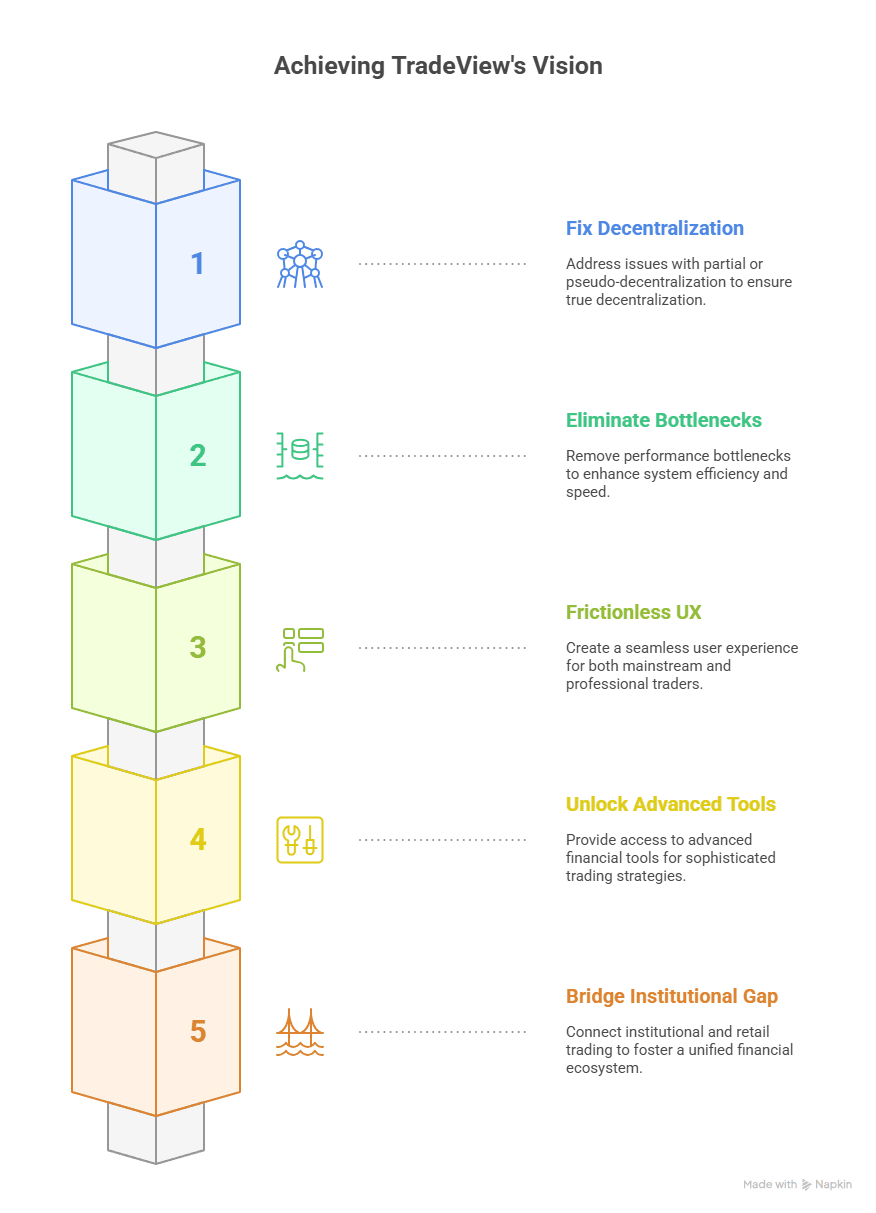
Below is a breakdown of how TradeView addresses each category of existing limitations:
2.3.1 Fixing Partial or Pseudo-Decentralization
- On-Chain Matching & Execution
TradeView introduces transparent, verifiable markets where every trade, order update, and liquidation is recorded immutably on-chain, auditable by anyone in real time, and executed deterministically without middlemen. This ensures equal access to truth and eliminates insider advantages. Here’s what it looks like:
-
Unlike most platforms that rely on off-chain order books and centralized match engines, TradeView runs a fully on-chain matching engine.
-
Every trade, order, and fill is verifiable by smart contract, ensuring transparency, fairness, and auditability.
-
With on-chain order placement and matching, there are no black-box operations or off-chain dependencies — traders can verify the integrity of every match and fill in real-time.
- No Sequencer Dependence
-
TradeView eliminates reliance on centralized sequencers that dominate rollup ecosystems and can be manipulated or censored.
-
Its custom Layer-1 chain is built using Tendermint BFT, providing deterministic finality with validator-based consensus.
-
The result is an infrastructure that doesn’t rely on trust in any operator — liveness, censorship resistance, and order sequencing are secured by cryptoeconomic consensus.
- Trustless Architecture
-
All trading logic — from order queuing to execution and settlement — is executed through audited smart contracts.
-
Governance is fully on-chain, removing admin backdoors and opaque multisigs that compromise decentralization.
-
Protocol upgrades are community-driven and verifiable via governance contracts, preventing unilateral control.
- Sequencer-Free = Verifiability + Neutrality
-
By avoiding centralized sequencing layers, TradeView ensures no preferential treatment for orders and no MEV extraction.
-
This neutrality builds trader confidence, particularly important for institutions and high-frequency strategies.
Result: TradeView delivers not just decentralized custody, but decentralized execution, governance, and verifiability — aligning with the original promise of DeFi.
2.3.2 Eliminating Performance Bottlenecks
- Execution-grade Performance Via Custom High-Performance Layer-1
-
TradeView is not deployed on a general-purpose blockchain. Instead, it runs on a custom Layer-1 built for execution-grade performance, with a deterministic Tendermint BFT consensus engine written in Go.
-
This architecture is engineered for throughput exceeding 10,000 TPS, allowing it to handle not only trades but also frequent order updates, cancellations, liquidations, and complex execution strategies — all without off-chain crutches.
-
Each transaction is processed with parallelized consensus and near-instant state transitions, ensuring no backlog even during volatility spikes.
- Low Latency Execution
-
Unlike L2 rollups with finality delays or Ethereum with 12–15s block times, TradeView achieves <1 second block finality, ensuring real-time execution.
-
This enables:
-
Sub-second trade placements
-
Instant position updates
-
Real-time liquidations
-
Precise entry/exit timing for scalpers and HFT users
-
-
TradeView’s finality model is deterministic, not probabilistic — traders know exactly when a transaction is confirmed, with no chance of reorgs.
- Volatility-Proof Execution Layer
-
TradeView leverages gasless meta-transactions handled via pre-funded relayer networks. Users never worry about native gas tokens or fluctuating network fees.
-
Gas spikes? No problem. Relayers maintain dynamic fee coverage buffers to ensure that all trading actions (order updates, cancellations, liquidation triggers) remain unaffected even during CPI drops or liquidation cascades.
-
This model ensures that during periods of high network stress — when timely execution matters most — TradeView maintains operational continuity.
- Intelligent Queueing and Oracle Optimization
-
Automated Liquidation Queues: TradeView dynamically ranks liquidation events and batch processes them for faster throughput and fair execution priority.
-
Oracle Batching: Instead of relying on external oracles for every update, TradeView uses batch oracle snapshots to reduce gas load and pricing lag.
-
These systems not only improve efficiency but also protect against front-running and timestamp manipulation common in MEV-ridden chains.
- Resilience Against Chain Congestion
-
TradeView’s infrastructure is decentralized but not congestible — performance is linear even under network stress.
-
This is in contrast to Ethereum-based DEXs or L2s, where even basic operations can stall during volatile windows.
Result: TradeView, therefore, addresses performance bottlenecks by building a custom Layer-1 chain designed specifically for trading perpetual contracts, removing general-purpose bottlenecks, and optimizing for performance.
The perpetual DEX also closes the latency and reliability gap with CEXs. It is the first perpetual DEX capable of supporting real-time strategies — including scalping, liquidation bots, and arbitrage flows — without compromising decentralization.
2.3.3 Frictionless UX for Mainstream and Pro Traders
- Gasless & Session-Persistent UX: No Repetitive Prompts, A Well-Maintained Flow and Control
-
TradeView removes one of the most frustrating friction points in DeFi: gas management. Traders are no longer required to hold or replenish native gas tokens (like ETH or AVAX). Instead, gas fees are abstracted through a system of meta-transactions executed via protocol-funded relayers.
-
This makes the user experience more predictable and intuitive. Whether placing an order, adjusting margin, or executing a stop-loss, users pay nothing and sign once.
-
Furthermore, TradeView introduces persistent session keys that allow users to authorize a session for a set duration (e.g.,24 hours), eliminating the need to manually approve every trade or action.
-
The result? True one-click trading. No pop-ups. No delays. No “Approve Transaction” loops in volatile markets.
- Mobile-First Interfaces
-
In contrast to most desktop-first DeFi platforms, TradeView is optimized for global usage patterns, especially in emerging markets like India, Southeast Asia, and LATAM, where 70 %+ of users trade via mobile.
-
The platform is built as a progressive web app (PWA) witha responsive UI that seamlessly scales down to mobile screens with adaptive UIs, collapsible panels, and mobile-native charts.
-
A dedicated mobile app (iOS/Android) is also planned for the app-ready derivatives trading infrastructure, with features that serve the next wave of global users. They include:
-
Biometric login via FaceID/Fingerprint
-
Push notifications for order fills, liquidations, or funding payments
-
Real-time wallet balance and PnL tracking
-
Light/dark mode and low-data mode for metered regions
-
-
Wallet integrations via WalletConnect v2 ensure seamless connectivity to mobile wallets like Trust Wallet, Coinbase Wallet, and Rainbow.
- Simplified, Dual Onboarding (Wallet + Email/Password)
-
TradeView supports dual onboarding mechanisms, making it equally accessible for crypto-native and Web2-native users:
-
Wallet Login: Connect with MetaMask, WalletConnect, or any EVM-compatible wallet.
-
Email/Password Login: For users who are unfamiliar with wallets, TradeView enables email-based onboarding with custodial key management (non-custodial access via abstraction layers).
-
-
This dual-mode onboarding significantly reduces the entry barrier, especially for:
-
Influencers onboarding followers
-
First-time DeFi users
-
Mobile-first traders in low-cost internet environments
-
Result: All of the aforementioned features create a seamless, intuitive, and high-speed trading experience indistinguishable from Web2 trading platforms. Its transparency, control, and composability give it an invincible edge.
2.3.4 Unlocking Advanced Financial Tools
- Comprehensive Order Types
TradeView introduces a rich financial infrastructure by supporting an extensive suite of sophisticated order types natively on-chain:
-
TWAP (Time-Weighted Average Price): Execute large trades over time without causing excessive slippage.
-
OCO (One Cancels the Other): Manage both upside and downside targets in a single order pair.
-
Trailing Stop Orders: Automatically track price changes and lock in profits.
-
Iceberg Orders: Break large orders into visible and hidden components to reduce market impact.
All execution logic is embedded in smart contracts, eliminating centralized intervention while offering automated, trustless behavior.
- Copy-Trading Vaults and Social Leaderboards:
-
Users can allocate funds into transparent, non-custodial smart contract-managed strategy vaults operated by experienced traders, a model that brings trust and automation, unlike custodial CEX-based copy systems.
-
Real-time mirroring ensures follower positions are matched with leader's strategies.
-
Vault transparency includes:
-
Historical PnL
-
Drawdown stats
-
Fee structures
-
-
Traders are incentivized through performance-based fees, aligning interests and creating a social finance flywheel.
- AI-Driven Portfolio Intelligence
-
Real-time dashboards present:
-
Account health
-
Margin status
-
Liquidation risk alerts
-
-
AI-powered features include:
-
Funding rate exposure analysis
-
Personalized risk flags
-
Performance heatmaps
-
Intelligent alerts
-
Sentiment indexing from market data & social feeds
-
Smart alerting based on position size, volatility, and historical patterns
-
These insights empower users to act proactively, not reactively.
- Structured Product Infrastructure
-
TradeView exposes modular APIs and strategy smart contracts to support advanced use cases like:
-
Custom index derivatives
-
Tokenized volatility products
-
Automated hedging vaults
-
-
Institutions and protocol builders can:
-
Integrate dashboards
-
Build risk-managed vaults
-
Offer curated, structured products to end-users
-
Result: These create a vibrant ecosystem where retail and pro traders both win. From retail to institutional, TradeView delivers the advanced trading tools needed to maximize capital efficiency, insight, and automation.
2.3.5 Bridging the Institutional Gap
- High-Throughput APIs & SDKs
-
TradeView offers comprehensive, low-latency GraphQL APIs and REST endpoints optimized for trading bots and algorithmic strategies.
-
SDKs in Python, JavaScript, and Rust enable quick deployment for funds, quantitative teams, and high-frequency trading (HFT) desks.
-
Real-time websocket feeds deliver order book snapshots, trade execution data, funding rates, and liquidation alerts — essential for latency-sensitive strategies.
Composability & Interoperability
-
Asset bridges allow capital to flow from Ethereum, Solana, and other ecosystems into TradeView’s margin pools.
-
Vaults are composable across major DeFi protocols like Aave, Lido, and Yearn, enabling traders to stake, borrow, and deploy within unified strategies.
-
Margin accounts support multi-collateral positions and seamless integration with vault and index infrastructure.
Operational Guarantees
-
TradeView’s consensus mechanism ensures deterministic block times, enabling reliable latency modeling for trading bots.
-
SLA-style performance transparency includes:
-
Uptime guarantees for RPC nodes
-
Execution latency metrics
-
Block finality logging
-
-
Institutional partners can:
-
Run their own validator or full node
-
Monitor chain-level metrics in real-time
-
Access whitelisted endpoints for guaranteed bandwidth and throughput
-
Result: TradeView becomes not just a trading venue, but a programmable backend for structured DeFi derivatives. It empowers funds, DAOs, and financial institutions to launch, manage, and automate on-chain strategies with precision.
TradeView: A New Archetype for DeFi Trading: By addressing structural flaws — performance, UX, decentralization issues, and tooling, it doesn’t just compete with CEXs, but defines DeFi superior, by design and functionality. It is not positioned as an interactive improvement but as a foundational layer for the next era of on-chain derivatives trading. "Where others compromise for decentralization, TradeView optimizes it. Where others imitate CEXs, TradeView redefines DeFi."
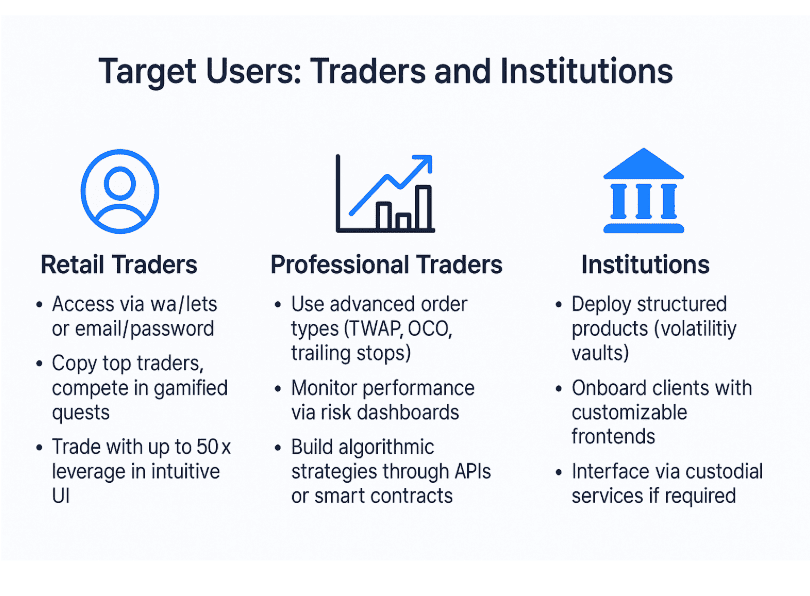
2.4 Target Users: Traders and Institutions
TradeView is designed with multi-segment usability in mind. It addresses the varied needs of retail traders, professional quants, and institutions by offering a seamless and powerful user experience that adapts to different skill levels, trading behaviors, and operational requirements, making it the best platform for a variety of potential traders.
2.4.1 Retail Traders
TradeView provides intuitive tools and onboarding paths tailored to the fast-growing segment of individual users exploring decentralized finance. Retail traders often prioritize ease of access, usability, and guidance — all of which TradeView offers natively:
A. Easy Onboarding
-
Begin trading instantly via MetaMask, WalletConnect, Coinbase Wallet, or other Web3 wallets.
-
Non-crypto-native users can sign up with an email/password, made possible by custodial key abstraction that mimics Web2 logins.
-
TradeView automatically handles session keys and removes the need for repeated wallet connections or gas estimation.
B. Gamified User Experience
-
TradeView includes interactive quests, missions, and achievement badges that reward activity milestones.
-
Leaderboards track ROI, volume, and other metrics, allowing users to compete and earn social validation.
-
Referral systems offer fee discounts or reward points for community-driven onboarding.
C. Simple Yet Powerful Trading Tools
-
Trade with up to 50x leverage on top perpetual markets like ETH, BTC, and trending altcoins.
-
Clear margin data, profit/loss insights, and liquidation alerts are accessible via a responsive interface.
-
Gasless, one-click execution simplifies every order — no manual fee setting or token conversions required.
D. Social Discovery and Copy Trading
-
Top traders can create public smart vaults, and retail users can allocate capital to mirror their trades.
-
Vaults have transparent fees, historical ROI, risk profiles, and withdrawal terms.
-
A reputation layer helps new users discover strategies and evaluate managers based on on-chain performance.
Result: Even novice users are empowered with tools that mirror the sophistication of centralized exchanges, minus the custody risks and learning barriers typically associated with DeFi platforms.
2.4.2 Professional Traders
TradeView recognizes the evolving needs of professional traders — from crypto-native arbitrageurs to full-time strategy developers and portfolio managers.
A. Advanced Order Types and Execution Logic
-
Native smart contract support for TWAP, OCO, iceberg, and trailing stop orders.
-
Execution logic runs autonomously on-chain, enabling precision and trustless algorithmic behavior.
-
Orders can be dynamically adjusted based on price feeds, funding rates, or risk thresholds.
B. Performance & Risk Monitoring
-
Real-time dashboards aggregate portfolio-level metrics including realized/unrealized P&L, margin utilization, exposure by asset, and funding rate deltas.
-
Automatic alerts notify users of liquidation thresholds, drawdown events, or major price dislocations.
C. API Access for Algorithmic Trading
-
Access fast, low-latency GraphQL and WebSocket APIs for order submission, position tracking, and historical data.
-
Bot SDKs are compatible with Python, TypeScript, and Rust, allowing integration into proprietary quant stacks.
-
Use prebuilt modules for backtesting and simulated execution before deploying capital live.
D. Capital Efficiency Tools
-
Smart margin architecture supports isolated and cross-margin modes with dynamic leverage curves.
-
Traders can access capital efficiency via vault composability, integrating collateral across lending, staking, and trading protocols.
-
Futures support will include synthetic exposure to long-tail assets without slippage-heavy swaps.
Result: TradeView gives professional traders an execution environment that matches — and in many cases exceeds — traditional Web2 systems, while preserving the transparency and self-custody ethos of DeFi.
2.4.3 Institutions
TradeView is architected to support regulated institutions, market makers, hedge funds, and prime brokerages — all while maintaining a permissionless, composable backend and eliminating intermediaries.
A. Structured Product Deployment
-
Institutions can deploy delta-neutral vaults, volatility harvesting strategies, or synthetic exposure products.
-
Each vault is programmable, with configurable fees, risk parameters, and rebalancing logic.
-
Institutional managers can tokenize vaults for secondary market liquidity and investor tracking.
B. Enterprise Integrations & Frontend Customization
-
Build bespoke frontends for client accounts using TradeView's SDK and design components.
-
Offer investor dashboards with branded themes, investor permissioning, and integrated reporting.
-
Route fees from vaults or trading activity directly to management wallets.
C. Custodial Options & KYC Integration
-
Optional whitelisted access via partner custodians allows institutions to interface with TradeView without directly managing keys.
-
Compliance partners may offer off-chain identity binding for regions that require it.
-
Supports wallet segregation, cold storage signing, and MPC custody workflows.
D. Compliance & Infrastructure Guarantees
-
Deterministic block times and uptime SLAs enable reliable execution for latency-sensitive trades.
-
Full API documentation and sandbox testing environments support pre-deployment simulations.
-
Enterprise support options include onboarding assistance, DevOps guides, and integration reviews.
Result: Institutions can engage with DeFi markets using battle-tested infrastructure, tailored interfaces, and operational assurances, without sacrificing the benefits of composability or decentralization.
TradeView’s permissionless foundation invites participation from every level of the Web3 economy — from solo traders to institutional desks.
2.4.4 Summing Up: The Unified Value Proposition
TradeView is not just built for one audience. It is engineered as a multi-layered infrastructure designed to serve all stakeholders in the modern DeFi economy.
Whether it’s a:
-
First-time mobile trader in LATAM using an email login and copy vaults to begin their DeFi journey,
-
Quantitative hedge fund in Singapore executing high-frequency arbitrage using custom APIs,
-
An Institutional capital allocator in Europe deploying a delta-neutral product with compliant custody layers,
TradeView adapts to their specific needs with tailored tools, UX primitives, and permissionless infrastructure.
What TradeView Delivers:
- Simplified Onboarding for Mass Retail
-
Dual sign-up paths: wallet or email/password.
-
Gamified UI and quests to reduce friction and increase user stickiness.
-
Smart vaults and social trading to accelerate learning and engagement.
- Professional-Grade Execution for Active Traders
-
Low-latency matching engine with support for institutional-grade order types.
-
Real-time risk dashboards and advanced analytics.
-
API access, SDKs, and bot tooling for programmable strategy deployment.
- Compliant Infrastructure for Institutions
-
SLAs, uptime monitoring, and deterministic block times for reliability.
-
Support for enterprise custody, whitelisted access, and KYC integration (via partners).
-
Vault creation and branded frontend components for product launches and client servicing.
*TradeView isn't merely a decentralized exchange.* It is an extensible, composable infrastructure layer powering the next generation of programmable financial products, from individual trades to structured funds.
It brings the depth of centralized trading, the transparency of DeFi, and the modularity of web3 protocols into one unified environment.