














7.1 Bridge Contracts with Ethereum
TradeView implements a robust and extensible cross-chain bridge infrastructure to enable permissionless and verifiable transfer of assets between its custom Layer-1 blockchain and Ethereum. This bridge system is critical to onboarding liquidity from the broader DeFi ecosystem and maintaining seamless composability with ERC-20 assets, especially USDC, ETH, and prominent stablecoins. The design avoids custodial or centralized relayers by anchoring on-chain verification into a hybrid staking + oracle model.
7.1.1 Architectural Overview of the Bridge System
The bridge system follows a lock-and-mint pattern for asset movement between Ethereum and TradeView:
-
Two-Way Lock & Mint Bridge Model:
-
Ethereum → TradeView:
-
Users initiate a deposit by locking ERC-20 tokens (e.g., USDC, ETH) into a verified bridge contract on Ethereum.
-
The bridge oracle quorum observes the lock event and validates its authenticity.
-
Upon confirmation, a corresponding wrapped token (e.g., wUSDC) is minted on the TradeView L1 and sent to the user’s wallet.
-
-
TradeView → Ethereum:
-
Users burn their wrapped assets (e.g., wETH) on TradeView through a bridge contract.
-
A withdrawal instruction is generated and validated by the oracle quorum.
-
The bridge then authorizes the release of the locked native token from the Ethereum bridge vault back to the user’s Ethereum address.
-
-
This model ensures one-to-one backing of wrapped assets with canonical tokens locked on Ethereum.
- Canonical Representation Logic:
TradeView maintains an on-chain canonical registry that maps bridged assets to their metadata and vault references:
-
Canonical Token IDs: Every bridged asset is assigned a unique identifier on TradeView L1.
-
Vault Anchoring: Bridged tokens are backed by a vault smart contract on Ethereum that holds the original tokens.
-
Asset Metadata: Decimal precision, symbol, and currency type are stored using a standardized schema, allowing dApps and vaults to present accurate UI data and support composability.
-
Upgradeable Logic: Registry contracts support upgradability via DAO proposals to handle token rebranding, deprecation, or migration (e.g., USDC.e to native USDC).
-
Bridge Security Anchors:
Security and censorship resistance are core to TradeView’s cross-chain design. The bridge system is fortified with multiple safeguards:
-
Validator-Oriented Oracle Quorum:
-
A minimum threshold of TradeView validators operates oracles that watch Ethereum logs.
-
Quorum consensus is required for relay actions (e.g., mint authorization, unlock validation).
-
-
Slashing-Backed Integrity:
-
If a bridge oracle signs conflicting transactions, misses relay windows, or censors valid events, it faces stake slashing.
-
This economic deterrent guarantees honest behavior and rapid event propagation.
-
-
Proof Aggregation Layer:
-
Each lock or burn event includes a hashed Merkle proof of block inclusion.
-
TradeView verifies the proof before minting or unlocking to eliminate reliance on external assumptions.
-
-
Replay Protection & Nonce Management:
- Bridge messages include session nonces to prevent replay attacks and enforce strict idempotency.
-
Emergency Circuit Breakers:
- In case of oracle misbehavior or L1-L2 desyncs, DAO governance or quorum consensus can pause minting or redemptions for a specific asset.
7.1.2 Deposit Flow: Ethereum to TradeView
| Step | Component | Function |
|---|---|---|
| 1 | User Wallet | Sends USDC to TradeView Bridge contract on Ethereum |
| 2 | Ethereum Smart Contract | Emits a lock event with deposit data (amount, user, nonce) |
| 3 | Bridge Oracle / Listener | Monitors Ethereum logs and prepares a proof |
| 4 | TradeView Bridge Module | Verifies proof and mints equivalent USDC on TradeView |
| 5 | TradeView Wallet | Credits user’s on-chain balance instantly |
Features:
-
Near-instant feedback on deposit (off-chain signature relay).
-
An optional delay buffer for large transactions to allow challenge windows.
7.1.3 Withdrawal Flow: TradeView to Ethereum
| Step | Component | Function |
|---|---|---|
| 1 | User Wallet | Burns wrapped USDC on TradeView via bridge contract |
| 2 | Burn Event | Captured and signed by TradeView bridge validators |
| 3 | Ethereum Relay Module | Submits the signed burn proof to Ethereum |
| 4 | Ethereum Smart Contract | Verifies and releases locked USDC to the user |
| 5 | Finalization | Transaction receipt returned to user wallet (Ethereum-side) |
Optimizations:
-
Batching logic to reduce gas on the Ethereum mainnet.
-
Retry queues to resubmit in case of relayer failure or high gas prices.
7.1.4 Bridge Governance and Upgradeability
-
Bridge Registry DAO Control:
-
The token address mapping registry (L1 ↔ Ethereum) is governed by TradeView DAO.
-
Enables future bridge routing to other canonical bridges or rollup aggregators.
-
-
Emergency Pausing Logic:
-
A protocol-controlled timelock admin can pause minting/burning operations under emergency conditions.
-
Vaults and oracles are isolated in per-asset modules to prevent systemic risk.
-
-
Validator Quorum Parameters:
-
Minimum validator set size: 12
-
Threshold: ≥ 2/3 signatures for a valid claim
-
Slashing conditions include:
-
Double-signing (conflicting proofs)
-
Inclusion of invalid event hashes
-
-
7.1.5 UX and Monitoring Tools
-
Real-Time Status Tracking:
-
Deposit/withdraw dashboards show per-chain status:
-
Transaction hash
-
Bridge status (pending/minted/confirmed)
-
Validator attestations (signatures shown)
-
-
-
Event Logging and Audit Trail:
-
All mint/burn events are:
-
Logged on-chain
-
Stored in off-chain analytics indexers
-
Available for integration with third-party dashboards or explorers
-
-
7.1.6 TradeView vs. Other Bridges: Security Comparison Table
| Feature | TradeView Bridge | LayerZero | Wormhole |
|---|---|---|---|
| Custom Token Registry | ✅ | ❌ (shared endpoint) | ❌ |
| Slashing-Based Validator Set | ✅ | ❌ (reputation-based) | ✅ |
| Modular Upgradability | ✅ | ✅ | ❌ |
| Canonical Minting | ✅ | ❌ (multiple wrapped variants) | ✅ |
| DAO Governance | ✅ | ❌ (relayer config) | ❌ |
| Real-Time Proof Verification | ✅ | ✅ | ❌ |
7.1.7 Summary
TradeView’s bridge architecture is built for:
-
Speed: Near-instant credits with oracle-triggered minting.
-
Security: Validator-signed proofs with slashing to discourage fraud.
-
Transparency: Fully auditable flows across both chains.
-
Control: Governance-based upgrades and emergency interventions.
It lays the foundation for broader cross-chain utility, including future bridges to Solana, Arbitrum, and Cosmos-native chains.
7.2 Fast Collateral Transfers (USDC, ETH)
TradeView’s on-chain design and native bridge infrastructure support ultra-fast collateral transfers across Ethereum and its Layer-1 chain. These mechanisms are engineered to meet the demands of real-time perpetual trading, where latency and capital availability directly impact trading performance, liquidation avoidance, and arbitrage efficiency.
7.2.1 Objectives of Fast Collateral Transfers
-
*Zero Downtime Collateralization* Ensure that traders can move assets between chains and wallets without interrupting margin availability.
-
*Settlement-Ready Collateral Mobility* Transfers are finalized within seconds to enable immediate use for margin, trading, or withdrawals.
-
*Risk-Responsive Transfer Protocols* Integrate oracle pricing and margin context to prevent overexposure during volatile periods.
7.2.2 Supported Collateral Assets
| Asset | Use Case | Bridging Logic | TradeView Representation |
|---|---|---|---|
| USDC (ERC-20) | Primary margin and settlement token | Lock & Mint | tUSDC |
| ETH (ERC-20) | Future cross-collateral support | Lock & Mint | tETH |
| stETH (LST) | Passive collateral (future roadmap) | Lock & Wrap | twstETH |
tUSDC, tETH, and other tokens are native representations of collateralized assets on TradeView’s Layer-1, maintained by the bridge vault contract.
7.2.3 Fast Transfer Modes
TradeView enables multiple fast transfer modes tailored to different latency and security preferences:
-
Standard Bridge Mode (Security-Focused)
-
Lock on Ethereum → Mint on TradeView (1–2 block confirmation)
-
~30s average round trip
-
Ideal for large transfers and institutions
-
-
Fast Relay Mode (Speed-Optimized)
-
Oracle-signed proofs → Instant minting
-
<5s latency for <threshold deposits
-
Optimized for individual traders needing fast margin refill
-
-
Cross-Wallet Transfer (Intra-Chain)
-
From one TradeView account to another
-
Settled instantly on-chain
-
Used for referrals, vault funding, or arbitrage accounts
-
7.2.4 Transfer Lifecycle Flow
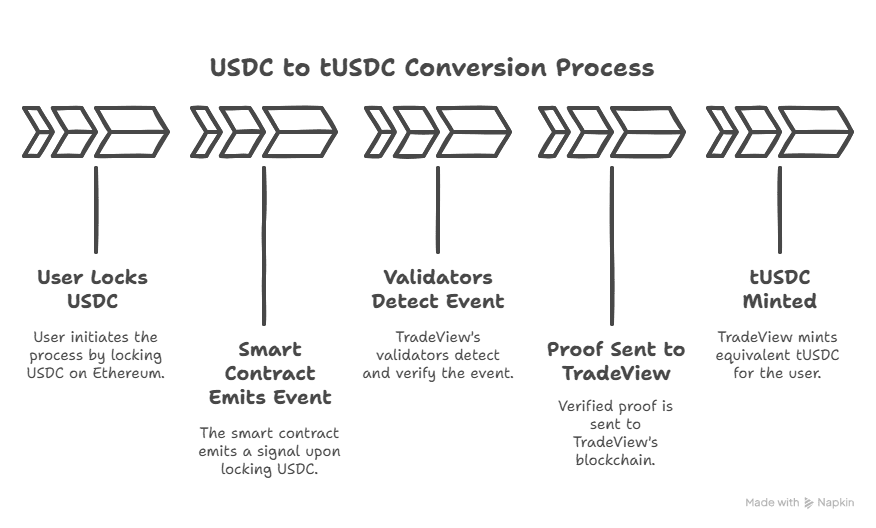
A. Ethereum → TradeView (Deposit Flow)
Let’s explore how USDC Comes Into TradeView (Deposit)
-
User locks USDC on Ethereum using a smart contract.
-
That smart contract emits a signal/event.
-
TradeView’s validators (or oracles) detect the event and verify it.
-
TradeView's blockchain receives this verified proof.
-
TradeView mints equivalent tUSDC for the user — now the user can trade.
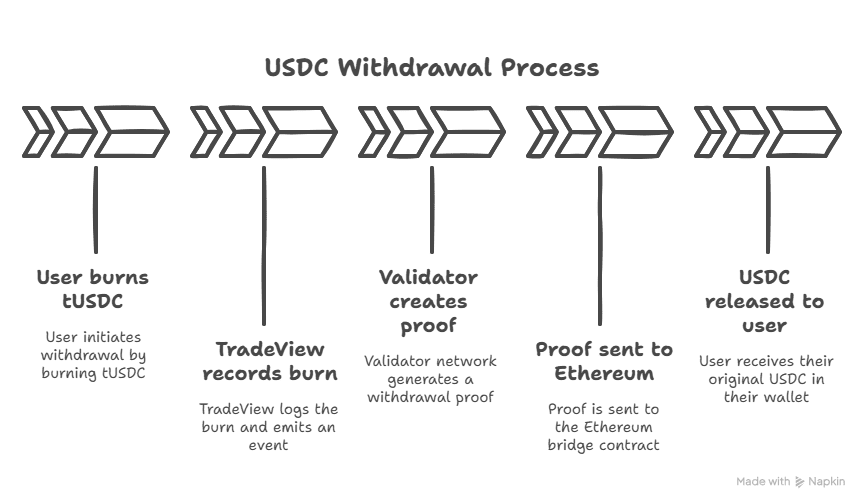
B. TradeView → Ethereum (Withdrawal Flow)
Let’s now explore how USDC Goes Back to Ethereum (Withdrawal)?
-
User burns tUSDC on TradeView — this tells the system they want to withdraw.
-
TradeView records this burn and emits an event.
-
The validator/oracle network picks it up and creates a withdrawal proof.
-
This proof is sent to Ethereum’s bridge contract.
-
The smart contract releases the user’s original USDC back to their Ethereum wallet.
7.2.5 Collateral Readiness Engine
-
Immediate Collateral Recognition:
-
As soon as tUSDC is minted, it is reflected in:
-
Margin engine
-
Trading engine
-
Account UI
-
Vault eligibility map
-
-
-
Granular Access Control:
-
Transfers > predefined thresholds require multiple validator signatures.
-
Admin-defined caps per asset type and chain (adjustable via governance).
-
-
Bridge Health Monitor:
-
Internal monitoring of:
-
Oracle latency
-
Validator quorum status
-
Event confirmation drift
-
-
7.2.6 Transfer Optimization Logic
| Optimization Layer | Function | Implementation |
|---|---|---|
| Signature Batching | Batches validator attestations to reduce gas | Merkle proof rollups |
| Gas Sponsorship Relay | Subsidizes bridge cost for small users | DAO-funded |
| Event Finality Cache | Stores recent transfer proofs for fast lookup | Off-chain cache + on-chain root |
7.2.7 Risk Mitigation Strategies
-
Transfer Lock Timers:
-
Temporarily delays minting for high-risk accounts based on:
-
Trading PnL volatility
-
Suspicious on-chain patterns
-
-
-
Reorg Protection Buffer:
- Ethereum → TradeView bridge includes a 3-block delay for minting finality.
-
Withdrawal Throttling:
-
Caps outflow from TradeView to Ethereum based on:
-
Liquidity pool depth
-
Bridge vault utilization
-
-
7.2.8 Analytics and Transparency
-
Bridge Transfer Analytics Dashboard
-
Volume per asset
-
Average latency per mode
-
Validator performance (uptime, proof delay)
-
-
User Wallet Explorer
-
Per-wallet transfer history across all chains
-
Audit of USDC balance before/after transfers
-
Verifiable claim signatures
-
7.2.9 Benefits of Fast Collateral Transfers in Perpetual Trading
| Benefit | Impact on Trading |
|---|---|
| Rapid Margin Top-Ups | Reduces liquidation risk during drawdowns |
| Instant Withdrawals | Improves trust and capital reusability |
| Arbitrage Efficiency | Enables high-frequency cross-market strategies |
| Composable Flows | Supports vault-to-margin and margin-to-vault workflows |
7.2.10 Summary
TradeView’s fast collateral transfer infrastructure ensures that capital is:
-
Instantly usable upon arrival
-
Securely verified via cross-chain attestation
-
Composable with margining and vault logic
-
Transparent and auditable at every step
This capability ensures TradeView’s L1 remains competitive with CEX-grade systems while adhering to full DeFi transparency and programmability.
7.3 Multi-Chain Asset Onboarding
TradeView’s architecture supports progressive onboarding of assets from multiple chains, enabling composable collateral use, broad market participation, and capital mobility. This module lays the foundation for onboarding not just ERC-20 tokens, but also assets from EVM and non-EVM ecosystems.
7.3.1 Architecture of Multi-Chain Onboarding
-
Asset Registry Module (ARM):
-
Central smart contract that tracks all whitelisted assets across chains.
-
Stores metadata such as:
-
Token decimals
-
Origin chain
-
Risk class
-
Oracle source
-
-
-
Bridge Adapter Interfaces:
-
Modular plug-ins that allow interaction with bridge protocols (native or third-party).
-
Each chain type (e.g., Solana, Avalanche, Arbitrum) has a custom adapter.
-
Ensures safe lock/unlock, mint/burn or wrapped representations.
-
-
Minted Token Representation:
-
Every bridged asset is assigned a TradeView-native equivalent.
-
Example:
-
ETH from Arbitrum → arbETH
-
USDT from Solana → solUSDT
-
-
These are issued as on-chain representations with redemption paths.
-
7.3.2 Supported Chains and Compatibility Layers
| Chain | Asset Type | Compatibility | Bridge Type |
|---|---|---|---|
| Ethereum | ERC-20, ERC-721 | Native | Lock & Mint |
| Arbitrum | L2-native tokens | EVM-compatible | Rollup Bridge |
| Avalanche | ARC-20 | EVM-compatible | 3rd Party |
| Solana | SPL Tokens | Non-EVM | Wormhole Adapter |
| Cosmos Zones | IBC Tokens | Non-EVM | IBC Bridge |
TradeView aims to progressively support non-EVM chains through message-passing bridges and wrapped token standards.
7.3.3 Token Onboarding Lifecycle
-
Asset Proposal Initiated
-
Via governance or the core team
-
Metadata submitted (e.g., decimals, oracle, bridge route)
-
-
Technical Verification
-
Validate the smart contract on the origin chain
-
Risk class assigned (stable, volatile, LST, LP)
-
-
Bridge Integration
-
Adapter linked or developed
-
Testnet dry-runs to verify flow
-
-
Token Whitelisting
-
Added to ARM
-
Wallet UIs updated
-
-
Collateral Configuration (Optional)
- Define haircut ratio, leverage limits, and eligibility
7.3.4 Security and Verification Logic
-
Origin Proof Checks:
-
Each bridge mint includes proof-of-origin signature batch.
-
Validator-set quorum threshold must be met.
-
-
Rate Limiters:
-
Prevent spam onboarding of unstable tokens.
-
Daily caps per new asset class (adjustable via governance).
-
-
Bridge Integrity Monitors:
-
Health checks across all integrated bridges.
-
Disable minting on compromised bridges automatically.
-
7.3.5 Governance-Driven Expansion
-
All new assets are subject to governance proposals that cover:
-
Oracle provider
-
Initial supply cap
-
Fee sharing
-
Collateral status
-
-
Parameters are upgradable without contract redeployment via:
-
Proposal-based voting
-
Smart contract proxy pattern
-
7.3.6 Benefits of Multi-Chain Asset Onboarding
| Benefit | Impact |
|---|---|
| Broad Asset Access | Traders can post margin in native assets from multiple chains |
| Capital Efficiency | Unused capital on sidechains can be instantly moved into trading vaults |
| Interoperable Vault Strategies | Vaults can use multi-chain tokens in arbitrage and delta-neutral strategies |
| Ecosystem Growth | Attracts liquidity from other L1s/L2s |
7.3.7 Challenges and TradeView’s Mitigation
| Challenge | Solution |
|---|---|
| Bridge Exploits | Use validator-quorum verification and circuit breakers |
| Token Spoofing | Enforce token contract whitelist at ARM level |
| UI Complexity | Abstract away chain origin in frontend wallet display |
| Liquidity Fragmentation | Incentivize unified pools and cross-asset margining |
7.3.8 Summary
TradeView's multi-chain onboarding architecture unlocks:
-
Composability across chains
-
Fast integration of emerging assets
-
Risk-aware token handling
-
Governance-led expansion
By streamlining the onboarding flow and modularizing bridge logic, TradeView ensures that any high-quality asset from any chain can become part of its perpetual trading ecosystem.
7.4 Cross-Chain Liquidity (Future Outlook)
TradeView envisions a fully composable, cross-chain liquidity layer that transcends individual blockchain ecosystems. While the current architecture supports bridged collateral and multi-chain onboarding, the next frontier is enabling native, dynamic liquidity across chains, without fragmenting the trading experience.
7.4.1 Vision: Unified Liquidity, Multi-Chain Execution
-
Single Interface, Multi-Chain Access
-
Users should interact with one order book, while collateral and settlement may span multiple chains.
-
Trade execution should be seamless, whether margin resides on Ethereum, Arbitrum, or Cosmos.
-
-
Composable Liquidity Across Vaults and Chains
-
Vaults can source liquidity from multiple chains in real-time to execute orders or rebalance.
-
Chain-specific capital pools can contribute to a global margin pool, using notional accounting and synthetic netting.
-
7.4.2 Architectural Goals of Future Cross-Chain Liquidity
| Component | Design Objective |
|---|---|
| Universal Order Router | Routes order to best execution venue (same chain or remote chain) |
| Inter-chain Margin Layer | Sums usable margin across chains using oracle-synced exchange rates |
| Synchronized Risk Engine | Margin checks apply globally, regardless of where the position is held |
| Cross-Chain PnL & Liquidation Sync | Reflects unified margin state for proper liquidation across networks |
7.4.3 Cross-Chain Liquidity Engine (CCLE)
The CCLE will be a dedicated layer that synchronizes capital availability, PnL accounting, and settlement between chains.
-
Chain Orchestrators:
-
Lightweight agents on each supported chain
-
Submit position state changes, PnL deltas, and margin updates to CCLE
-
Ensure slashing or liquidation messages are trustlessly relayed
-
-
Liquidity Aggregation Bus:
-
Aggregates collateral availability across bridges
-
Maintains a “virtual balance” for each account per chain
-
Prevents over-leverage by accounting for bridge latency and confirmation slippage
-
-
Event Forwarding Relays:
-
Any liquidation, position change, or funding payment on Chain A is mirrored and enforced on Chain B
-
Uses light-client verification or quorum-based notarization (depending on chain type)
-
7.4.4 Strategic Rollout Phases
Phase 1: Siloed Collateral Pools (Current)
-
Each chain’s liquidity is used independently.
-
Users manually bridge funds to interact with TradeView.
Phase 2: Cross-Chain Collateral Netting
-
Margin on multiple chains counted toward global position exposure.
-
Initial sync uses off-chain watchers with ZK or MPC proofs.
Phase 3: Real-Time Execution via Unified Engine
-
Orders from any chain are routed to the unified order book.
-
Execution and settlement completed across chains using instant bridge messages.
Phase 4: Cross-Chain Vault Liquidity Streaming
-
Vaults on Chain A can deploy capital into strategies on Chain B.
-
Earnings are automatically streamed back via composable strategy layers.
7.4.5 Benefits of Cross-Chain Liquidity
| Benefit | Description |
|---|---|
| Capital Efficiency | Users don’t need to fragment collateral across chains |
| Market Depth | Combines liquidity from multiple L1s/L2s into a single market |
| UX Simplicity | Users trade on one interface, while TradeView handles cross-chain logistics |
| Strategy Flexibility | Vaults and bots can borrow or lend liquidity cross-chain |
| Safety & Redundancy | Liquidity can failover between chains during congestion or outages |
7.4.6 Risk Mitigation Strategies
| Challenge | Mitigation |
|---|---|
| Message Delay or Bridge Failure | Time-weighted liquidity accounting; fallback circuit breakers |
| Oracle Inconsistency | Multiple oracle providers per chain; medianization and sanity checks |
| Slashing Risk (if used for validators) | Dynamic stake thresholds tied to chain performance metrics |
| Bridge Exploit | Use of secure bridges with cryptographic proof-based finality (e.g., ZK or IBC) |
7.4.7 Governance and Liquidity Routing Policies
-
Governance Roles:
-
Approve which chains are trusted for the margin
-
Define whitelisted bridge protocols
-
Set maximum allowable cross-chain exposure per user or strategy
-
-
Liquidity Routing Configurations:
-
Dynamic fees for cross-chain execution
-
Incentives for liquidity to rebalance from overfunded to underfunded chains
-
Vaults may vote on routing weights based on performance or cost
-
7.4.8 Key Use Cases Enabled
| Use Case | Impact |
|---|---|
| Multi-Chain Arbitrage Bots | Bots can trade between chains without needing real-time capital transfers |
| Institutional Cross-Chain Portfolios | Institutions can manage risk and deploy across chains from a single UI |
| LST & LP Token Composability | LSTs from any chain can act as a global margin without manual bridging |
| Global Order Book Access | A trader on Solana can fill orders from a vault on Ethereum in one click |
7.4.9 Summary: Toward a Fluid, Frictionless DeFi Infrastructure
TradeView’s Cross-Chain Liquidity layer aspires to become the first globally composable, real-time collateral network for perpetual trading, ensuring:
-
High throughput execution across blockchains
-
Shared liquidity without compromising decentralization
-
Margin flexibility and liquidation integrity
-
Future extensibility toward multi-protocol DeFi coordination